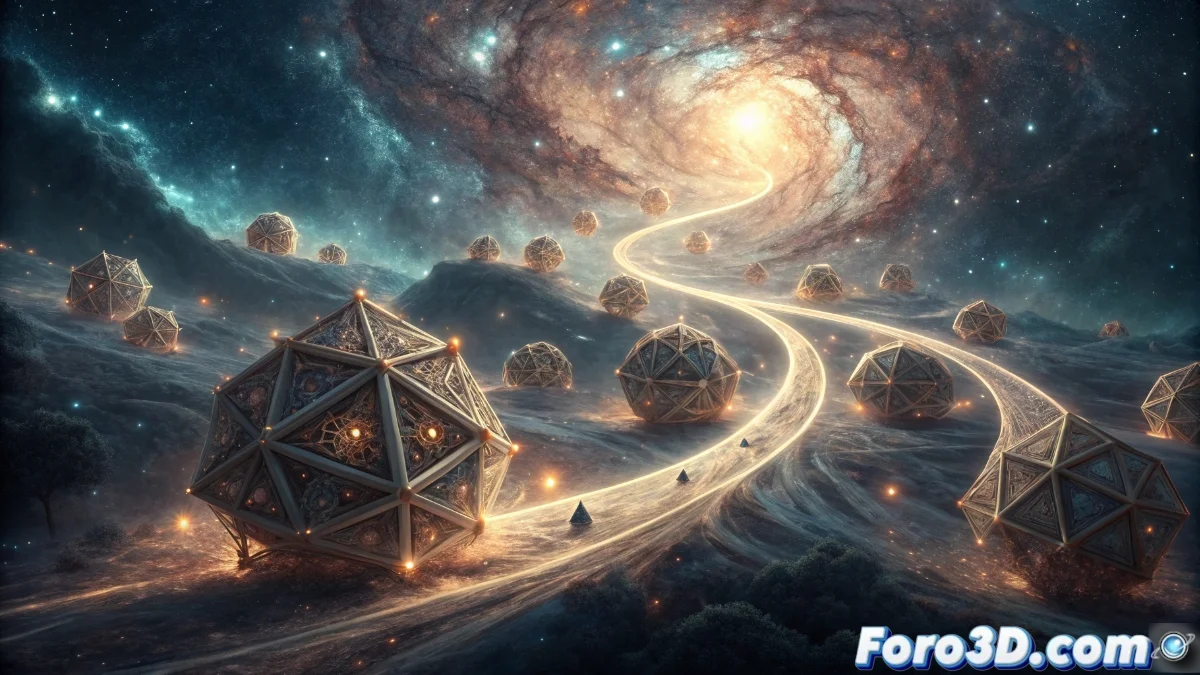
Procedural Flocking: Simulation of Collective Behaviors in Graphics
The procedural flocking technique constitutes a simulation method that reproduces group behaviors in sets of virtual entities without requiring detailed physical laws. 🌀 These implementations frequently use elemental algorithms that give rise to sophisticated emergent movements, where each element makes local determinations based on its immediate context. The end result is dynamic configurations that emulate natural patterns like bird flocks or fish schools, but through computational rules optimized for real-time execution.
Essential Algorithmic Mechanisms
Flocking systems are generally based on three basic principles: separation to prevent collisions between nearby elements, alignment to move in a similar orientation to the collective, and cohesion to maintain proximity with the group. These guidelines are implemented individually in each agent through spatial neighborhood calculations, generating synchronized global behaviors without needing centralized control. The implementation can be carried out using various technologies such as conventional scripts | vertex shaders | compute shaders, choosing the alternative according to the required scale and complexity.
Key System Components:- Separation: maintains a safe distance between adjacent entities
- Alignment: synchronizes group movement direction and speed
- Cohesion: preserves the integrity of the group through moderate attraction
The beauty of flocking lies in how simple individual rules generate collective complexity - a fundamental principle in emergent systems
Implementations in Contemporary Visual Development
These simulations find extensive application in visual effects for film production | video game development | virtual reality environments, where realistic crowds | swarms | animal formations are needed but computationally efficient. Creators particularly appreciate the ability to modify parameters such as detection radius | rule weighting | speed limits to achieve diverse visual behaviors. The system's adaptability enables creating everything from natural flocks to abstract behaviors for interfaces or generative art.
Highlighted Practical Applications:- Crowd effects in film productions
- NPC behaviors in strategy video games
- Particle simulations for interactive art installations
Final Reflection on the Technique
The paradox is that while real birds require millennia of evolution to refine their formations, we reproduce them in minutes with a handful of lines of code and three fundamental rules that any beginner could understand. 💡 This gap between natural complexity and computational simulation demonstrates the power of procedural algorithms in computer graphics, offering elegant solutions to complex visual challenges through intelligent approximations rather than literal replications.