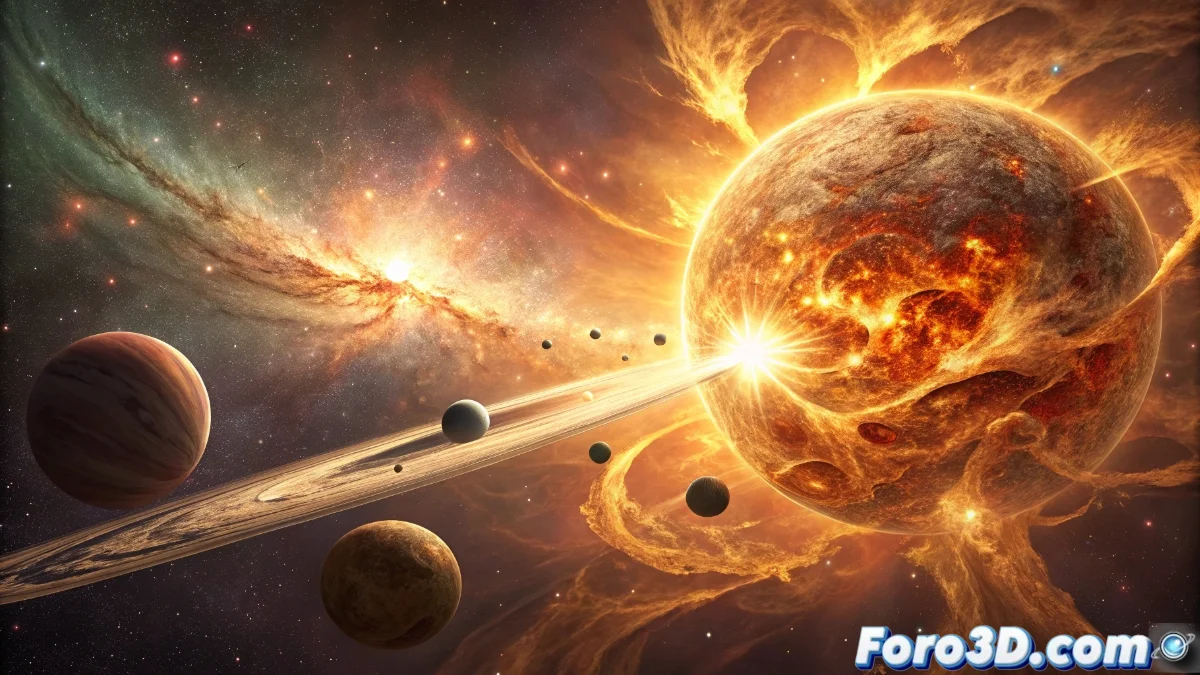
First Direct Detection of Coronal Mass Ejection from a Distant Star
An international team of astronomers has achieved a historic milestone by confirming the first direct observation of a coronal mass ejection originating from a star located 130 light-years from Earth. This stellar phenomenon, captured using state-of-the-art telescopes, marks a fundamental advance in understanding magnetic activity in stars other than our Sun and its potential consequences for the planetary systems that orbit them 🌟.
Consequences for Planetary Habitability
Coronal mass ejections represent enormous expulsions of plasma and charged particles that travel at extreme speeds through interstellar space. When these events reach planets in their path, they can cause atmospheric erosion and drastically alter the conditions necessary for life. The researchers emphasize that this discovery raises crucial questions about how these extreme stellar phenomena could affect the potential habitability of exoplanets orbiting stars with high magnetic activity.
Specific Impacts on Planetary Systems:- Progressive erosion of planetary atmospheres due to bombardment by charged particles
- Alteration of protective magnetic fields in orbiting worlds
- Modification of environmental conditions essential for the development of life
This finding transforms our understanding of how extreme stellar events shape the evolution of entire planetary systems - Astronomical Research Team
New Paths for Cosmic Exploration
This pioneering discovery establishes new directions for investigating space weather in other stellar systems and its influence on planetary evolution. Scientists can now conduct comparative studies on how these processes operate in different stellar types, enabling the development of more accurate predictive models about the formation and preservation of planetary atmospheres in our galaxy.
Emerging Research Areas:- Characterization of magnetic activity in diverse stellar types
- Modeling of interactions between stellar ejections and planetary atmospheres
- Assessment of habitability windows in systems with active stars
Implications for the Search for Cosmic Life
The astronomical community considers this advance a fundamental step in deciphering the mechanisms that govern habitability in the cosmos. Although we are separated by 130 light-years, these stars continue to demonstrate their dynamic and temperamental nature, reminding us that the universe presents a fascinating complexity we are only just beginning to understand 🔭.