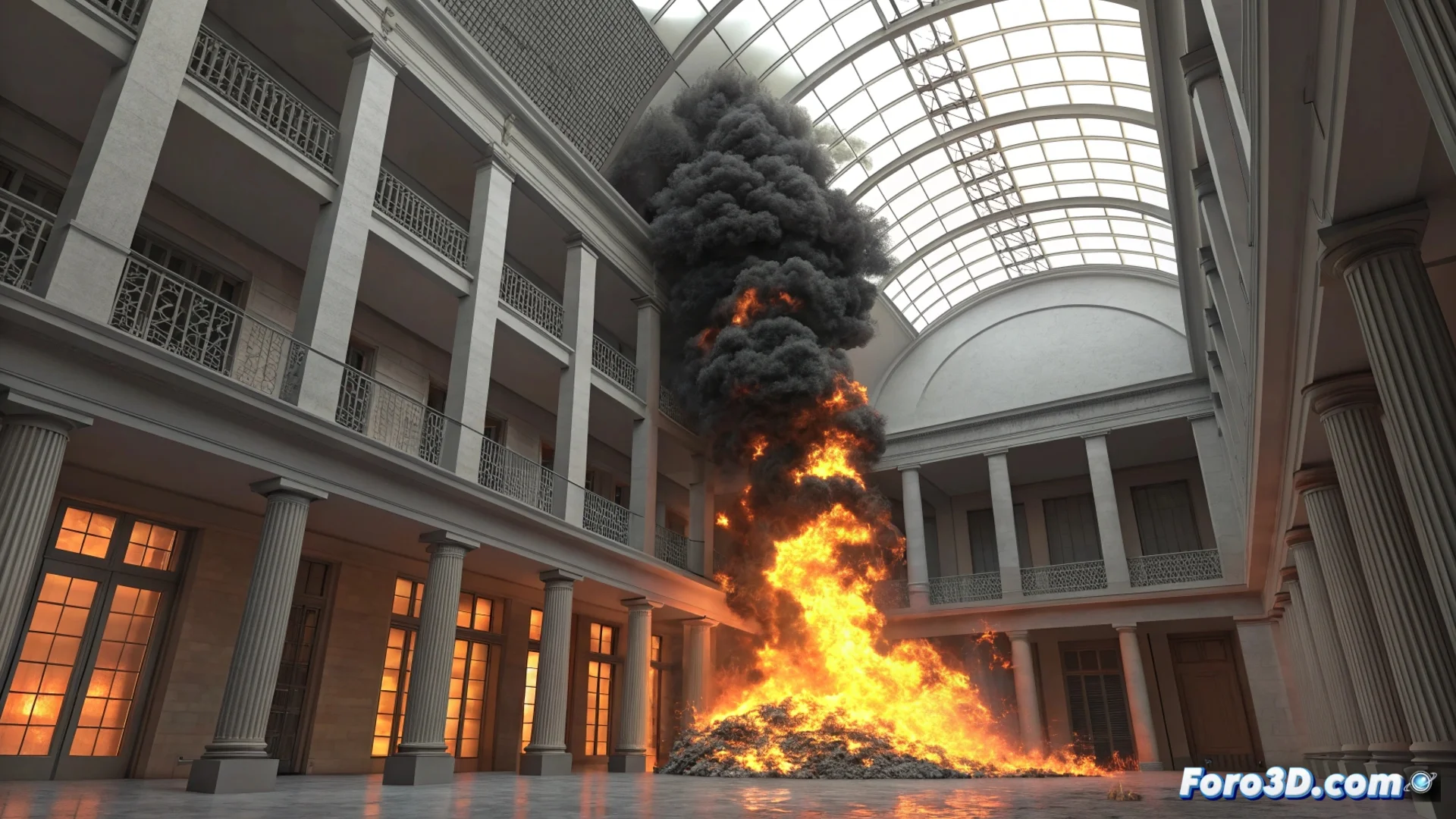
Fire Dynamics Simulator: Modeling Fires with Fluid Simulations
The Fire Dynamics Simulator (FDS) is an open-source tool specialized in simulating fire behavior. This program applies Computational Fluid Dynamics (CFD) methods to solve complex fire safety and protection problems, providing detailed analyses for engineers and designers 🔥.
The Core of the Simulation: Equations and Turbulence
To calculate low-speed fluid motion, FDS relies on the Navier-Stokes equations, specifically adapted to model heat and mass transfer. Its power lies in accurately predicting how smoke and hot gases disperse in large spaces like atriums or tunnels. The key to efficiently handling turbulence is the use of the Large Eddy Simulation (LES) model.
Main Features of the LES Model in FDS:- Directly calculates the largest and most energetic eddies, which have the greatest influence on fire behavior.
- Models the smaller eddies, allowing for high physical realism without excessive computational resources.
- Enables simulating large-scale fires in realistic architectural scenarios in a feasible way.
FDS allows validating designs and improving safety protocols before construction, transforming complex data into practical engineering decisions.
Results Beyond Visualization
The software not only generates striking visual representations. Its true value lies in producing precise quantitative data that professionals use to make fundamental decisions. This information is crucial for designing effective protection systems and assessing risks.
Key Data Generated by FDS:- Temperature and gas velocity at different points in the space.
- Concentration of toxic species and smoke density over time.
- Variables that help define the available evacuation time and the performance of sprinklers or detectors.
Application in Practical Engineering
Engineers use this data to evaluate how structures behave under heat, optimize suppression system designs, and plan evacuation routes. It is an indispensable tool for complying with regulations and protecting lives. Although it predicts fire physics with great accuracy, as a curious note, it still cannot simulate human reactions, like panic in a boardroom over a safety budget cut 😉. Its focus remains on rigorous scientific analysis to prevent disasters.