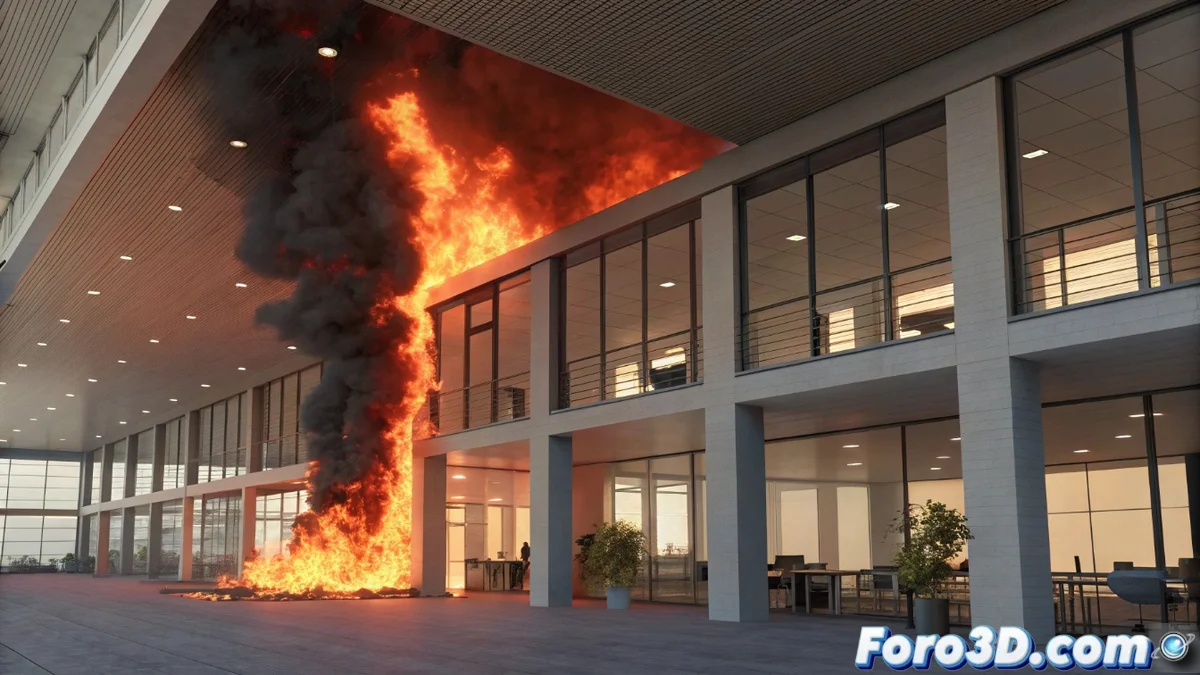
Fire Dynamics Simulator: Essential Tool for Fire Modeling
Commonly known as FDS, this specialized software represents an advanced solution for the predictive analysis of fire behavior, developed by the prestigious National Institute of Standards and Technology of the United States. 🚒
Applications in Fire Protection Engineering
Professionals use this computational tool to design and validate safety systems in complex structures such as smart buildings, transportation tunnels, and airport terminals. The software allows recreating multiple emergency scenarios to optimize evacuation routes and evaluate the efficiency of automatic suppression systems.
Main professional uses:- Evaluation of automatic sprinkler systems in shopping centers and hospitals
- Design of ventilation systems for smoke control in underground parking lots
- Forensic reconstruction of real fires to determine causes and propagation patterns
The predictive capability of FDS has revolutionized the way we approach fire safety in complex architectural spaces
Computational Methodology and Technical Features
The program implements advanced numerical methods based on finite volumes over Cartesian meshes, solving the complex Navier-Stokes equations adapted specifically for combustion phenomena. It includes the Smokeview module for interactive visualization of results through three-dimensional animations that show the complete temporal evolution of the fire. 🔥
Key features:- Modeling of complex architectural geometries with multiple combustible materials
- Simulation of radiant and convective heat transfer between different zones
- Analysis of toxic gas concentrations and smoke dispersion patterns
Limitations and Practical Considerations
Although FDS achieves notable levels of accuracy in predicting fire physical behavior, there are aspects of human behavior during emergencies that escape its modeling capability. The software cannot simulate emotional reactions such as panic in critical situations, especially in domestic contexts where psychological factors significantly alter evacuation responses. 🧯