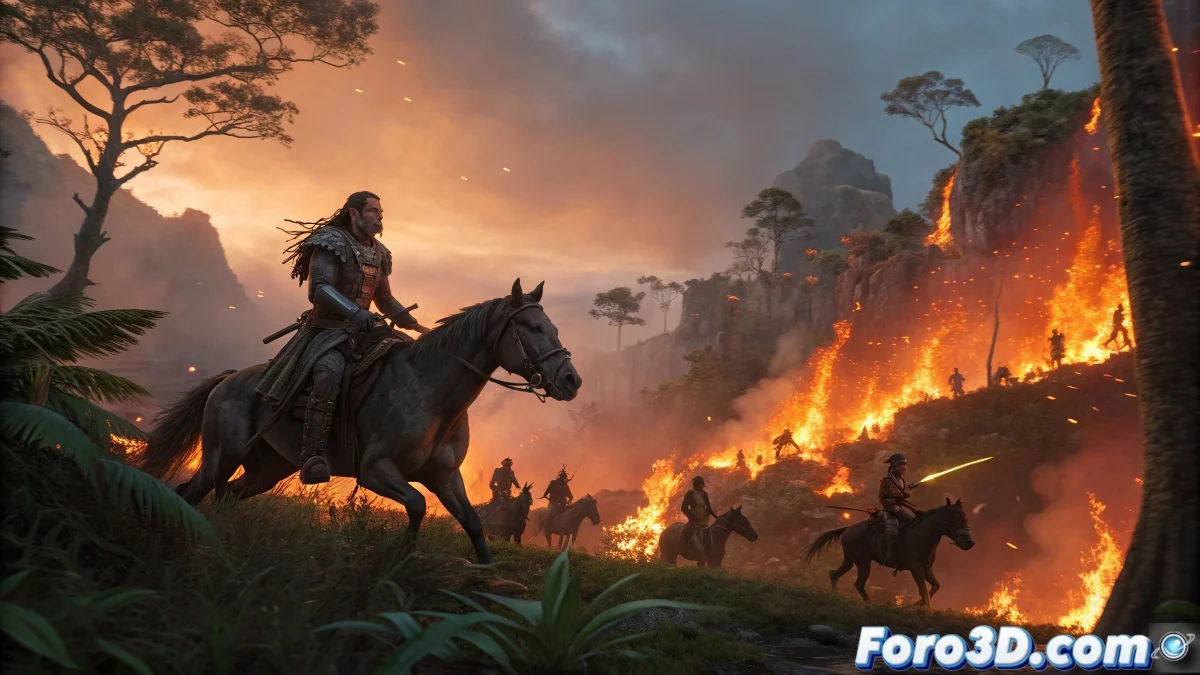
Pandora Burns in the Third Installment of the Saga
James Cameron returns with Avatar: Fire and Ash, a film that promises to immerse audiences in the darkest and most epic chapter of the saga. The extended synopsis places Jake Sully and Neytiri leading their family in a war that not only pits Na'vi clans against each other but also threatens to destroy Pandora's fragile ecosystems. Fire stands as a powerful symbol of destruction and possible rebirth in a narrative where hope struggles to break through. 🔥
A Two-Front War for the Protagonists
The story presents a complex duality. On one hand, the human threat persists, seeking to exploit the planet's resources. On the other, internal tensions arise among the Na'vi clans, where some see the conflict as an opportunity to gain power. This dynamic forces the protagonists to navigate a fragile political reality while discovering new regions of Pandora and never-before-seen creatures, all under the shadow of the title Fire and Ash.
The Technological Leap Behind the Visual Magic
As is customary with Cameron, technological innovation is a fundamental pillar. The production team has taken motion capture techniques to new extremes, perfecting underwater capture and expanding it to environments dominated by fire and ash. Special cameras have been developed capable of recording facial micro-expressions under extreme conditions, translating into an unprecedented level of realism for the Na'vi characters. 🎥
Weta FX Raises the Bar for Visual Effects
The studio Weta FX, the technical soul of the saga, once again deploys its full arsenal. For this installment, they have implemented advanced simulation tools that recreate with scientific precision the behavior of fire and ash particles in Pandora's diverse ecosystems. Furthermore, the bestiary expands with biologically designed hybrid creatures, modeled in 3D with a hyper-realism that challenges perception.
- Fluid and Particle Simulation: For destructive elements like fire and ash.
- Hyper-realistic 3D Modeling: In the design of new creatures and environments.
- Advanced Global Illumination: To seamlessly integrate all digital elements.
The combination of the tangible and the digital solidifies Avatar Fire and Ash as a work that blurs the line between art and technology.
The result is an immersive experience where Pandora feels more alive than ever, but also more vulnerable. Every texture and lighting effect tells a part of the story, reinforcing the idea of the planet as a central character.
In the end, Cameron reminds us that making an Avatar movie isn't just filming actors in front of a green screen; it's practically governing an entire digital planet. And whoever said directing actors was difficult clearly never had to direct a computer-generated bioluminescent creature. 😉