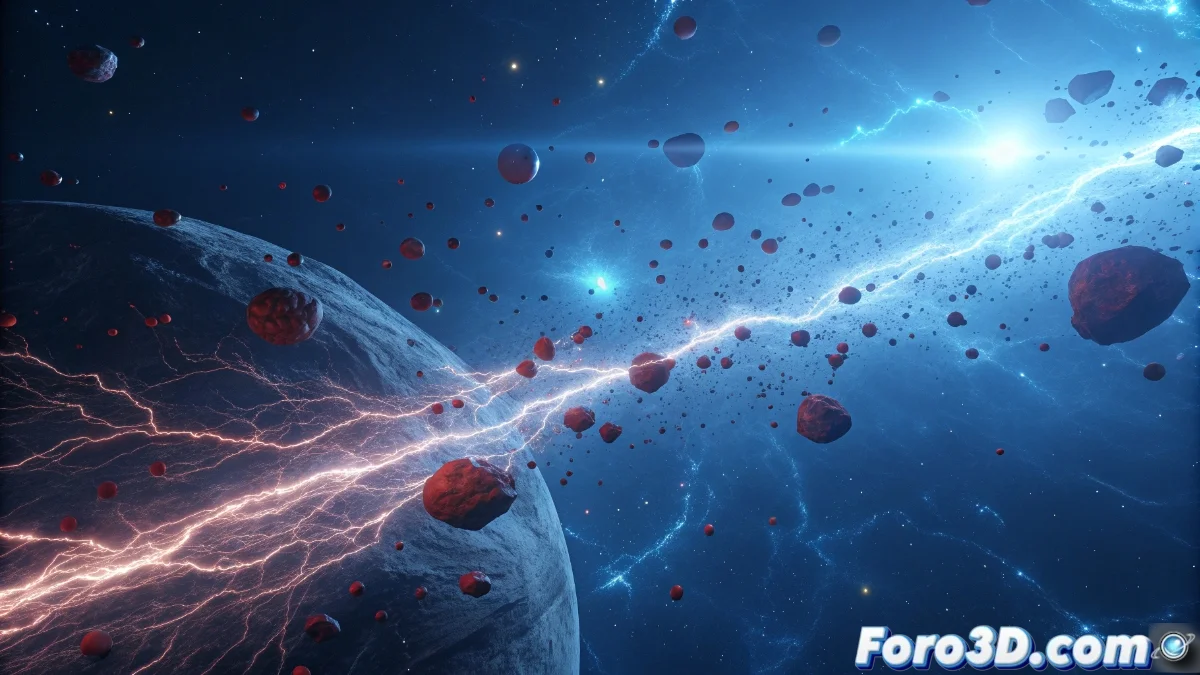
Field System in Unreal Engine: Native Integration of Niagara and Chaos Physics
The field system in Unreal Engine marks a revolutionary advancement for simulating dynamic effects, natively fusing Niagara and Chaos Physics. This unified framework enables developers to design sophisticated interactions between particles, destructible physics, and environmental forces through a set of specialized operators. Vector, scalar, and integer fields act as modular entities that can influence multiple systems simultaneously, establishing causal relationships that previously required custom solutions. 🎮
Modular Architecture of the Fields
The architecture is based on reusable components that specify attributes such as gravity, wind, turbulence, or attraction and repulsion forces. Each field operates as a layer of influence that Niagara particle systems and Chaos physics objects can sample in real time. The true power emerges when combining multiple fields through blending operations, where a wind field can interact with a noise field to generate organic patterns, while a Chaos destruction field alters the geometry in response to these forces. This allows for creating coherent and dynamic visual experiences.
Key features of the architecture:- Modular components that define properties like gravity, wind, and turbulence for easy reuse
- Real-time sampling capability by particle systems and physics objects
- Blending operations that enable interaction between multiple fields for complex effects
The integration of fields in Unreal Engine simplifies the creation of dynamic simulations, reducing the need for custom solutions and accelerating the development of advanced visual effects.
Practical Workflow with the Field System
In practice, technical artists use the Field System Component as the main container, incorporating various types of field nodes that generate, transform, or combine data. The system supports both predefined and procedural fields, facilitating the creation from simple directional forces to intricate patterns based on 3D textures. Integration with Blueprints and C++ provides flexibility for advanced scripting, allowing the connection of a field's intensity to gameplay parameters or animating its properties via timelines. This opens up a wide range of creative possibilities for customizing effects at runtime.
Workflow elements:- Use of the Field System Component as the core for managing and organizing fields
- Addition of field nodes for generating, transforming, and combining field data
- Support for predefined and procedural fields, adapting to simple or complex needs
Conclusion and Final Reflections
The field system in Unreal Engine not only optimizes the creation of dynamic effects but also encourages experimentation, such as accidentally setting up an inverted gravity field and watching characters fly into the sky. This underscores that even in advanced simulation environments, creative chaos can lead to unexpected and fun results. By maintaining a modular architecture and a flexible workflow, developers can explore new frontiers in visual effects, making the process both efficient and entertaining. 🌟