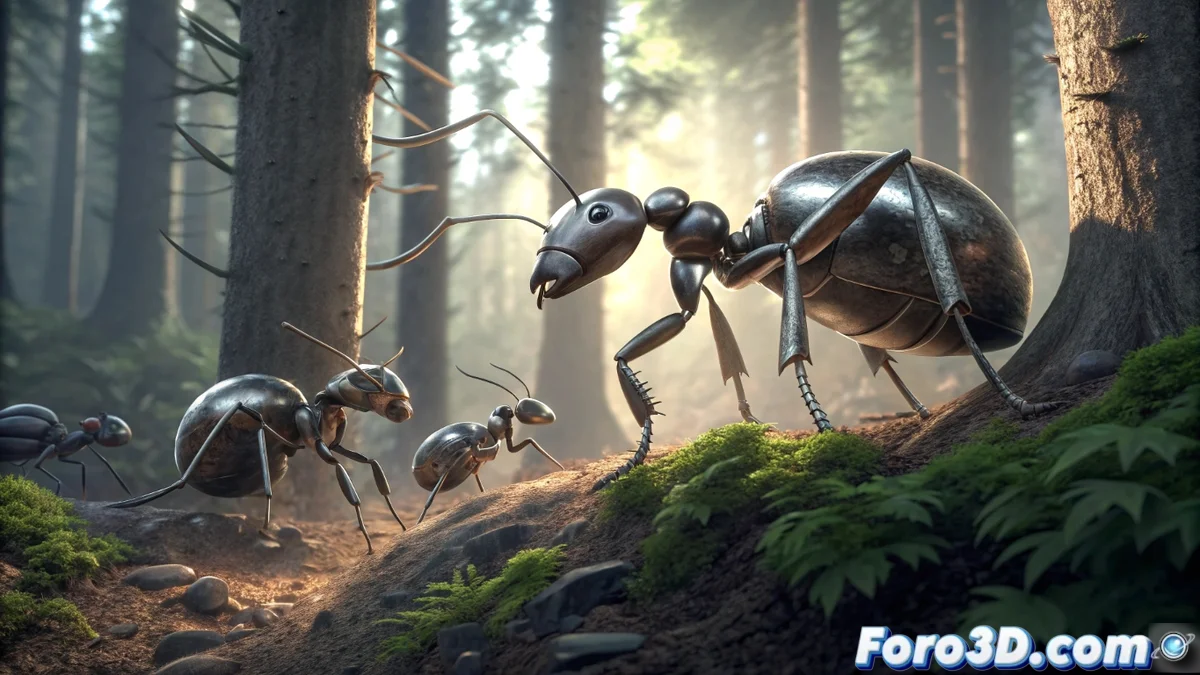
Festo's BionicANTs: Robotics Inspired by Nature
The German company Festo has created a series of fascinating robots called BionicANTs. These devices not only replicate the shape of an ant, but also emulate its sophisticated collective behavior. Their ability to communicate and act in a coordinated manner opens new frontiers in automation 🐜.
Cooperative Operating Principle
Each BionicANT unit operates autonomously but is intrinsically connected to the group. Through optical sensors and complex artificial intelligence algorithms, they perceive their environment and share data instantly. This allows the swarm to self-organize to overcome obstacles and perform tasks that would be impossible for a single robot, such as moving heavy loads.
Key Technical Features:- Wireless Communication: They exchange position and status information in real time for precise coordination.
- Swarm Algorithms: They decide on collective actions based on simple rules, without central control.
- Adaptability: The system dynamically reconfigures itself in response to changes in the environment or task.
True intelligence emerges from collectivity, not from the complexity of a single agent.
Potential Impact on Industry
The practical application of this technology is vast. In sectors such as logistics and manufacturing, these robotic swarms could optimize workflows, assemble components, or manage inventories more efficiently and flexibly than traditional automated systems.
Main Fields of Application:- Autonomous Warehouses: For sorting and transporting goods.
- Assembly Lines: Performing cooperative tasks to assemble products.
- Operations in Complex Environments: Such as search or inspection tasks in confined spaces.
Final Reflection on the Future
The BionicANTs represent a significant milestone in collaborative robotics. They demonstrate how biological principles can solve complex engineering problems. As they advance toward possible industrial implementation, their development continues to explore the limits of distributed artificial intelligence and biomimicry 🤖.