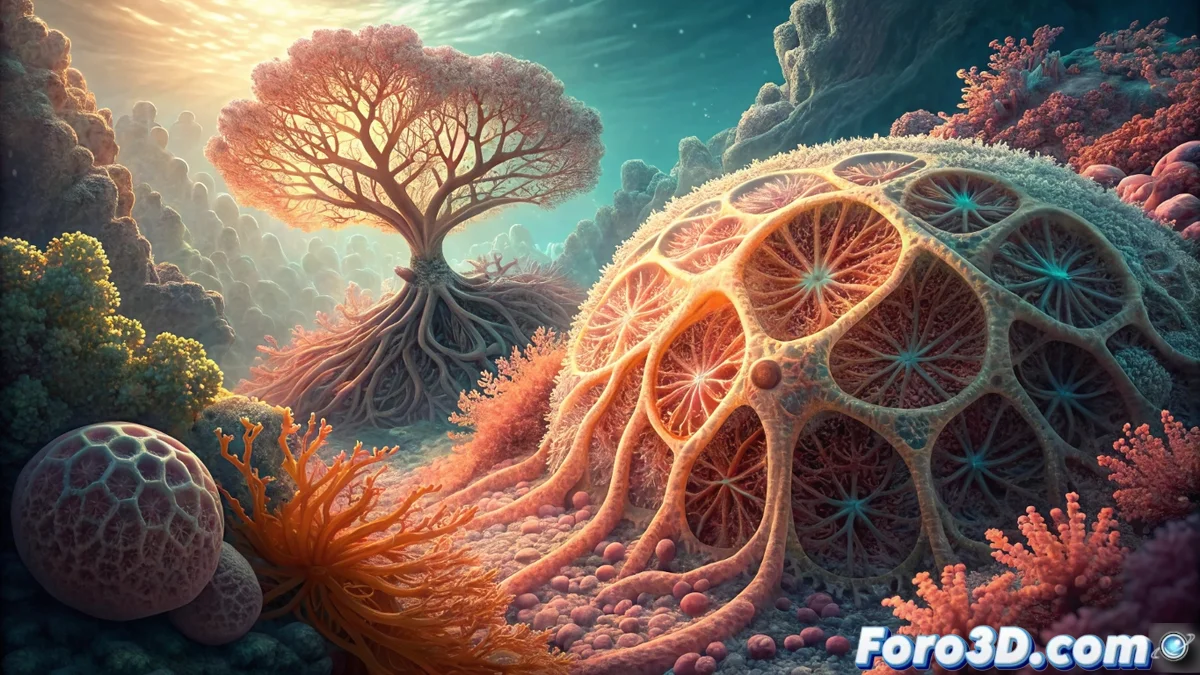
Exploring the Reaction-Diffusion Technique for Computer Graphics
In the fascinating world of generative graphics, the reaction-diffusion growth technique emerges as a procedural method that imitates chemical and biological processes. By simulating how two or more substances react and diffuse in a medium, organic patterns of astonishing complexity are spontaneously generated, formally known as Turing patterns. This tool is a pillar for digital artists seeking to create realistic and dynamic textures, from the scaly skin of fantastic creatures to intricate vein systems or coral formations, all through efficient algorithms. 🧪
Practical Applications in the 3D Industry
The integration of this system into modeling and visual effects software has revolutionized workflows. Leading programs like Blender and Houdini allow artists to implement these algorithms to generate textures that evolve over time, facilitating the creation of natural scenes and self-organizing systems. This eliminates the need for exhaustive manual modeling, offering unique creative control over digital morphogenesis.
Main advantages of its use:- Generation of organic patterns: Creates complex and realistic structures that would be very laborious to design by hand.
- Low computational cost: The algorithms are relatively efficient, allowing rapid iterations even on moderate hardware.
- Dynamism and evolution: Textures can change and grow procedurally, ideal for special effects animations.
Turing patterns, conceived to explain morphogenesis in biology, are now the key to bringing digital science fiction creatures to visual life, as if nature itself designed the special effects.
Considerations and Key Adjustments for Artists
Although it is an accessible technique, its power lies in mastering its parameters. To avoid chaotic or undesired results, it is crucial to understand and adjust variables such as the diffusion speed, reaction rates, and initial conditions. This fine control makes it suitable for both beginners exploring procedural generation and experts requiring specific, high-quality results in professional projects. 🎨
Fundamental parameters to control:- Diffusion speed: Determines how quickly the virtual "reactants" spread, affecting the scale and density of the pattern.
- Reaction rates: Define how substances interact, influencing the shape of the resulting structures (spots, stripes, rings).
- Boundary conditions and initial seed: The starting point and system boundaries condition the final result, allowing growth to be directed.
From Biological Theory to Digital Magic
The beauty of reaction-diffusion growth lies in its bridge between pure science and applied art. What began as a theoretical explanation for spots on a leopard or stripes on a zebra has transformed into an indispensable tool in the digital artist's toolkit. It allows emulating the essence of natural growth, offering a level of authenticity and organic detail that deeply enriches realism in cinema, video games, and immersive visual experiences. Its legacy demonstrates that the deepest principles of nature can be the best allies for digital creation. 🌿