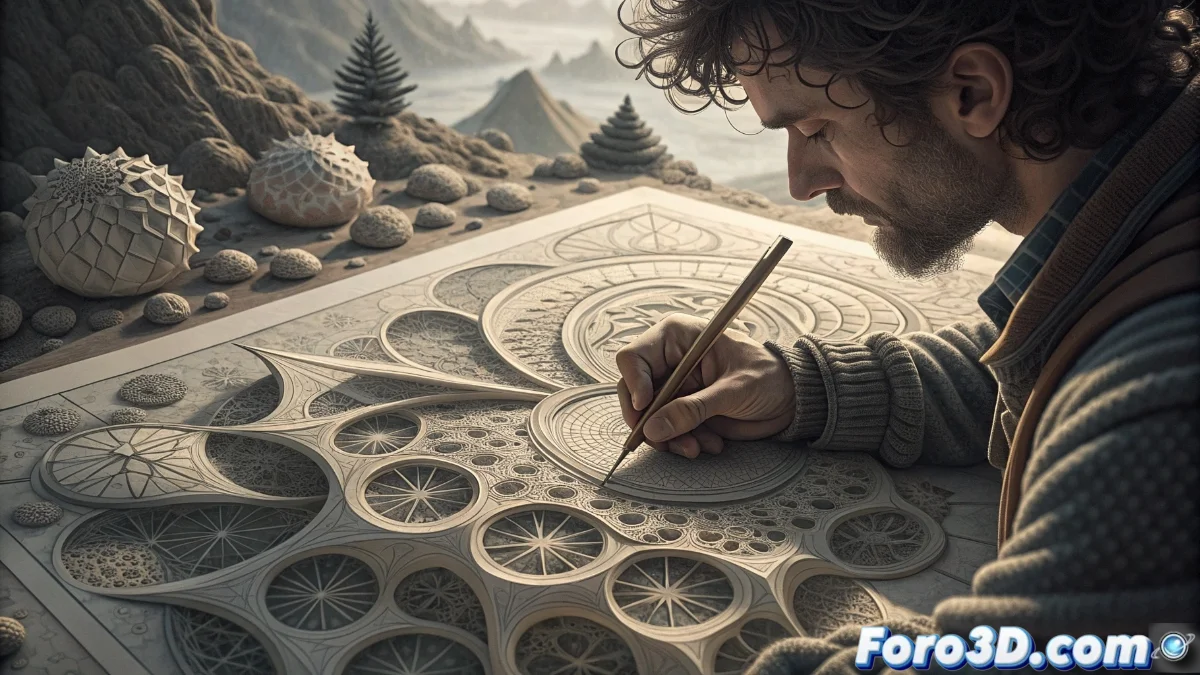
Exploring Fractal Art: Repetitive Patterns and Geometry in Drawing
Fractal drawing represents a revolutionary approach where visual complexity arises from elementary principles, allowing artists to build graphic universes through the systematic repetition of fundamental geometric structures 🎨.
Mathematical Fundamentals Applied to Artistic Creation
Fractal geometry provides a conceptual framework where simple recursive algorithms generate compositions of extraordinary visual richness. By experimenting with classic fractals like the Mandelbrot set or the Sierpinski triangle, creators develop a deep understanding of how base patterns manifest across multiple scales simultaneously.
Essential Principles of Fractal Drawing:- Decomposition of complex images into basic geometric modules
- Application of recursive transformations while maintaining self-similarity
- Integration of subtle variations to avoid visual monotony
True mastery in fractal art lies in balancing systematic repetition with creative innovation, creating compositions where each element harmoniously converses with the whole.
Practical Methodology for Integrating Repetitive Patterns
Repetitive patterns function as constructive units that, organized through precise geometric rules, allow for the development of compositions of seemingly infinite complexity. The practice begins with elementary tessellations that progressively incorporate spatial transformations such as rotations, scaling, and mirror reflections.
Creative Process with Iterative Patterns:- Starting with pure geometric shapes like triangles and squares
- Application of progressive iterations that maintain structural coherence
- Exploring how minimal alterations generate dramatically different results
Developing Artistic Skills Through Fractal Practice
Constant exploration with these systems not only produces visually striking works but fundamentally trains spatial perception and develops exceptional compositional intuition. Artists learn to recognize underlying structures in nature and translate them to the two-dimensional plane through systematic processes that, while requiring dedication, offer extraordinary aesthetic rewards ✨.