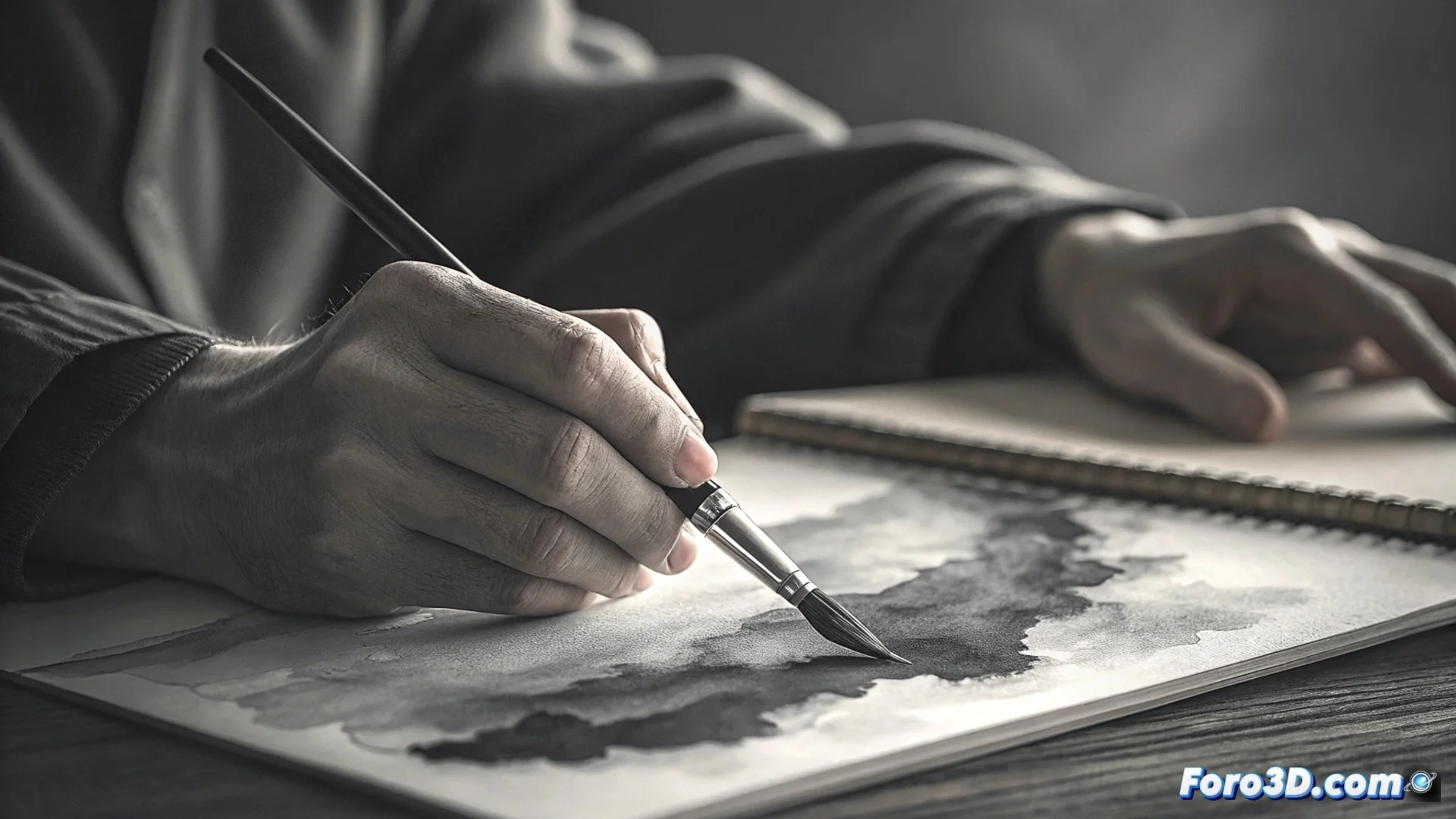
Explore drawing with unusual tools to unleash your creativity
When the pencil or precise brush becomes routine, your hand and mind can stagnate. This proposal invites you to draw with everyday objects that were not designed for it. By changing the instrument, the way you relate to the stroke and the support changes completely. 🎨
Discover a universe of unprecedented marks and textures
Each absurd tool possesses a unique graphic identity. The handle of a brush with ink generates expansive smudges with soft outlines, an effect impossible to achieve with precision tools. A wooden toothpick, dragged over the paper, tears the surface and produces dry, fragmented lines. A sponge moistened with watercolor deposits color capriciously, creating organic textures full of pores and gradations. Even your own fingers, on paper or touch screen, offer direct but rough control that drives broad and expressive gestures. These new line qualities permanently expand your visual vocabulary.
Graphic results by tool:- Brush end: Creates smudges and thick lines with blurred and soft edges.
- Wooden toothpick: Generates dry, broken strokes with a torn quality on paper.
- Natural sponge: Provides porous, irregular textures with a very marked organic character.
The instrument does not define the artist, but rather the opposite. This practice is a powerful reminder of that principle.
Train your ability to adapt and synthesize
By facing the deliberate limitations of an unsuitable object, your brain must seek alternative solutions. You cannot rely on the fine tip to define details, so you are forced to communicate form, volume, and light with more essential and economical means. This process trains your eye to capture the essential and discard the superfluous. The initial frustration of not being able to control the stroke usually transforms into a liberating surprise when you discover that you can express an idea with seemingly restrictive means.
Key benefits of this exercise:- Develops greater looseness and flexibility in the drawing gesture.
- Combats creative block by breaking established habits and routines.
- Encourages thinking in terms of visual synthesis and capturing the essence of the subject.
Integrate what you've learned into your usual workflow
The true value of this experiment emerges when you return to your conventional tools. Your normal pencil may then be perceived as a high-precision device, and you are likely to handle it with more confidence or less fear of making mistakes. The textures and gestural language discovered during the exploration can be consciously integrated into your usual projects, enriching your personal style. It's not about abandoning professional tools, but about remembering that creativity resides in the mind, not in the instrument.