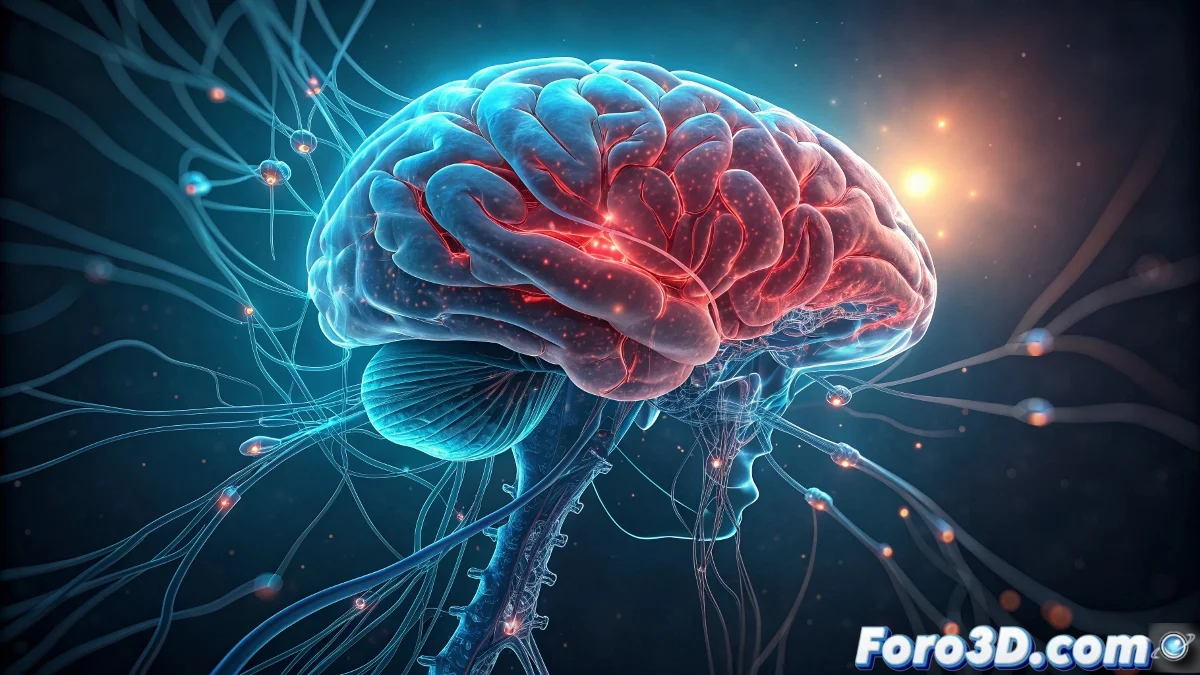
Why the Brain Fears the Dark: Modeling Our Ancestral Fears in Womp
That feeling of unease when the lights go out is not mere imagination; it is a deeply ingrained evolutionary echo in our neurobiology. The fear of the dark is one of the oldest and most universal responses of the human brain, a survival tool that saved our ancestors from predators and nighttime dangers. Understanding the brain mechanisms behind this fear is not only fascinating from a scientific perspective but also offers a perfect opportunity to use Womp as an educational visualization tool, transforming abstract neuroscience concepts into comprehensible and engaging 3D models. 🧠
The Amygdala: the Sentinel of Fear
At the heart of our fear response lies the cerebral amygdala, a small almond-shaped structure that acts as the primary alarm system. When darkness eliminates our primary sense—vision—the amygdala activates, preparing the body for a potential threat. In Womp, we can model this structure by highlighting it in intense colors within the brain, showing how it receives incomplete sensory information in the dark and interprets it as potentially dangerous. The key is to visualize how this small region orchestrates an entire symphony of physiological responses—from increased heart rate to hypervigilance. 🔴
Brain Responses in the Dark:- amygdala activation as a threat detector
- release of cortisol and adrenaline for fight/flight response
- increased auditory acuity to compensate for lack of vision
- activation of the emotional memory system to recall past dangers
Modeling in Womp: From Abstract Brain to Concrete
Womp is ideal for this project because its organic sculpting approach allows us to create realistic brain shapes without needing perfect topology. We start by sculpting the basic brain shape using freeform modeling tools, then add the characteristic sulci and gyri with detail brushes. For the amygdala, we create a separate almond-shaped form that we then integrate into the main model. Womp's advantage is that we can quickly experiment with different representations—from anatomically precise versions to educational abstractions—finding the perfect balance between scientific accuracy and communicative clarity. 🎨
We don't fear the darkness itself, we fear what our evolution tells us it might hide
Evolution in 3D: Why This Fear Persists
Our ancestors who overestimated threats in the dark were more likely to survive and reproduce. In Womp, we can create a visual representation of this evolutionary heritage. We model abstract elements representing ancestral predators—shadows suggesting large feline shapes, sounds evoking snakes—and show how the modern brain still reacts to these ambiguous stimuli. Using Womp's layer system, we can overlay these ancestral threats onto the brain, showing how evolution has wired fear responses that are no longer functional but persist. 🐾 Evolutionary Elements to Represent:
- nocturnal predators that threatened our ancestors
- loss of visual advantage as diurnal primates
- uncertainty as a trigger for stress response
- genetic memory of dangers in the dark
Alert System and False Alarms
The brain prefers to err on the side of caution rather than underestimate a real threat. In Womp, we can visualize this concept by creating a neuronal "traffic light" system that shows how the brain interprets ambiguous stimuli—a vague noise, a moving shadow—as potentially dangerous. Using particle effects and colors, we can represent the alert signals propagating from the amygdala to other brain regions. Animating these fear pathways helps understand why we react physiologically even when we rationally know there is no real danger. 🚨
Contrast with the Rational Brain
A fundamental part of the visualization is showing the conflict between the limbic system and the prefrontal cortex. In Womp, we model the prefrontal cortex as a control structure that tries to calm the hyperactive amygdala. We can use different colors and visual effects to represent this "brain battle": red/orange tones for the emotional response, blue/green for logical reasoning. This representation is not only scientifically accurate but also helps normalize the fear of the dark as a natural phenomenon rather than a personal weakness. 💡
Visualization Techniques in Womp:- warm colors for emotional activation
- particle flows for neural signals
- transparencies to show internal structures
- smooth animations for physiological processes
Representing the fear of the dark in Womp is an exercise in scientific translation and educational empathy. By transforming abstract neurobiological processes into tangible 3D models, we not only explain a common psychological phenomenon but also destigmatize a universal human experience. Every sculpting tool, every color choice, every animation in Womp contributes to a deeper understanding of why, at the brain level, darkness remains—and probably always will be—a territory of uncertainty and caution. And in that understanding, we find not only scientific knowledge but comfort in knowing that our fear is not irrational, but the echo of a survival mechanism that kept us alive for millennia. 🌙