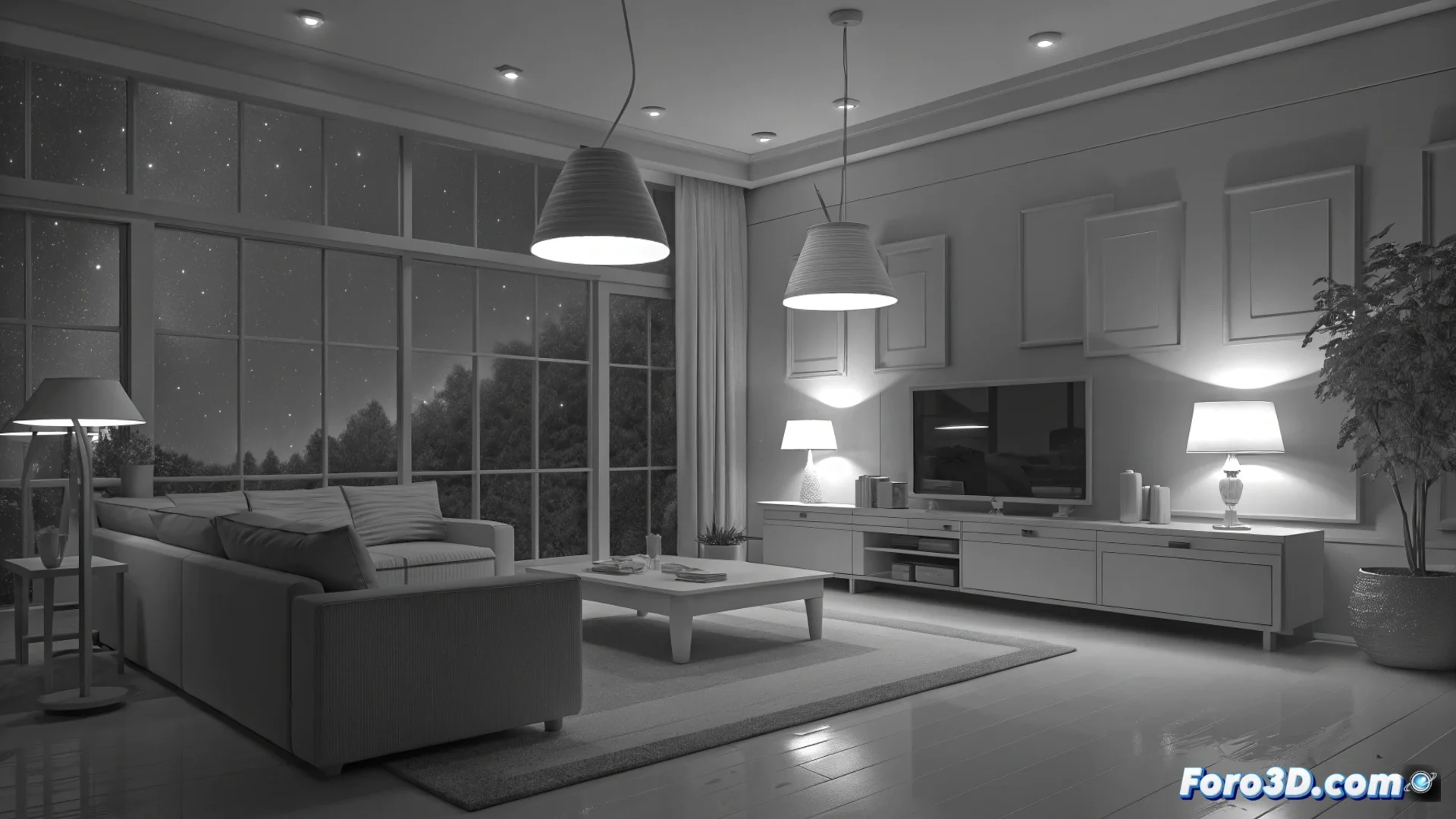
Excessive Glow Flattens Visual Contrast
It is common to see renders where every light source and every shiny surface emits a constant glow or bloom. This practice, far from improving the image, usually damages it, generating a milky and uniform atmosphere that invades the entire composition. The problem lies in not discriminating, treating equally the lights that should stand out and the more subtle reflections, which ends up significantly reducing the dynamic range. 👁️
Indiscriminate Bloom Tires the Eyes and Flattens the Scene
When everything shines with the same intensity, nothing really stands out. Applying the effect ubiquitously creates a persistent diffuse halo that makes the eyes tire when trying to focus. The scene may be perceived as a technical rendering error rather than a deliberate artistic choice. This constant whitish veil eliminates deep shadows and light accents, turning a potentially dramatic scene into a flat visual experience.
Consequences of Misusing Bloom:- Generates a constant milky halo that invades the entire image.
- Reduces the dynamic range and flattens the composition, eliminating contrast.
- Tires the viewer's eyes by creating many diffuse areas without clear focal points.
- Can make the render seem like a technical failure rather than an artistic decision.
A render where everything shines with the same intensity ends up highlighting nothing. It is the visual equivalent of writing an entire text in bold.
Using Bloom with Artistic Intent
The real purpose of the bloom effect is to simulate how intense light overflows in a camera sensor or the human eye, adding realism and atmosphere. Its power lies in selectivity. It should be reserved for the brightest light sources or key specular reflections, those that truly dazzle. By precisely controlling the intensity threshold, diffusion radius, and attenuation, the viewer's attention is directed and a clear visual hierarchy is created.
Technical Alternatives for Precise Control of the Effect:- Adjust the bloom threshold so that it only affects pixels that exceed a specific luminance value. This is the first fundamental step.
- Combine threshold adjustment with render masks or auxiliary channels. These tools allow isolating specific lights or materials for total artistic control.
- Use the functions of many graphics engines to exclude specific layers from post-processing. This way, for example, a lamp can shine without the entire wall acquiring a veil.
The Key Lies in Light Hierarchy
A subtle and strategic bloom in key points adds depth and enhances important elements. On the contrary, applying it indiscriminately achieves the opposite effect: it reduces impact. Effective lighting is based on contrast and gaze direction. Controlling this effect is not just a technical matter, but an essential compositional decision for the scene to convey the desired emotion and realism, guiding the viewer's perception to where the artist wants. 🎯