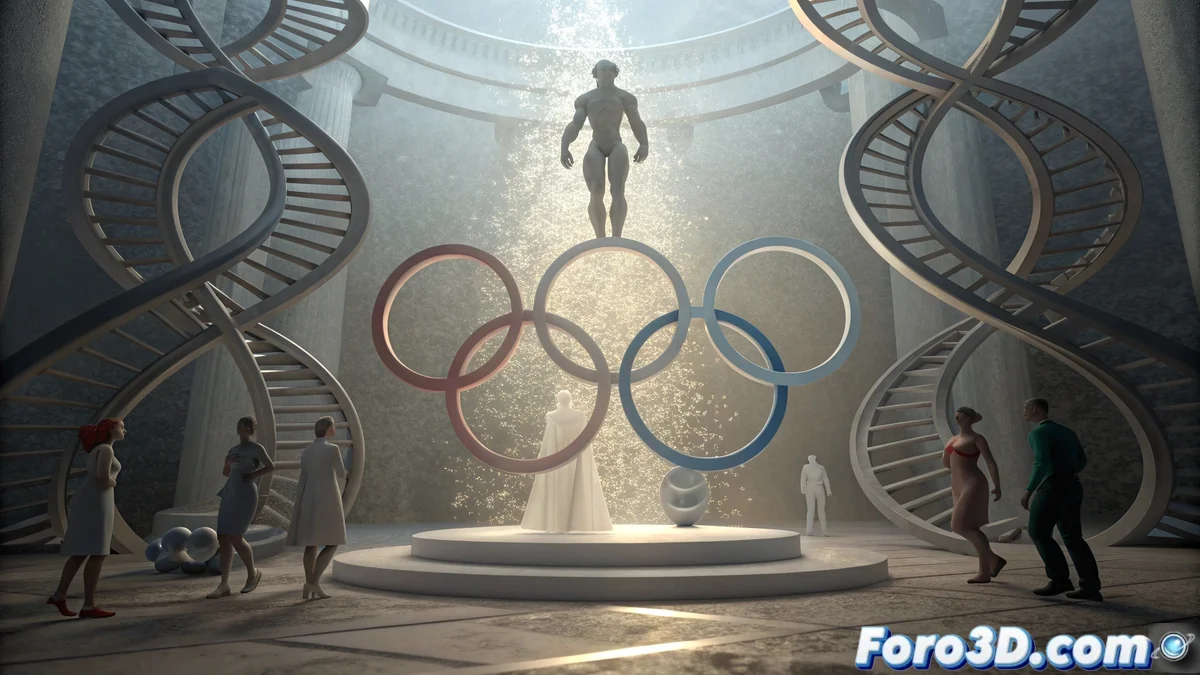
Evolution of Gender Testing in Sports and Its Visual Representation in Blender
Gender eligibility controls in the sports arena represent one of the most complex and controversial topics in the history of Olympism. Their origins date back to the 1960s when the first femininity verification protocols were established through chromosomal analysis and invasive physical examinations. 🏅
Historical Background and Normative Transformation
The International Olympic Committee has substantially modified its criteria over six decades, transitioning from bodily tests to systems based on hormone levels. In 1999, mandatory examinations were eliminated but the possibility of specific investigations was maintained, while the most significant change came in 2003 with the implementation of testosterone parameters. These policies seek to balance sports inclusion with fair competition, generating intense ethical and medical debates.
Key stages in normative development:- 1960s: Implementation of barré body tests and gynecological examinations as first verification methods
- 1999: Elimination of mandatory controls but maintenance of case-by-case investigation mechanisms
- 2003: Introduction of criteria based on testosterone levels as a fundamental parameter
The evolution of these protocols reflects the permanent tension between individual rights and competitive equity in elite sports.
Technical Setup in Blender for Conceptual Representation
The creation of abstract visualizations that communicate these complexities requires meticulous planning in Blender. It is recommended to start by setting a 16:9 aspect ratio and configuring color management to Filmic, creating scenes that function as visual metaphors of the evaluative process. Organization into separate render layers allows precise control over background elements, institutional symbols, and medical data representations.
Initial workflow:- Preparation of the main scene with elements symbolizing procedural transparency and balance
- Setup of the compositor node system from preliminary stages
- Organization of hierarchies in logical collections to facilitate later animations
Development of Visual and Symbolic Elements
Geometric modeling must convey concepts of impartiality and scientific precision. Stylized Olympic rings can be created using Bezier curves combined with the Array modifier, while laboratory symbols like test tubes require extrusion and subsurface subdivision techniques. The incorporation of abstract human elements through metaballs and smoothed meshes adds emotional dimension to the composition.
Lighting System and Expressive Materials
The lighting setup with a tripod system (key light, fill light, and back light) generates essential visual depth for complex narratives. Principled BSDF materials with transmission variations symbolize procedural transparency, while procedural textures using Noise and Voronoi nodes suggest official documentation and clinical data. Differentiation of roughness values helps distinguish between organic surfaces and institutional elements.
Advanced technical elements:- Implementation of particle effects to visualize information flows and decision-making processes
- Rendering in Eevee during development with screen space reflections enabled
- Final render in Cycles with 1500 samples and OptiX denoiser for maximum quality
Conceptual Integration and Final Reflection
The fundamental irony lies in creating perfectly balanced visual representations to illustrate a topic where the perfect balance between inclusion and fair competition remains elusive. Cases of athletes like Caster Semenya have evidenced the profound ethical complexities, while recent announcements about tests for the Milan-Cortina 2026 Games confirm the continuity of these efforts to maintain competitive standards. The application of color correction and subtle glitch effects in the compositor visually conveys the intricate nature of eligibility decisions that directly affect athletes' careers while seeking to preserve the integrity of Olympic and Paralympic competitions. 🎯