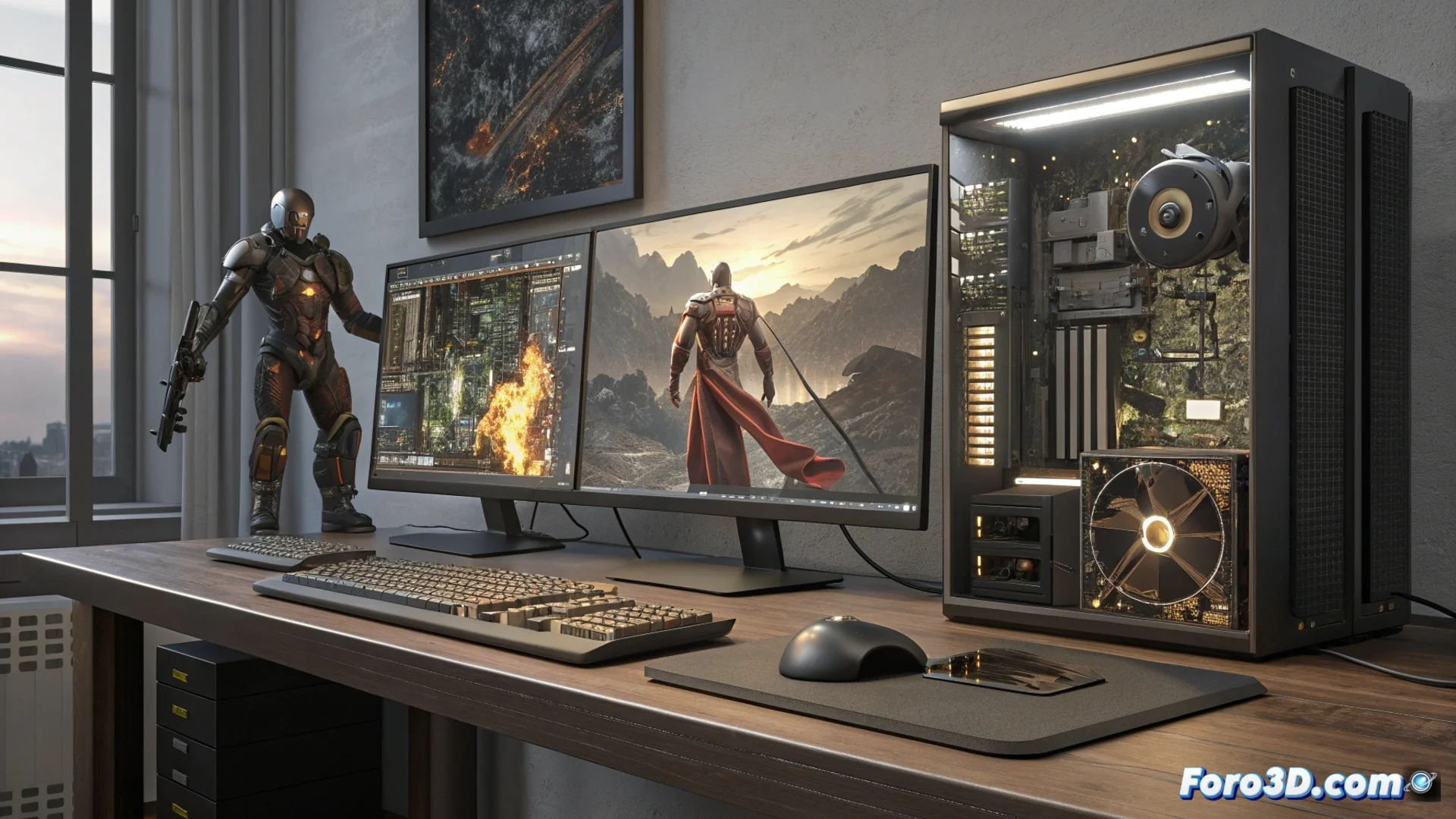
Evaluate a Configuration with RTX 5060 Ti and Ryzen 7 5800X for 3D Modeling
Building a system with a 16 GB RTX 5060 Ti, a Ryzen 7 5800X processor, 32 GB of RAM, and a 1 TB SSD under Windows 11 Home provides a solid foundation for those who want to model and texture in three dimensions. This hardware setup allows running applications like Blender, Maya, or ZBrush smoothly, facilitating the creative process without major initial obstacles. 🖥️
Where the System Shows Its Capability and Where It Encounters Barriers
The power of the GPU is key to manipulating scene previews agilely, while the speed of the CPU cores accelerates certain specific calculations. However, this balance has clear boundaries.
The limits become evident when:- Simulating complex physical phenomena, such as large volumes of fluids or massive particle systems.
- Rendering with resource-intensive graphics engines, like Cycles or Redshift.
- Working in virtual or augmented reality environments with very dense geometry and high-resolution textures.
The processor, being powerful, does not perform as well as modern CPUs with more cores in tasks like CPU-only rendering or extensive simulation calculations.
RAM and Storage Dictate the Workflow
Having 32 GB of RAM is adequate for many projects, but it is not unlimited space. Extremely detailed scenes or keeping 3D software, Photoshop, and a web browser with multiple tabs open simultaneously can exhaust available memory and slow down the entire system. For a more comfortable margin of operation, upgrading to 64 GB is an option to consider. 💾
Storage Considerations:- A 1 TB SSD can fill up quickly when saving projects, high-definition texture libraries, and render cache files.
- Managing available space becomes a recurring task, so considering a higher capacity drive or additional storage scheme is prudent.
- The SSD's speed accelerates project and texture loading, improving daily productivity.
System Software: Cover the Basics and Anticipate Needs
Windows 11 Home meets the fundamental requirements for 3D creation, but lacks advanced virtualization tools, network management, or system policy configuration. These features may be necessary in a more controlled professional production environment or when integrating the machine into a corporate infrastructure. It is a detail that is often underestimated until one of those utilities is needed and is not available. Essentially, it is comparable to having an agile vehicle for daily use, but not prepared to carry heavy loads or compete at a high level; it fulfills its function, but within a defined scope. ⚙️