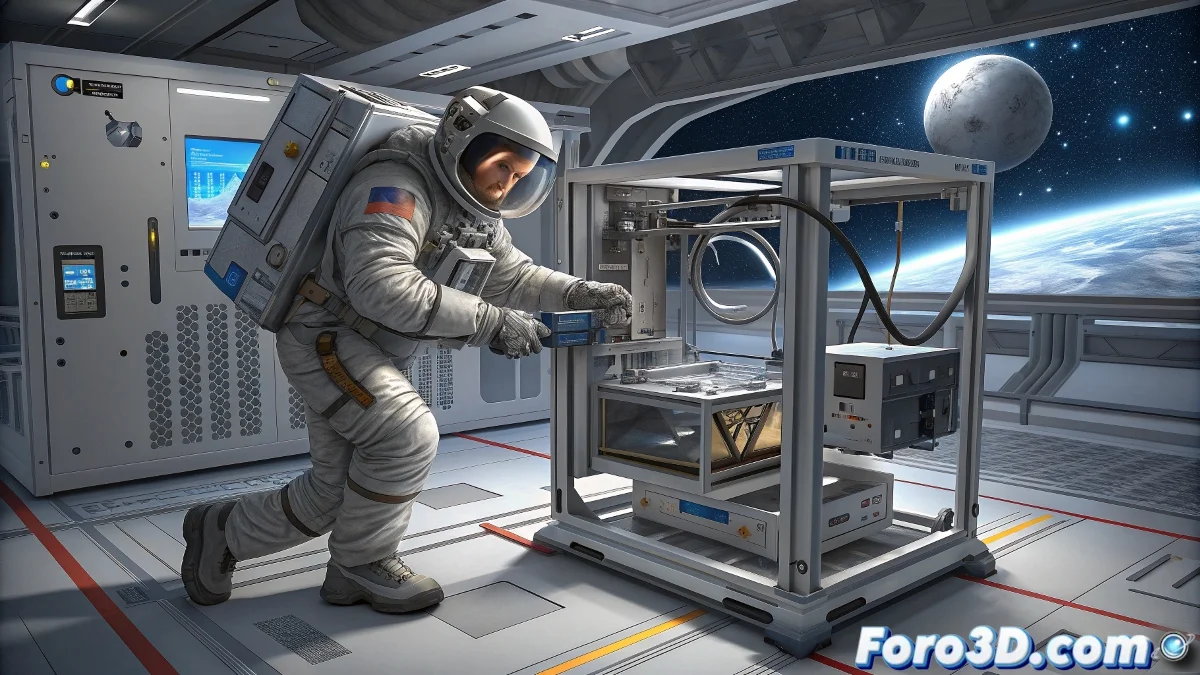
When Additive Manufacturing Conquers the Final Frontier
Europe is about to write a new chapter in the history of space exploration with a technological milestone that sounds like science fiction. The European Space Agency, in collaboration with Airbus, has sent the first metal 3D printer to the International Space Station. The Metal3D project represents a quantum leap in space manufacturing capabilities, fundamentally transforming how we approach maintenance, repairs, and autonomy in long-duration missions.
This innovation solves one of the biggest logistical challenges of space exploration: dependence on spare parts from Earth. Until now, every screw, every specialized tool, and every critical component had to be anticipated and sent from our planet. With Metal3D, astronauts will be able to manufacture on demand what they need, when they need it, drastically reducing waiting times and launch costs. 3D printing in space has just come of age. 🚀
In space, printing a metal part can be more valuable than bringing it from Earth
The Technical Challenges of Printing Metal in Microgravity
Metal 3D printing on the ISS requires overcoming obstacles that do not exist on Earth. Microgravity changes all the rules.
- Management of metal powder that behaves unpredictably and potentially dangerously in weightlessness
- Advanced thermal control without natural convection to dissipate the heat from the melting process
- Process stability ensuring adhesion between layers without gravity to aid compaction
- Safety in confined environments with breathable atmosphere and sensitive electronic equipment
Airbus's system uses an additive manufacturing technique that has been specifically adapted to operate safely in the unique environment of the space station, where every gram and every watt counts.
Applications That Will Transform Space Exploration
The ability to print metal in orbit has immediate and far-reaching implications for the future of human presence in space.
- Manufacturing of customized tools for specific scientific experiments
- Production of critical spare parts for life support systems and other essential equipment
- Creation of adapters and connectors for hardware from different space agencies
- Rapid prototyping of solutions for unforeseen problems during missions
For future missions to the Moon and Mars, this technology could mean the difference between success and failure when Earth is days or months away.
The Path to Autonomous Space Manufacturing
This milestone marks the beginning of a new era in space manufacturing. Metal3D is just the first step.
If the project proves its viability, we could see metal 3D printers become standard equipment on all next-generation spacecraft. The ability to manufacture en route would massively reduce the need to launch huge inventories of spare parts, making missions lighter, more economical, and more resilient. Europe thus positions itself as a leader in the next industrial revolution... which will take place off our planet. 🌌
And if printing in space works as well as they hope, soon astronauts will be able to boast of having manufactured the first Martian screw... although probably with more complicated assembly instructions than any Ikea furniture 😉