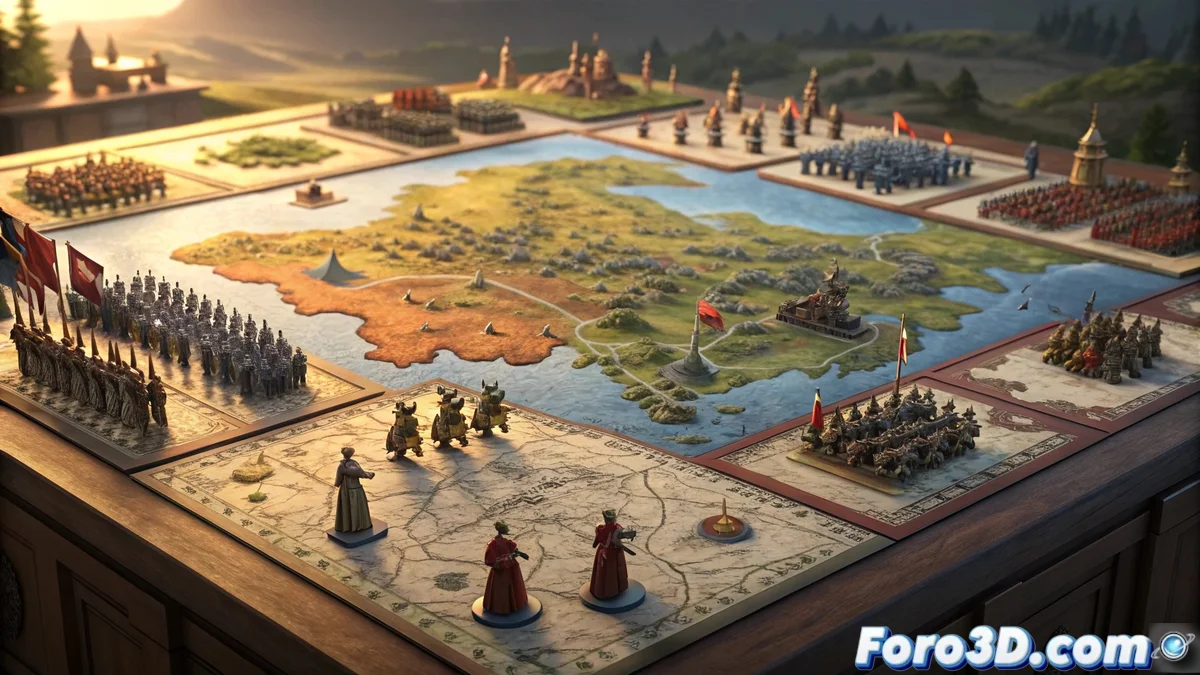
Europa Universalis V: Clausewitz Engine and 3D Development Tools
The Clausewitz Engine from Paradox Development Studio forms the technological foundation of Europa Universalis V, optimized through the Jomini Toolset to effectively handle complex strategy games with extensive maps and abundant historical data 🌍.
Specialized Graphics Technology
This engine stands out for visually representing detailed maps, military units, and geographical elements with an approach that prioritizes strategic clarity and immersion over photorealism. Players manage complex empires through intuitive interfaces that highlight crucial events and territorial changes immediately.
Main features of the engine:- Optimized rendering for extensive maps with multiple layers of information
- User interface designed to highlight territorial changes and important events
- Efficient management of large volumes of historical and geopolitical data
"The priority is strategic functionality: every graphical element must communicate information instantly" - Paradox Design Philosophy
Tools for 3D Content Creation
For tridimensional asset development, both the official team and the modding community use applications like Blender and Autodesk Maya, enhanced with the IO PDX Mesh plugin that streamlines the integration of units, structures, and terrain components into the Clausewitz engine 🛠️.
Workflow with 3D tools:- Modeling of units and buildings in Blender or Maya with optimized textures
- Simplified export via the IO PDX Mesh plugin for native compatibility
- Direct implementation in the engine without compromising overall game performance
Strategic Visual Philosophy
The game's visual approach focuses on providing clear and functional representations that facilitate tactical decision-making, avoiding distractions with hyperrealistic graphics. Visual elements, from maps to military units, are meticulously designed to convey information quickly and effectively, supporting gameplay rather than competing with it 🎯.
This approach ensures that players can maintain their focus on imperial management and historical evolution, without getting lost in superfluous visual details while facing unexpected rebellions or territorial expansion. The user experience benefits from this visual coherence that prioritizes strategic utility over aesthetic impact, creating an environment where every graphical element serves a specific function in the empire's narrative.