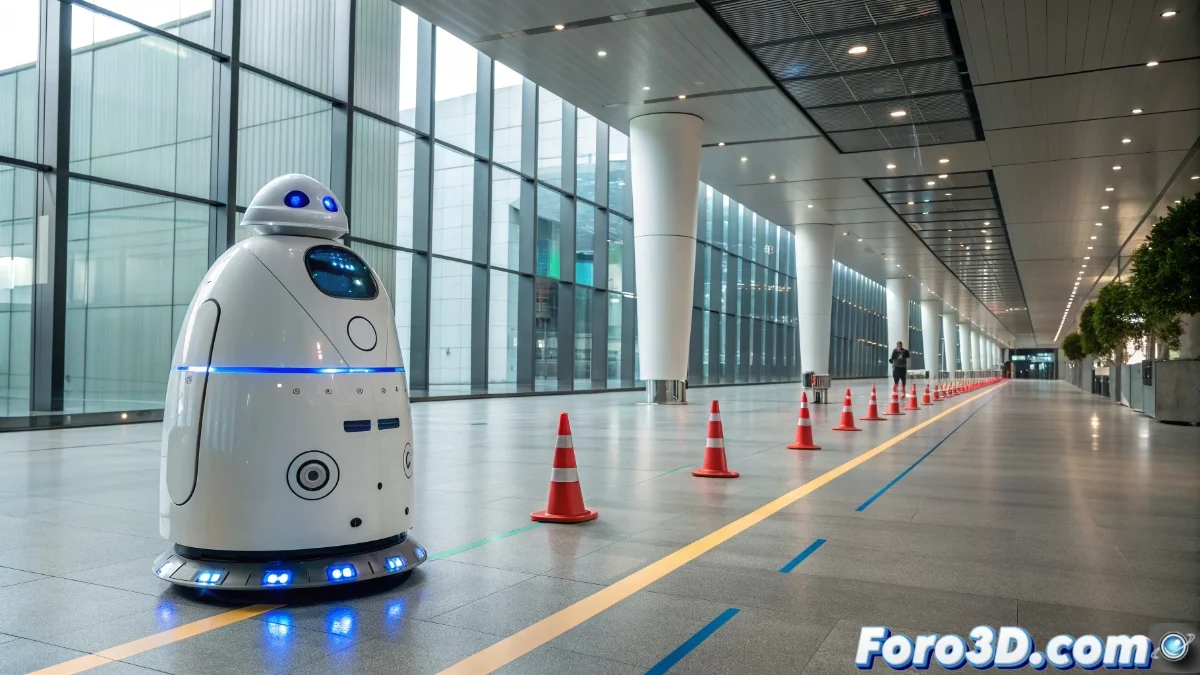
Embodied Bayesian Learning for Continuous Motion Control in Assistance Robots
The application of Bayesian learning systems together with embodied dynamics constitutes a significant advance in the design of assistance robots that operate in built environments. This approach fuses direct sensory perception with advanced probabilistic models, allowing machines to adapt their tracking behavior continuously and in real time, considering the uncertainties inherent in constantly changing architectural spaces. The synergy between these techniques favors smoother and more anticipatory navigation, crucial in assistance contexts where smoothness in movements and predictive capability are determining factors 🤖.
Foundations of the Bayesian Approach in Mobile Robotics
Bayesian learning applied to mobile robotics incorporates uncertainty as a central component in decision-making, allowing robots to constantly update their beliefs about the environment state through the assimilation of new sensory observations. Embodied dynamics leverage the direct physical interaction between the robot and its environment, facilitating the system to refine its internal models through motor experience. This combination of probabilistic reasoning and physical interaction generates a perception-action cycle that progressively optimizes the effectiveness of pursuit behavior, proving especially valuable in environments with unpredictable obstacles such as busy corridors or areas with variable furniture.
Key aspects of the integration:- Continuous updating of beliefs through sensory observations to reduce environmental uncertainty
- Refinement of internal models through direct motor experience and physical interaction
- Generation of a perception-action cycle that improves adaptability in dynamic spaces
The irony lies in the fact that, while we try to create robots that navigate perfectly in environments built for humans, these same spaces were designed without considering that one day they would have to accommodate machines with completely different movement patterns.
Applications in Continuous Tracking Control
For continuous tracking tasks in built environments, this method enables robots to maintain smooth trajectories while dynamically adjusting their speed and direction based on probabilistic predictions about the target's movements. The system constantly evaluates multiple hypotheses about future positions, assigning probabilities that guide control decisions without the need for stops or abrupt recalculations. This capability is particularly useful in assistance scenarios where robots must follow people with variable movements, avoiding collisions with fixed architectural elements and other users, while maintaining an appropriate safety distance and a natural displacement that does not intimidate humans.
Advantages in assistance environments:- Maintenance of fluid trajectories with dynamic adjustments based on probabilistic predictions
- Constant evaluation of hypotheses about future movements to guide decisions without interruptions
- Collision prevention and conservation of safe distances in spaces shared with humans
Final Reflections on Robotic Adaptation
The implementation of embodied Bayesian systems represents a crucial step toward robotic adaptability in environments built for humans. The underlying paradox is that human architecture, originally conceived without foreseeing coexistence with machines, has become the main challenge for mobile artificial intelligence. However, through the integration of sensory perception, probabilistic models, and embodied dynamics, assistance robots can overcome these barriers, offering continuous pursuit behavior that prioritizes safety, naturalness, and efficiency in everyday interactions 🏗️.