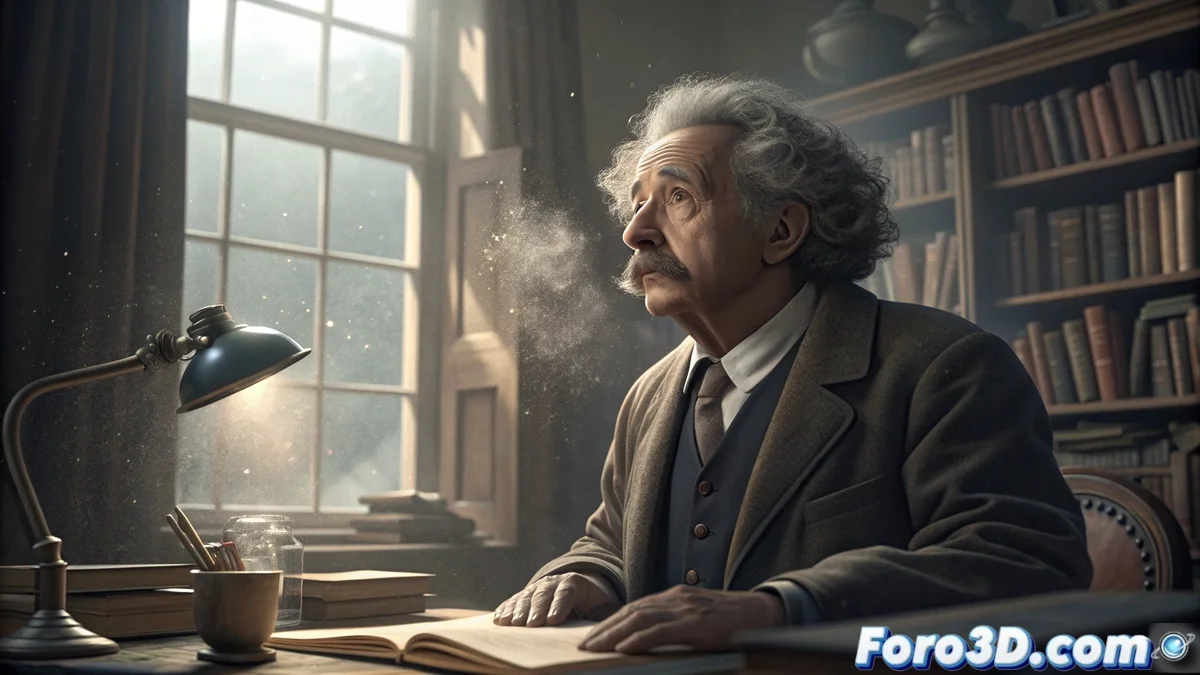
Digital Einstein: Historical Recreation with Artificial Intelligence at CloudFest 2025
The digital resurrection technology reaches new frontiers with the presentation of a fully interactive avatar of Albert Einstein during the CloudFest 2025 event. This innovation allows real-time conversations with the historical figure, recreating not only his physical appearance but also his documented scientific thinking through advanced artificial intelligence algorithms. 🤖✨
Revolution in Digital Historical Preservation
The project developed by CloudFest and 1SP Agency represents a paradigmatic shift in how we interact with historical figures. Using original archives of Einstein including manuscripts, voice recordings, and gestural records, the system can generate responses coherent with his documented thinking. The experience takes place in an exact replica of his Princeton office, creating an authentic spatial context that transports users directly to the space where the genius worked.
Innovative Technical Features:- Natural language processing system trained with 5,000 original Einstein documents
- Facial animation engine that replicates 47 characteristic expression points of the physicist
- Gestural database with 200 documented movements from his lectures and interviews
Pure mathematics is, in its way, the poetry of logical ideas - Albert Einstein
Houdini Technical Setup for Historical Recreation
Creating the avatar requires a meticulous workflow in Houdini, starting with the project setup to ensure historical accuracy and visual realism. The process involves multiple specialized stages that combine traditional techniques with advanced procedural innovations. 🎨🔄
Detailed Step-by-Step Instructions for Houdini:- Step 1 - Initial Project Setup: Create new project with metric units (centimeters), set frame rate to 24 fps and resolution to 3840x2160. In viewport preferences, enable "High Quality Viewport" and set subdivision level to 2 for real-time visualization.
- Step 2 - Import of Historical References: Use the File COP node to import reference photographs of Einstein and his office. Set up reference planes in X, Y, Z viewports with 30% opacity. Organize images in the node network using Null nodes labeled "REF_EINSTEIN_FRONT", "REF_OFFICE_45DEG".
- Step 3 - Facial Modeling with Digital Sculpting: Start with a base sphere in SOP context, apply Catmull-Clark subdivision with 3 levels. Use the Clay Build Up tool with strength 0.4 and radius 15px to sculpt the characteristic bone structure. For the nose, use Grab tool with strength 0.6, creating the distinctive shape through controlled displacements.
- Step 4 - Procedural Hair System: Create guide curves using the Line node with 12 subdivisions. Apply the hair system via the Hair Generate node, setting density to 8000, length variation 0.3. Use VEX expression in the Point Wrangle node: @pscale = fit(rand(@ptnum), 0, 1, 0.8, 1.2); for natural variation.
- Step 5 - PBR Materials Setup: Develop shaders in the Material context using Principled Shader. For skin: base color #E8B796, subsurface 0.8, roughness 0.3, specular 0.5. For hair: melanin 0.7, roughness 0.6, use procedural noise with frequency 25 to add natural grays.
- Step 6 - Historically Accurate Lighting: Implement HDRI with intensity 1.2 from the Environment Light node. Add 3 Area Lights: key light (intensity 2.5, temperature 4500K), fill light (intensity 1.2, 3200K), rim light (intensity 1.8, 5500K) to recreate historical desk lamp lighting.
- Step 7 - Atmospheric Effects and Rendering: Create light volume using the Pyro node with density 0.03, temperature 0.1. Set up render in Karma XPU with samples 512-1024, denoiser enabled. Separate render passes: beauty, lighting, shadow, volumetric for post-production control.
Cultural Impact and Future Projection
This project establishes new ethical standards for the digital recreation of historical personalities, generating important debates about historical authenticity and responsibility in the use of artificial intelligence. The viralization of the content demonstrates the educational potential of these technologies to make intellectual legacies accessible to new generations. 🌍📚
Future Applications and Developments:- Interactive educational platforms with multiple historical figures
- Virtual museums with temporal immersion experiences
- Linguistic and cultural preservation tools for endangered languages
Technical Legacy and Ethical Considerations
The digital recreation of Einstein represents a technological milestone that transcends the entertainment realm to become a tool for cultural preservation. The balance between historical accuracy and technological innovation sets important precedents for future similar projects, opening new possibilities to keep the dialogue alive with history's brightest minds. The true success lies not only in visual fidelity, but in the ability to capture and transmit the intellectual essence that defines the legacy of these historical figures. 💡🕰️