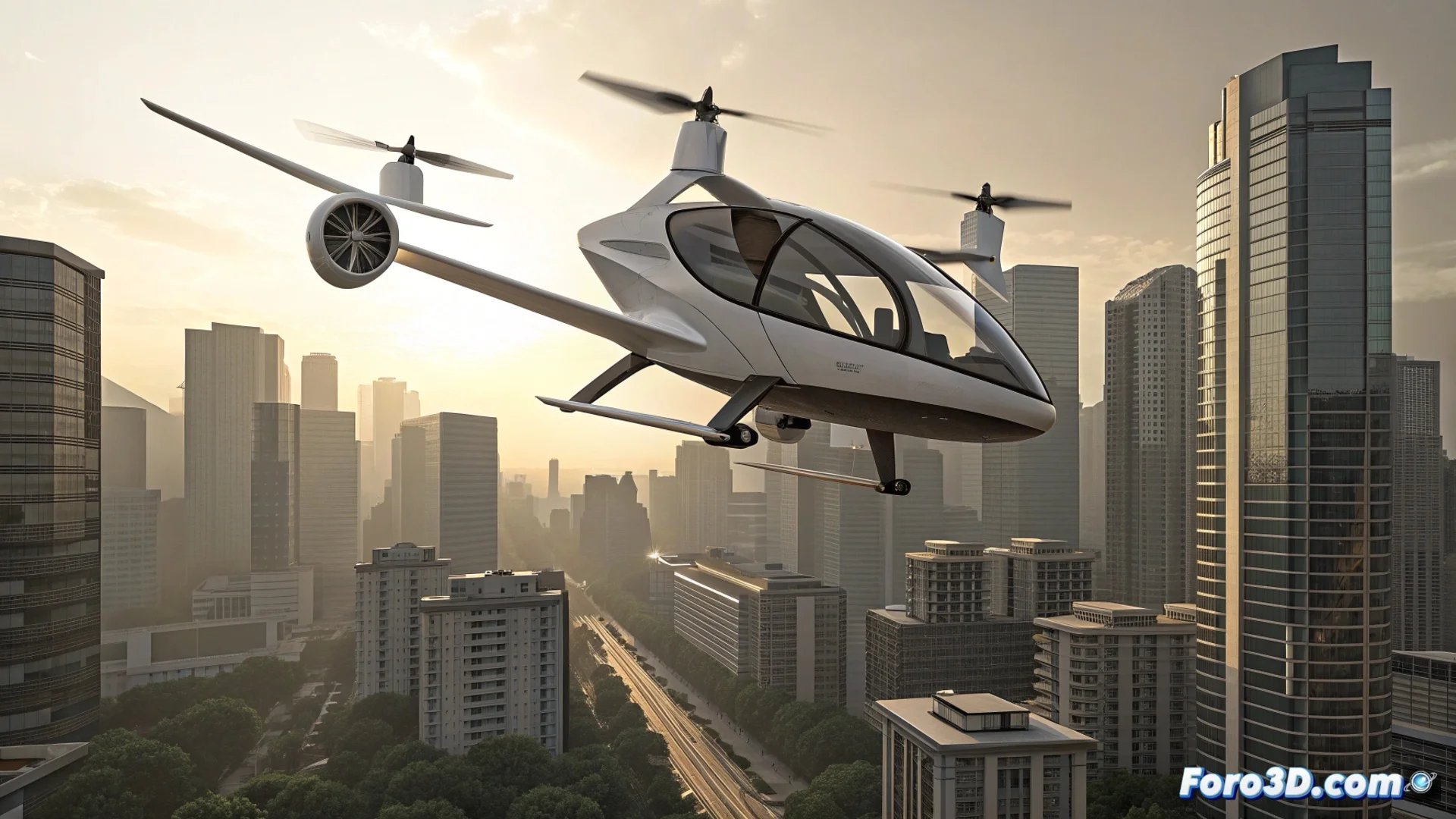
Ehang Presents Its New VT-35 Aerial Vehicle in Hefei
The Chinese company Ehang has showcased to the world the capabilities of its latest development in air mobility. At a public event in the city of Hefei, the VT-35 vehicle completed its first demonstration flight, marking a step forward in urban electric transportation. This aircraft represents a significant evolution compared to previous models like the EH216. ✈️
A Design That Evolves to Fly Farther
The VT-35's configuration introduces fundamental changes to optimize its performance. It incorporates two fixed rigid wings and a rear pusher propeller. This combination allows the vehicle to generate lift during cruise flight, which relieves the workload of the main rotors and reduces energy consumption. The main objective is to extend its operational range, a decisive factor for integrating these vehicles into cities.
Key features of the new design:- Fixed wings: Provide aerodynamic lift in horizontal flight, making flight more efficient.
- Rear propeller: Pushes the aircraft forward, optimizing propulsion and saving energy.
- Vertical Takeoff and Landing (VTOL): Retains the ability to operate without runways, using small spaces like rooftops.
This public flight in Hefei serves to demonstrate the technology in a real environment, a further step toward the possible implementation of commercial urban air mobility services.
Focused on Solving City Mobility
The purpose of the VT-35 is clearly defined: to operate as a transportation system within metropolitan areas. Its profile is designed to move between districts or connect main transportation hubs, such as airports or train stations. The necessary infrastructure is simplified to the maximum, as it can use building rooftops as operating bases.
Advantages for the urban environment:- Vertical integration: Uses airspace and rooftops, without competing for ground space.
- Improved autonomy: The new design allows covering greater distances within the city.
- Autonomous operation: It is designed to fly without a pilot, which could streamline transportation services.
The Future of Transportation Takes Off
The demonstration in Hefei is not just a technological spectacle, but a validation in real conditions. It shows the path toward a model of urban air mobility that could be implemented commercially. Although it poses the future challenge of managing air traffic in cities, it promises an alternative for traveling quickly and directly over congested ground traffic. Traffic jams, perhaps, will soon have a new vertical dimension. 🚁