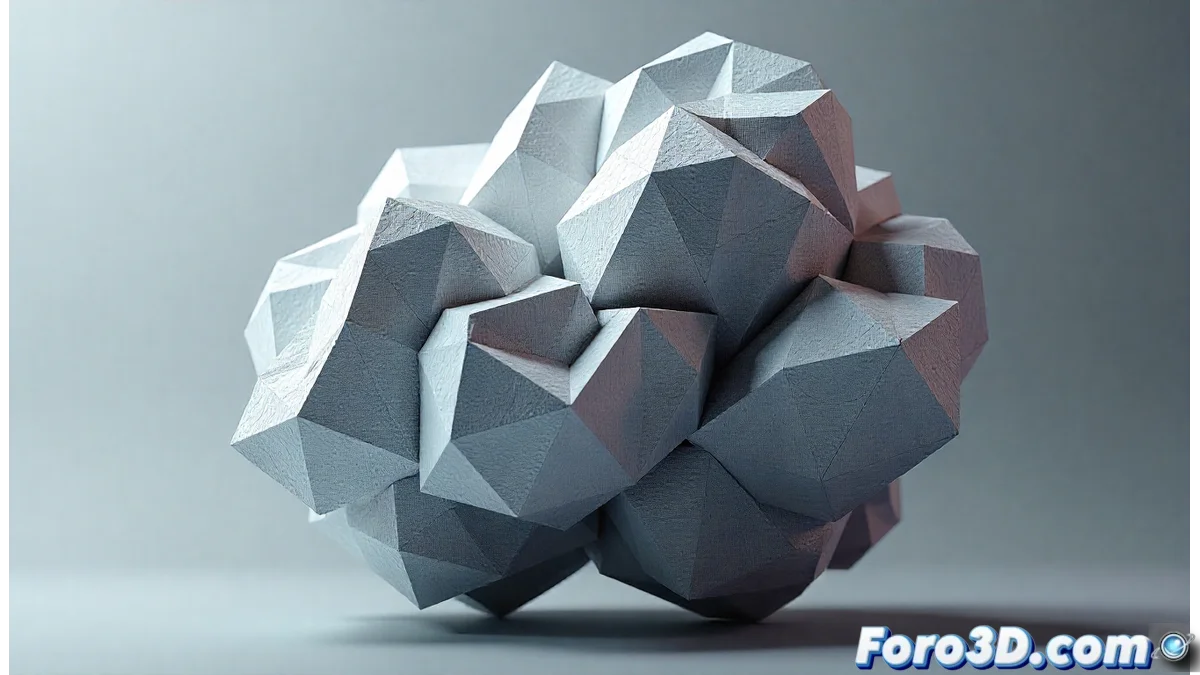
Edge Creasing: Control Edges in SubD Modeling
In 3D modeling with subdivisions, adjusting how edges behave is fundamental. The edge creasing or edge weighting technique gives the artist direct control over how defined or rounded the edges remain after applying the algorithm. This eliminates the need to add unnecessary edge loops, optimizing the topology and speeding up the creative process. 🛠️
Edge Weighting Mechanics
The system processes the values assigned to each edge during the subdivision calculation. A value of zero produces a completely smooth edge that rounds according to rules like Catmull-Clark. Conversely, a higher value, which can reach five or more depending on the software, forces the edge to maintain its original position, creating a sharp edge. Internally, the algorithm adjusts the positions of the new vertices it generates, bringing them closer to the edge with greater weight.
Value Scale and Its Effect:- Value 0: Smooth edge. It fully integrates into the rounded surface.
- Value 1 to 3: Medium transition. The edge maintains some definition but with smoothing.
- Value 4 or higher: Hard edge. The edge remains almost intact, mimicking a geometric cut.
Edge creasing is a non-destructive tool that allows iterating on the level of detail without altering the base mesh.
Practical Advantages in the Workflow
Using this technique speeds up creating complex shapes that blend organic surfaces with sharp edges, such as in vehicle design, hardware, or furniture. It allows testing different levels of definition dynamically without compromising the initial topology. This facilitates experimenting with the final look before deciding to freeze the subdivision or add definitive support cuts.
Key Benefits of Implementing Edge Creasing:- Lighter Meshes: Avoids saturating the model with support geometry, only where strictly necessary.
- Fast Iteration: Adjusting a numerical value is faster than remodeling or adding cuts.
- Non-Destructive Control: Values usually live in a modifier stack, allowing changes at any time.
Final Considerations and Balance
A modeler can fine-tune creasing values to achieve a perfect profile in the 3D view, but when rendering under specific lighting, the edge may appear softer. Finding the optimal point between a light mesh and the desired visual result is an iterative process. Mastering this technique is essential for any artist seeking efficiency and precision in subdivision modeling. ⚖️