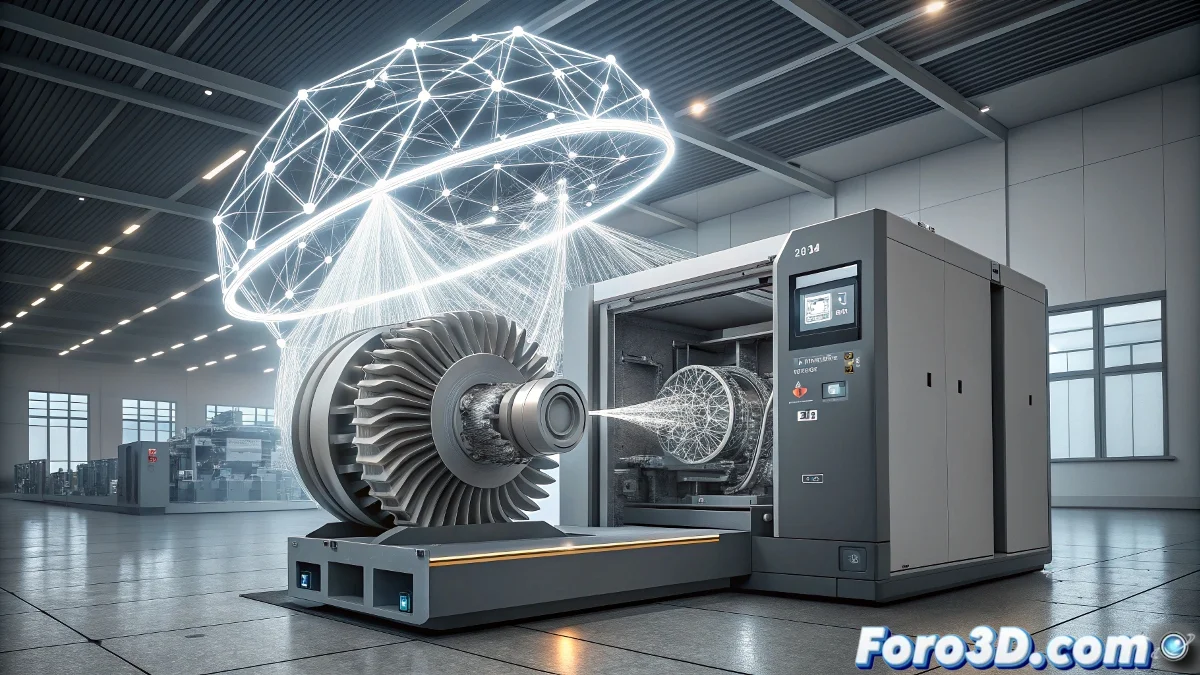
When Software and Hardware Unite to Print the Future
A significant step in industrial additive manufacturing has just taken place: Dyndrite has announced the integration of its powerful computational geometry engine with Additive Industries' MetalFAB platform. This collaboration is designed to drastically optimize workflows in large-scale metal 3D printing, offering users unprecedented levels of automation, control, and flexibility in print path design. It is a qualitative leap toward the factory of the future. 🏭
Intelligent Automation for Complex Processes
The heart of this integration lies in advanced automation. Tasks that traditionally required considerable manual intervention and expertise, such as optimized support generation, intelligent part orientation in the print chamber, and segmentation of complex trajectories, can now be performed faster and more accurately. This translates into a critical reduction in preparation times and greater repeatability, key factors for industries like aerospace and medical.
Tangible Benefits for Serial Production
MetalFAB was already recognized for its modular and scalable approach. With Dyndrite's power, the platform becomes even more robust. Direct benefits for manufacturers include:
- Higher Production Volume: Ability to handle more parts with less human supervision.
- Improved Traceability: More detailed control over every step of the process.
- Error Reduction: Minimization of failures caused by manual intervention.
- Mass Customization: Facilitates efficient production of small, highly customized batches.
It's a winning combo for advanced manufacturing. ⚙️
This move reinforces the industry's trend toward open and modular software environments, where different providers combine their strengths.
A Strategic Collaboration with a Forward-Looking Vision
Beyond the technical benefits, this alliance symbolizes a crucial industry trend: synergy between specialists. Dyndrite brings its expertise in algorithms and high-performance geometric processing, while Additive Industries contributes its proven and reliable industrial hardware. Together, they create a more competitive ecosystem prepared for the challenges of Industry 4.0, where interoperability is fundamental. 🤝
In the end, this integration brings additive manufacturing closer to its ultimate promise of efficiency. And of course, with such a high level of automation, soon the machines won't just print parts, but also the excuses for delaying deliveries. 😉