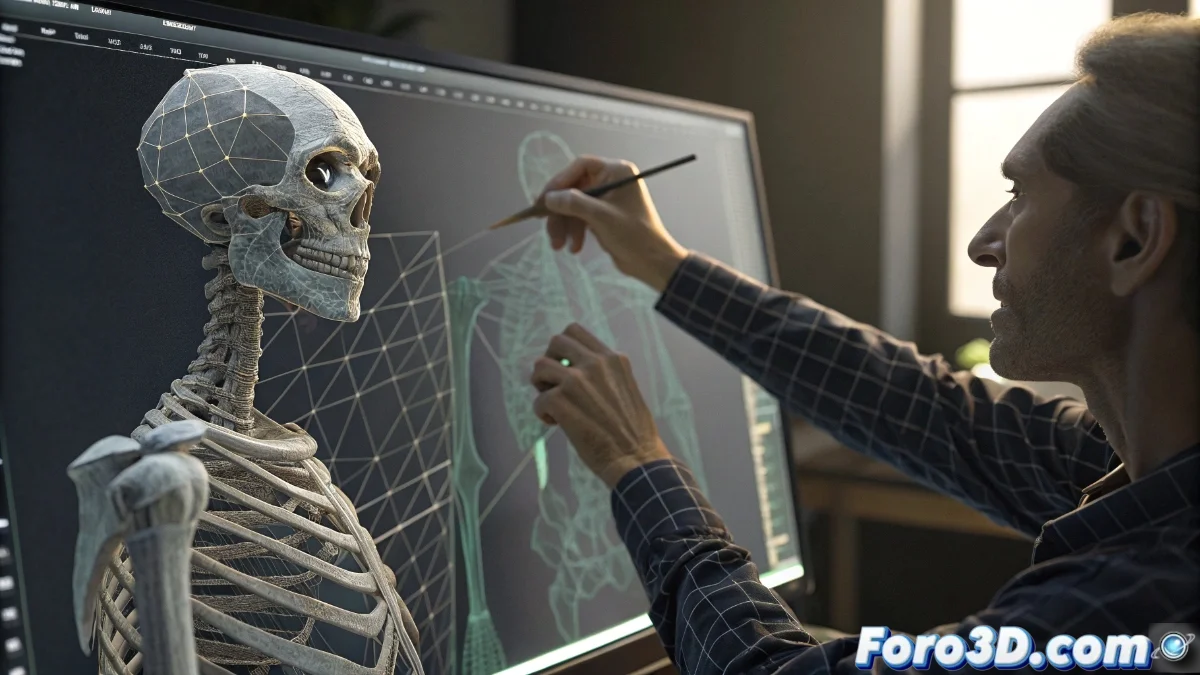
Dust3D: Open-Source Skeleton-Based 3D Modeling
In the current landscape of three-dimensional design, Dust3D emerges as an innovative solution that revolutionizes the traditional approach through its skeletal construction system. This open-source platform allows creating complete 3D models starting from simple interconnected nodal structures, automatically generating production-ready geometries 🎯.
Fundamental Software Features
Dust3D's minimalist interface is one of its greatest attractions, drastically reducing the learning time compared to conventional 3D applications. The program incorporates automated tools for UV mapping, normal calculation, and export to standard formats like OBJ, FBX, and GLTF, facilitating integration into professional pipelines.
Highlighted Features:- Nodal skeleton system that automatically generates meshes with smoothed surfaces
- Non-destructive workflow allowing real-time adjustments throughout the creative process
- Accelerated prototyping capabilities ideal for character design and game assets
The magic of Dust3D lies in transforming simple structures into complex 3D models through automatic procedural generation
Practical Applications and Competitive Advantages
This tool demonstrates special effectiveness in creating organic shapes where development speed is crucial. Independent artists, small studios, and educators find in Dust3D an accessible alternative that does not require advanced knowledge of topology or digital sculpting to achieve professional results.
Main Use Cases:- Indie game development with direct integration to Unity and Unreal Engine
- Teaching 3D concepts without the complexity of traditional professional software
- Rapid creation of visual prototypes for presentations and pre-production
Considerations on Its Implementation
Although it greatly simplifies 3D modeling, some users report that complex structures can become intricate to handle, similar to the difficulty of organizing tangled cables. However, its open-source nature allows continuous improvements through community contributions, ensuring constant evolution and adaptation to emerging needs in the three-dimensional design sector 🚀.