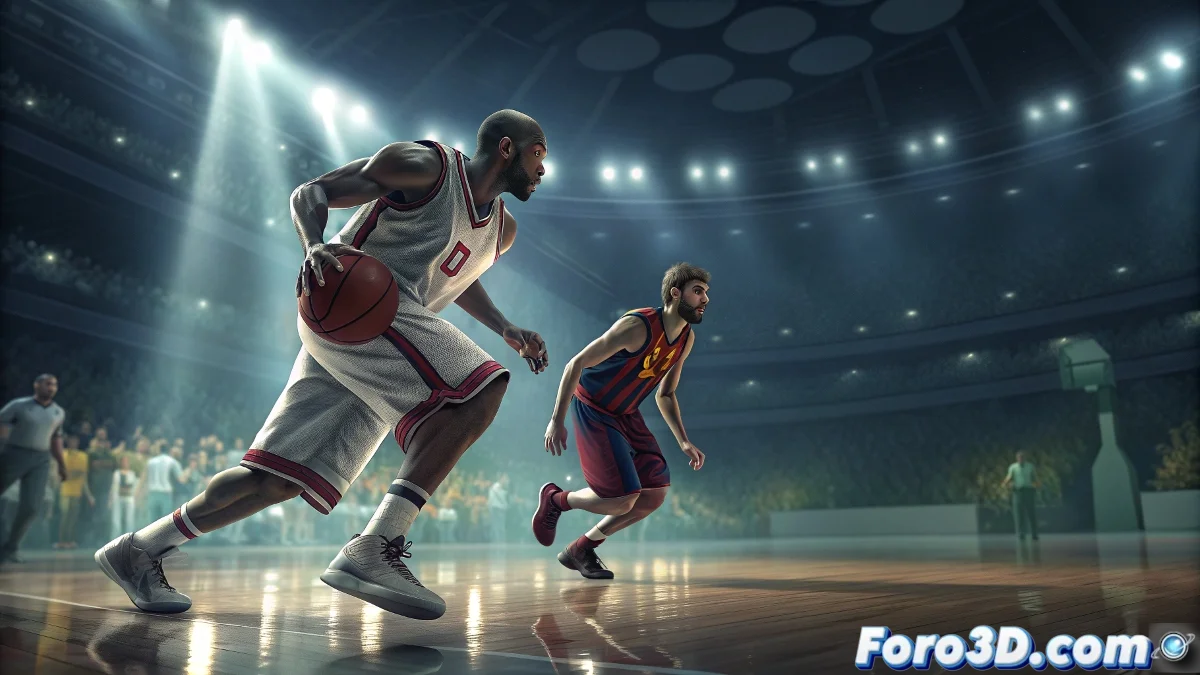
Dubai vs Barcelona: Bringing Elite Basketball to Blender
The matchup between Dubai Basketball and FC Barcelona in the EuroLeague is not just a basketball game; it's a high-level sports spectacle that represents the perfect challenge for any 3D artist. Recreating this scene in Blender involves mastering everything from precise court modeling to athletic movement animation and creating emotion-charged atmospheres. Where sports meets digital art. 🏀
Reference Analysis: Understanding the Real Scene
Before opening Blender, it's crucial to study real references. A EuroLeague game is characterized by its dramatic lighting, perfect court lines, high-visibility uniforms, and the energy of a full stadium. Photographs and videos of Dubai Basketball Club and Barça will provide the necessary information on corporate colors, court design, and even the players' characteristic gestures. This prior research is the foundation of a credible result.
Key Elements to Research:- EuroLeague court design and markings
- Dubai Basketball Club uniform (colors and sponsors)
- FC Barcelona uniform (classic blaugrana)
- Typical camera angles in sports broadcasts
- Crowd behavior at sports events
Court Modeling: Millimetric Precision
The basketball court follows strict official dimensions (28x15 meters). In Blender, we can create this using subdivided planes and precision tools. The court lines, center circle, and three-point areas can be made with Bevel and Shrinkwrap modifiers to keep the geometry clean. Don't forget details like the EuroLeague logo in the center and the painted sponsor areas, which add immediate realism.
In sports animation, as in real basketball, details make the difference between amateur and professional.
Player Creation and Animation
For the players, we can start with base humans from MakeHuman and refine them in Blender. The key is in the athletic anatomy: broad shoulders, muscular legs, and above-average height. Animation requires studying real motion captures: the jump shot, between-the-legs dribble, crouched defense, and rebound jump. The rigging system must be robust enough to handle explosive movements and sudden direction changes.
Sports Animation Techniques:- Use of the Graph Editor to smooth movements
- Clothing and accessory animation with cloth simulations
- Facial expressions of effort and concentration
- Realistic ball physics (spin, parabola, bounce)
- Player interactions (collisions and reactions)
Crowd Simulation and Atmosphere
An empty stadium will never feel real. To fill the stands, we can use particle systems with instancing or the powerful Crowd add-on. The magic is in creating variation: different fan models with clothing variations, gestures, and simple animations (cheering, shouting, clapping). Stadium lighting with volumetric light points creates those characteristic light cones that highlight the court, while the stands remain in relative shadow.
Post-Production: The Live Emotion
Blender's compositor is where the scene comes to life on TV. Adding slight camera shake simulates live excitement, a cinematic grain touch, and color adjustments to increase contrast between uniforms. Elements like a score overlay (which we can create directly in the compositor or add in post-production) seal the illusion of watching a real game.
Recreating Dubai vs Barcelona in Blender is more than a technical exercise; it's a masterclass in visual storytelling, capturing not only the shapes and movements, but the competitive intensity and passion that define the EuroLeague. The final result should make anyone who sees it feel the same urge to cheer a three-pointer as in a real game. And who knows, maybe this is your winning shot to enter the world of professional sports visualization. 🏆