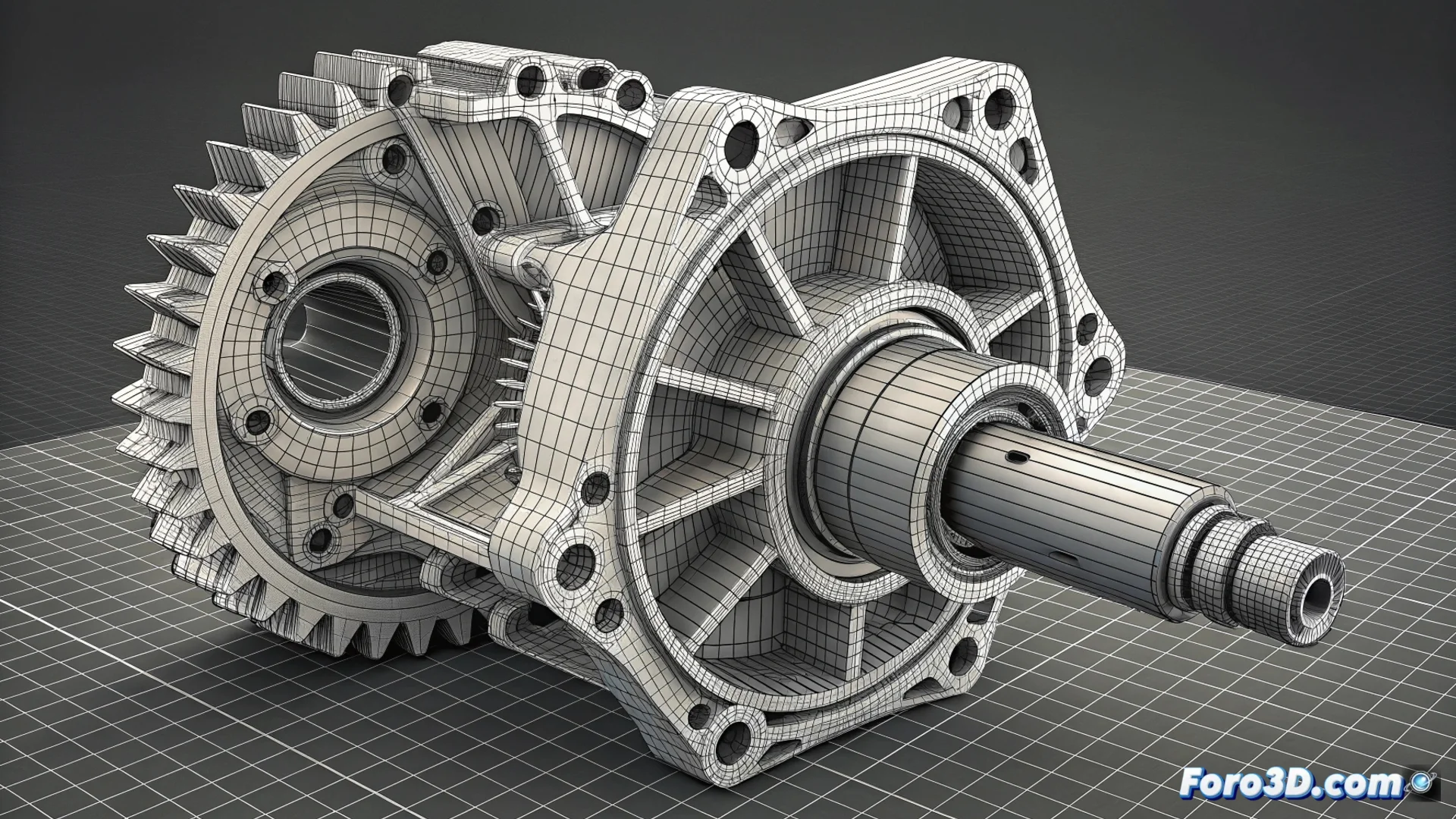
Dual Contouring: Generating Meshes from Signed Distance Fields
In the field of computer graphics, extracting a mesh from a signed distance field (SDF) is a fundamental task. The Dual Contouring algorithm presents itself as a direct evolution of the classic Marching Cubes, standing out for its method of placing the vertices of the final geometry. Instead of positioning them on the edges of the grid, this system calculates an optimal point within each cubic cell, allowing for a more faithful representation of the angular features typical of CAD models. 🧊
A Strategic Vertex per Cubic Cell
The core of the algorithm lies in how it processes each cell of the voxel grid that contains the implicit surface. For each one, it identifies the points where the surface defined by the SDF crosses its edges. Then, it evaluates the distance field normals at those intersection points. The goal is not to interpolate, but to solve a system of equations that minimizes the quadratic error, placing a single vertex inside the cell in the position that best fits all the inferred tangent planes. Finally, these vertices from adjacent cells are connected to form the polygons of the output mesh.
The algorithm's workflow:- Evaluate the cell: Each grid cell is analyzed to detect surface intersections with its edges.
- Process the normals: The SDF normals are obtained at each crossing point, defining local tangent planes.
- Calculate the optimal vertex: A minimization problem is solved to place a vertex inside the cell that fits those planes.
- Connect the topology: Vertices from contiguous cells are joined to create quadrilaterals or triangles, forming the continuous mesh.
Of course, because sometimes a cube should look like a cube, not a potato smoothed by a timid algorithm.
Ideal for Capturing Geometry with Defined Edges
This methodology shines when the implicit surface has hard features: flat regions, straight edges, or well-defined corners. While Marching Cubes tends to smooth these details, Dual Contouring is designed to preserve them. For this reason, its use is common in contexts where geometric precision is critical.
Key application areas:- Reverse engineering: Extracting precise meshes from scanned volumetric data.
- Procedural modeling: Visualizing algorithmically generated shapes with angular structures.
- Scientific visualization: Representing complex data with well-defined boundaries.
Trade-off Between Computational Cost and Quality
Although the computational cost of Dual Contouring is higher compared to simpler methods, the improvement in mesh quality justifies its use in specific applications. The result is a representation that respects the original geometric intent of the distance field, making edges look sharp and corners pronounced, essential for working with technical or industrial origin surfaces. 🛠️