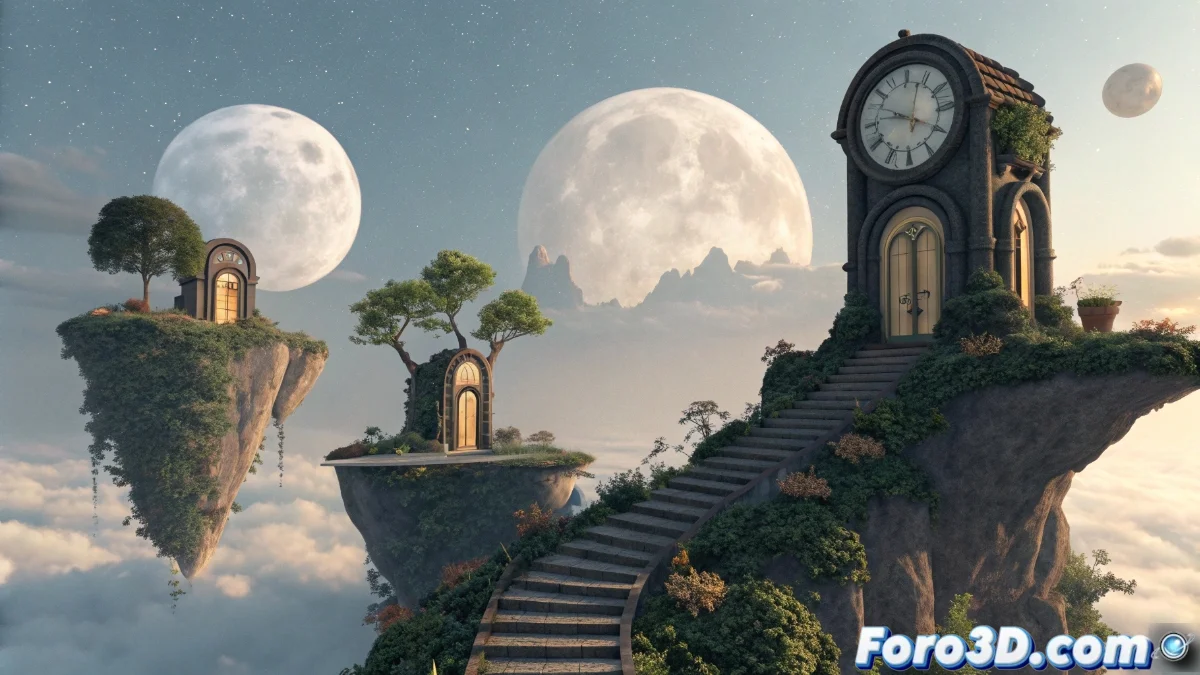
Dreamlike Visualization in Digital Environments
Dreamlike visualization focuses on developing digital environments that emulate the illogical and fluid nature of dreams. Through advanced rendering techniques and procedural algorithms, spaces with impossible scales and transitions that defy physical reality are constructed. These systems foster free association of ideas, allowing elements to transform or merge spontaneously, mimicking the functioning of the subconscious during sleep 🌌.
Implementation Techniques in Graphics Engines
To achieve these effects, developers integrate custom shaders and real-time compute systems that dynamically manipulate vertices and textures. Surreal transitions are achieved with non-linear interpolations and dynamic masks that blend disparate scenarios. Managing impossible scales requires meticulous control of coordinate systems and virtual cameras, frequently using multipass rendering to preserve visual fluidity without sacrificing dreamlike details.
Key Components in Implementation:- Shaders and compute shaders for spatial distortions and morphing between objects
- Non-linear interpolations and dynamic masks for surreal transitions
- Coordinate systems and virtual cameras to handle impossible scales
Dreamlike visualization represents a bridge between graphics technology and artistic expression, challenging the limits of traditional physical coherence.
Practical Applications and Technical Challenges
These dreamlike visualizations find use in immersive virtual reality experiences, interactive digital art, and previsualization of creative concepts for film and video games. The main challenges include performance optimization when managing complex geometries and real-time transformations, as well as maintaining an coherent aesthetic despite the chaotic nature of the content. Successful implementation depends on the balance between controlled randomness and artistic direction, often employing machine learning to generate unpredictable but visually appealing variations.
Main Challenges:- Performance optimization with complex geometries and real-time transformations
- Achieving aesthetic coherence in chaotic and surreal environments
- Integration of machine learning for unpredictable but aesthetic variations
Final Reflections
Dreamlike visualization not only expands the boundaries of digital creativity, but also poses interesting technical challenges in advanced rendering and resource management. As a curious note, if your dream includes a pink elephant playing saxophone over an ocean of melting clocks, you might want to review your dinner before blaming the software 🎷⏰.