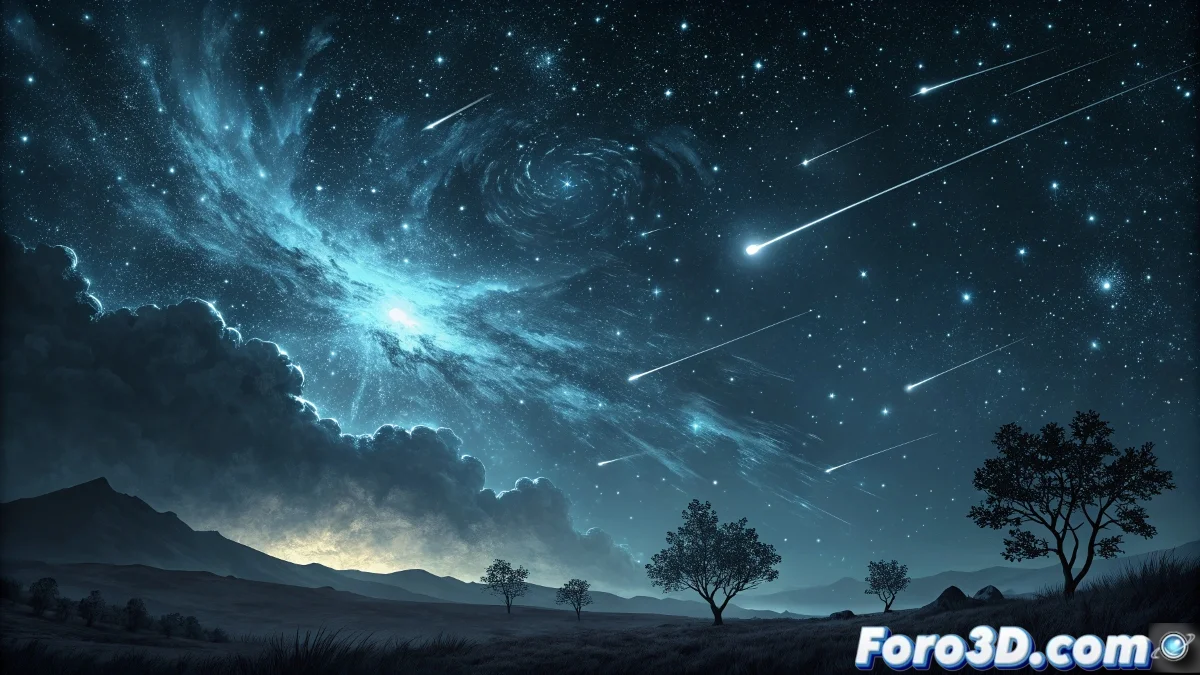
Draconids: The Invisible Spectacle Revealed by Radars
On the night of October 8, while most casual observers saw an apparently calm sky, meteorological radars captured one of the year's most intense astronomical events: the Draconids, a meteor shower that this year exceeded all expectations with up to 10,000 meteors per hour. The particularity of this event was that, although massive, it went mostly unnoticed visually due to the low luminosity of the meteors, making radar technology the true protagonist of the observation. This fascinating phenomenon—where science reveals what eyes cannot see—offers a perfect opportunity to explore Blender's capabilities in astronomical visualization. 🌠
The Science Behind the Invisible Spectacle
The Draconids are notably slow meteors (20 km/s compared to 60 km/s of the Perseids) and typically visually faint, but this year Earth passed through a particularly dense region of debris from comet 21P/Giacobini-Zinner. The extraordinary part was that, while the human eye could only capture the brightest meteors, radar systems detected the true magnitude of the event. These systems work by emitting radio waves that bounce off the ionization trails left by meteors as they vaporize in the atmosphere, revealing activity that would otherwise remain hidden. 📡
Unique Characteristics of the 2025 Draconids:- zenithal hourly rate: up to 10,000 meteors per hour
- entry velocity: 20 km/s (slow meteors)
- origin: comet 21P/Giacobini-Zinner
- radiant: Draco constellation (Dragon)
- main detection: radar systems
Particle System for Thousands of Meteors
In Blender, we recreated this massive shower using the advanced particle system. We set up a spherical emitter representing the comet's debris cloud, with particles directed toward a focal point (Earth). The key is adjusting the velocity and direction to simulate the slow meteors characteristic of the Draconids. We used Physics Properties to define trajectories that converge from the Draco constellation, creating that "radiant" effect that defines meteor showers. To handle thousands of simultaneous meteors, we employed instancing and levels of detail (LOD) that optimize performance. 💫
Radars showed us that sometimes the most spectacular astronomical events are the ones we cannot see directly
Materials and Shaders: The Magic of Faint Meteors
The visual particularity of the Draconids—their low luminosity—requires a creative approach in Blender. We developed custom shaders in the Node Editor that simulate faint meteors. We combined an Emission Shader with a Noise Texture to create that characteristic irregular glow, and added a Color Ramp with bluish and greenish tones typical of low-magnitude meteors. For the trails, we used Volumetric Materials that create that atmospheric ionization effect that persists briefly after the meteor's passage. Subtle lighting is crucial to convey that these are events that are almost visible to the naked eye. ✨ Material Techniques for Meteors:
- emission shaders controlled by noise texture
- volumetric materials for ionization trails
- luminosity intensity animation to simulate flickering
- subtle lens flare effects for bright meteors
Representation of the Radar Detection System
The most innovative part of the visualization is showing how radars reveal the invisible. In Blender, we created a abstract representation of radar operation: spherical radio waves expanding that, upon intersecting with meteor trails, generate return points. We used the Geometry Nodes system to create a visualization where each radar detection is represented as a bright point that appears momentarily. This visualization layer overlays the starry sky, showing how technology completes our perception of astronomical reality. 📊
Composition and Terrestrial Atmosphere
To contextualize the event, we created a realistic atmospheric environment in Blender. We used a World Shader with high-resolution HDRI star map, positioned to correctly show the Draco constellation. We added a subtle Volumetric Scatter that simulates Earth's atmosphere and how it affects the visibility of faint meteors. The composition includes terrestrial elements—radar antennas, horizon—that anchor the scene in reality and provide scale. The final render combines all these layers to tell a complete story: what we see, what we don't see, and what technology allows us to discover. 🌍
Composition Elements:- starry sky with precise constellations
- particle system for meteor shower
- radar effects overlaid as visualization layer
- terrestrial elements for scale and context
- volumetric atmosphere for realism
Representing the Draconids in Blender is much more than creating an astronomically accurate animation; it is exploring the boundary between the visible and the detectable. By combining particle systems, advanced shaders, and abstract representations of technology, we not only recreate a celestial event, but visualize the power of science to expand our senses. Each faint meteor, each radar wave, each ionization trail, contributes to telling a story about how our understanding of the universe depends less and less on what we can see directly and more on what we can measure indirectly. And in that story, we find a powerful metaphor about scientific progress itself. 🔭