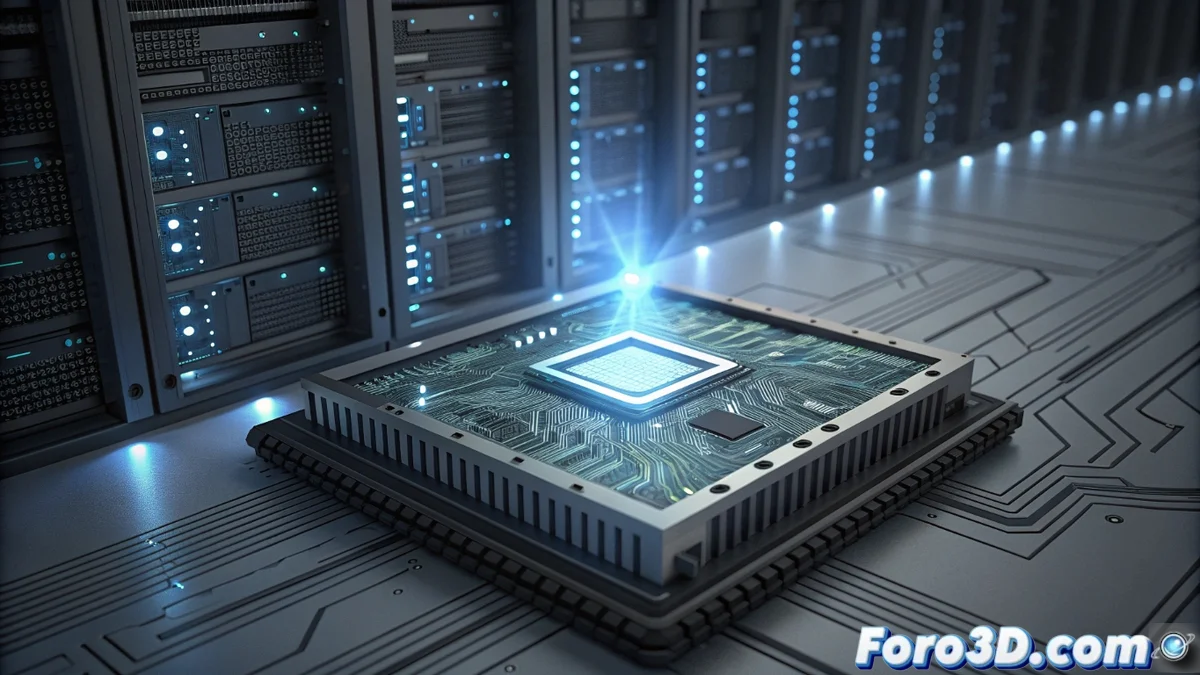
DPU and SmartNIC: Key Accelerators for Modern Servers
In the architecture of data centers and high-performance servers, the pursuit of extreme efficiency is a constant. Beyond general-purpose CPUs, specialized components such as DPU (Data Processing Units) and SmartNIC (Smart Network Interface Cards) emerge. Far from being passive peripherals, they are silicon accelerators that integrate into the server to take on specific workloads, freeing the main CPU to focus on application logic. This paradigm not only maximizes performance but also redefines energy efficiency and computational density. 🚀
SmartNIC or DPU? Unraveling the Key Differences
Although the terms are sometimes used interchangeably, they mark a clear technological evolution. A traditional SmartNIC specializes in accelerating networking functions, such as Network Functions Virtualization (NFV), traffic encryption, or offloading protocols like TCP/IP. Its main goal is to relieve the CPU of these tasks. A DPU, on the other hand, represents a qualitative leap: it is a system-on-a-card that incorporates powerful multi-core processors (typically Arm), ultra-low-latency networking hardware, and dedicated accelerators for storage and security. It functions as an autonomous infrastructure node, capable of managing software-defined storage, orchestrating containers, or acting as a lightweight hypervisor.
Main Operational Distinctions:- Scope: The SmartNIC focuses on networking. The DPU extends its domain to networking, storage, security, and infrastructure management.
- Compute Power: A DPU includes programmable multi-core CPUs, while a SmartNIC may rely more on fixed logic (ASIC) or FPGA for specific functions.
- Autonomy: The DPU can run a full operating system and manage resources, transforming into the "brain" of the server's disaggregated infrastructure.
While your old NIC just moved packets, DPUs and SmartNICs process, protect, optimize, and intelligently redirect them without consuming precious cycles from the central CPU.
Practical Applications and the Infrastructure Horizon
The impact of these accelerators is transformative in scenarios like hybrid cloud, edge computing, and hyperconverged environments. By offloading heavy and routine tasks—such as firewalls, load balancing, compression, deduplication, or networked storage services—they enable main CPUs to deliver more predictable performance with lower latency for end applications. For businesses, this translates into the ability to run more workloads with the same physical hardware, reducing the carbon footprint, operational costs (OPEX), and data center complexity.
Highlighted Use Cases:- Virtualization and Containers: Offloading vSwitches (like Open vSwitch) and container networking management (Kubernetes).
- Software-Defined Storage (SDS): Running storage stacks like Ceph directly on the DPU, freeing host servers.
- Zero-Trust Security: Implementing microsegmentation policies, encryption, and deep packet inspection on the adapter itself.
- Edge Computing: Real-time data processing in remote locations with limited resources, where efficiency is critical.
Conclusion: Toward a Dynamic and Aware Infrastructure
The future of data centers points toward a fully disaggregated and composable infrastructure. In this ecosystem, the DPU emerges as the intelligent control center that dynamically and securely orchestrates compute, networking, and storage resources. It is not just about accelerating, but about redefining server architecture. Thus, while the main CPU can dedicate itself to high-value tasks, these specialized accelerators work in the background, ensuring the infrastructure is not only faster, but also more agile, efficient, and prepared for the demands of the data era. 🔄