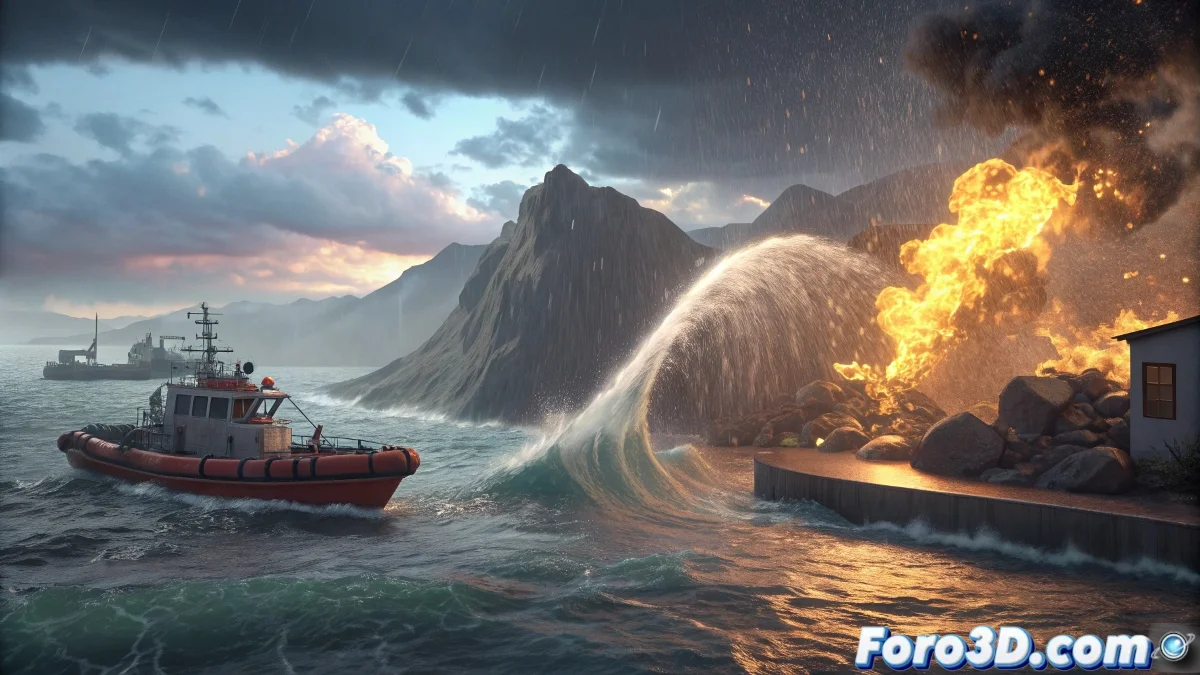
Dongji Rescue: VFX Breakdown by StaticVFX
The studio StaticVFX has released an impressive technical breakdown of their work on Dongji Rescue, revealing the complex orchestration of visual effects needed to create the intense winter rescue sequences of the production. This breakdown not only shows the final result but meticulously decomposes each layer of effects that transformed controlled environment footage into epic survival scenes under extreme conditions. The work demonstrates a perfect integration between practical elements and CGI, where water simulations, atmospheric effects, and digital environments combine to create an immersive and visually spectacular cinematic experience. ❄️
The practical base: Filming in controlled environments
The starting point for the visual effects of Dongji Rescue was footage shot in controlled environments and water tanks specially designed to simulate extreme winter conditions. The actors worked in front of green screens and on partial sets that would later be digitally extended. StaticVFX captured key practical elements such as real water splashes, interaction with practical snow, and physical performances that would serve as the fundamental reference for digital simulations. This practical base provided the essential authenticity that would then be amplified and enriched through advanced VFX techniques, maintaining the realism of the performances while exponentially expanding the visual scope.
Practical elements captured on set:- Real actor interaction with water and snow
- Reference water splashes and turbulence
- Authentic facial expressions and body language
- Practical lighting for integration reference
- Physical costume and prop elements
Water simulations: The central technical challenge
One of the most highlighted aspects of StaticVFX's breakdown is the complex water simulation in icy conditions. The team developed simulation systems that combined FLIP (Fluid Implicit Particle) methods for the base water behavior with secondary foam and bubble simulations. What was particularly challenging was recreating how water behaves at sub-zero temperatures, where it begins to form ice crystals and exhibits different viscosity. StaticVFX implemented custom force fields that altered the simulation to achieve that characteristic semi-frozen look of water in arctic environments, creating a perfect balance between fluid water and icy rigidity.
Semi-frozen water requires simulating two states of matter simultaneously: liquid and solid in constant transition.
Atmospheric effects and winter environment
Creating the believable winter environment was crucial for immersion. StaticVFX developed multiple layers of atmospheric effects that included falling snow, blizzards, breath vapor, and condensation. Each element was addressed with different techniques: snow used particle systems rendered as volumes, breath vapor was simulated as volumetric density affected by wind fields, and blizzards combined 2D particles with snow cards and atmospheric depth effects. The key was to vary the scale and density of these elements based on proximity to the camera, creating a three-dimensional sense of depth and scale in the environment.
Implemented atmospheric layers:- Foreground snow: 3D rendered particles
- Midground blizzard: particle systems with sprites
- Ambient snow: optimized 2D cards for distance
- Breath vapor: per-character volumetric simulations
- Surface condensation: custom shaders and moisture maps
Digital environments and set extensions
The practical sets were digitally extended to create the vast winter landscapes seen on screen. StaticVFX used a combination of matte paintings projected onto 3D geometry and fully computer-generated environments. Distant mountains were created using terrain generation techniques, while foreground elements incorporated 3D scans of real snow and ice textures. The integration between the actors filmed on green screen and these digital environments required careful lighting matching, where lighters digitally recreated the direction, intensity, and quality of arctic light to seamlessly unite all elements.
Integration and final compositing
The compositing phase was where all elements converged. StaticVFX used Nuke to integrate the over 100 layers of elements that made up each final shot. The process included depth integration for atmospheric effects, where snow and blizzards were rendered with depth passes to interact correctly with 3D geometry. Compositing artists applied atmospheric blur gradients to simulate natural depth of field, and meticulously adjusted contrast and saturation levels to match the cold, desaturated aesthetic of real winter environments. The attention to detail in this phase sealed the final illusion.
Nuke integration pipeline:- Merge of CG elements with filmed plates
- Application of depth-based atmospheric effects
- Color grading for color temperature matching
- Integration of 2.5D elements for atmospheric effects
- Grain matching and final texture adjustments
- Perspective correction and shadow integration
The technical legacy of the breakdown
StaticVFX's breakdown for Dongji Rescue not only shows the final result but educates on the meticulous process behind modern VFX. It reveals how contemporary studios tackle projects requiring multiple technical disciplines working in harmony. For aspiring visual effects artists, this type of breakdown is invaluable, showing not only the "what" but the "how" of creating immersive environments. It demonstrates that realism in VFX does not come from a single revolutionary technique, but from the careful integration of dozens of specialized elements, each contributing subtly but crucially to the final illusion.
StaticVFX's work on Dongji Rescue sets a new standard for representing extreme winter conditions in cinema. Through the combination of advanced simulations, environment extensions, and meticulous compositing, the studio has created an immersive world that fully transports the viewer to a hostile arctic environment. This technical breakdown not only celebrates the art of visual effects but serves as an educational testament to the incredible collaborative effort required to create contemporary cinematic magic.