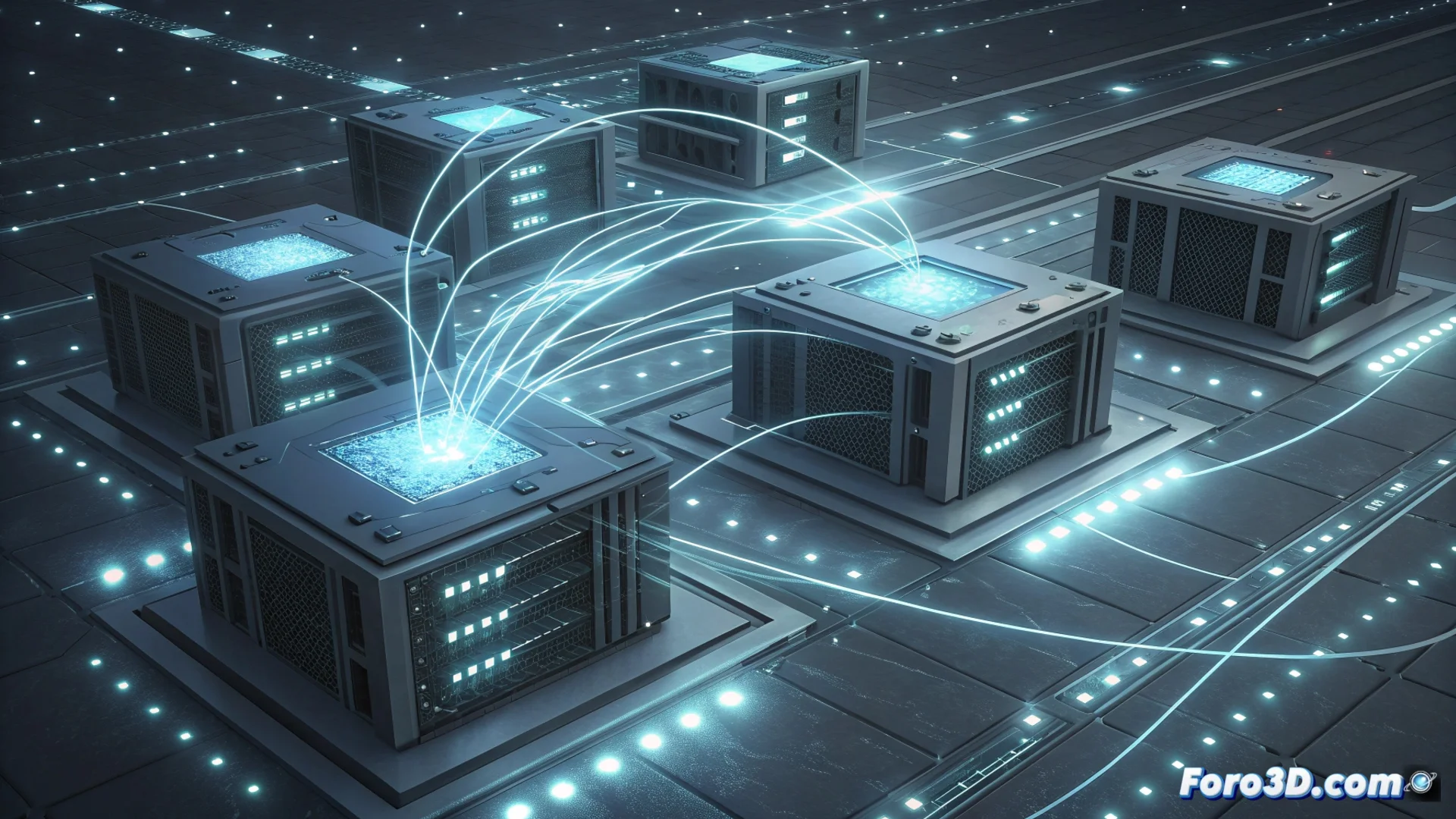
Distributed Quantum Computing Connects Processors to Scale
Building a single quantum machine with millions of stable qubits is an enormous challenge. That's why the scientific community is researching connecting several smaller quantum processors via a network. This distributed architecture aims to bypass the physical barriers of a single chip and scale computing power in a modular way. 🔗
Connecting Nodes to Run Algorithms in Parallel
The fundamental idea is that different quantum modules, called nodes, cooperate to solve a calculation. They are linked using quantum communication channels, often with photons, to entangle qubits that are separated. Thus, a complex problem is broken down into parts that each node computes simultaneously. This not only expands the total number of qubits that can be used but also gives the system greater resilience against failures in an isolated component.
Key advantages of this model:- Modular scalability: It is more feasible to add new nodes than to integrate millions of qubits into a single unit.
- Fault tolerance: An error in one node does not necessarily collapse the entire computation.
- Parallel processing: Allows splitting large algorithms to accelerate their resolution.
Coordinating a single quantum computer was already complex. Now imagine synchronizing several, each with the stability of a flan in an earthquake. The future is to distribute the challenges.
The Technical Obstacles Still to Overcome
Materializing this vision is no easy task. Preserving quantum coherence and entanglement between qubits hosted in different machines is extremely complicated. Synchronizing the nodes and correcting errors across the network adds layers of complexity. Additionally, creating efficient interfaces for nodes to exchange quantum information is a very active area of study. Overcoming these hurdles is crucial to making the concept a reality.
Main challenges to resolve:- Maintaining entanglement at a distance: Quantum links are fragile and prone to decoherence.
- Network synchronization: Coordinating operations between independent processors with extreme precision.
- Communication interfaces: Designing fast and reliable mechanisms to transfer quantum states between nodes.
The Path to Large-Scale Quantum Systems
Distributed quantum computing is emerging as a promising route to achieve the scale necessary for practical applications. By connecting processors, computing capacity can be expanded in a more manageable way than with a single giant device. Although the engineering challenges are formidable, progress in this field could unlock the true potential of quantum technology, transforming how we approach optimization, simulation, and cryptography problems. ⚛️