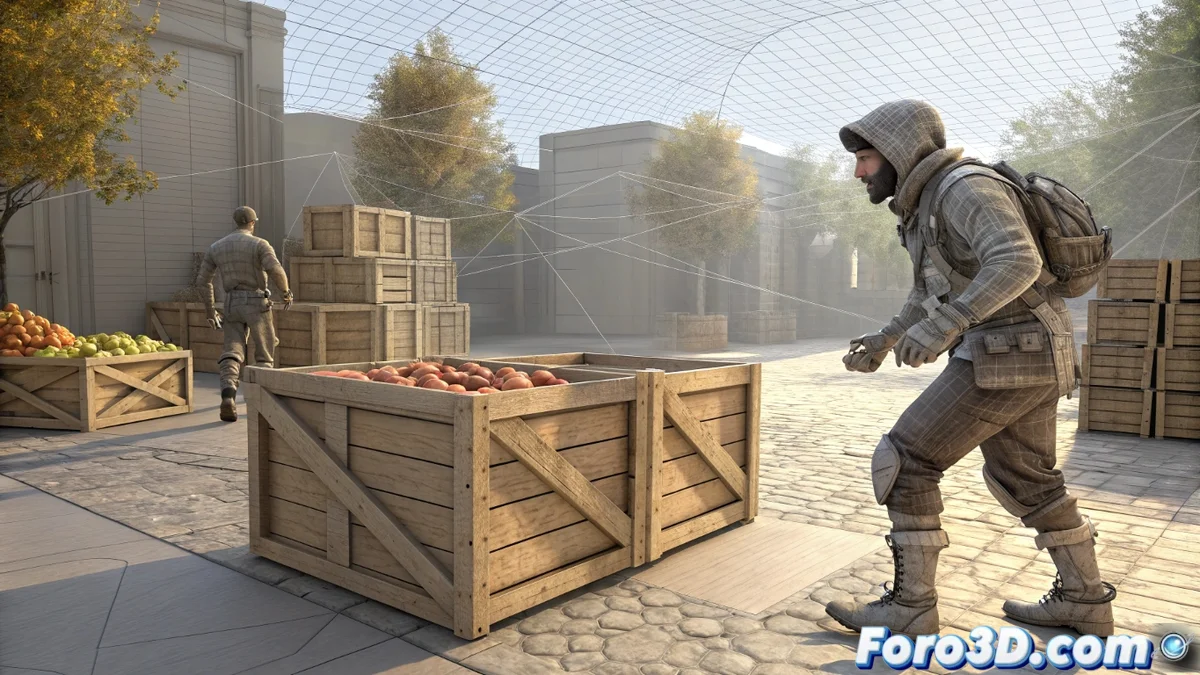
Distance Field Ambient Occlusion: ambient occlusion with distance fields
In the realm of real-time graphics, simulating how ambient light darkens in corners and crevices is key to achieving realism. Distance Field Ambient Occlusion (DFAO) emerges as a powerful alternative to methods like SSAO, using a volumetric representation of the scene to calculate contact shadows in a more stable and coherent way, especially with dynamic geometry. 🎮
The core of DFAO: querying a data volume
This technique does not operate directly on the visible geometry on screen. Instead, it pre-processes the entire scene to build a global signed distance field (SDF). This SDF is a 3D volume where each cell stores the distance to the nearest surface. During rendering, for each pixel, the engine samples this volume around the point to estimate how much ambient light remains occluded by the surrounding geometry, regardless of whether it is currently in the field of view.
Main workflow for implementing DFAO:- Generate the SDF volume: A 3D distance map is calculated and stored for the entire navigable scene.
- Query during post-processing: For each on-screen fragment, multiple samples are taken in the volume around its position in 3D space.
- Integrate the occlusion: The sample results are combined to produce the final ambient light attenuation factor.
DFAO shifts the complexity of the calculation from a per-screen process, like in SSAO, to a per-scene process, using a precomputed data volume.
Comparison with SSAO and performance considerations
The decisive advantage of DFAO over traditional Screen Space Ambient Occlusion (SSAO) is its independence from the current depth buffer. This eliminates artifacts such as flickering or fading when objects or the camera move, and allows objects to occlude and be occluded consistently, even if they are not visible to the camera in that frame.
Key aspects when evaluating DFAO:- Advantage: Temporal coherence: Occlusion does not change abruptly between frames, providing a more stable feel.
- Advantage: Global reach: Works in large volumes and with all scene geometry, not just the visible one.
- Cost: Memory and processing: Requires storing the SDF volume and power to generate/query it, which can be costly in highly dynamic scenes.
When to use distance field ambient occlusion?
DFAO is ideal for projects that prioritize realistic and stable ambient occlusion in extensive environments with dynamic elements, such as a character casting soft shadows under a destructible bridge. It represents a balance between resource cost and superior visual quality, offering a robust solution where SSAO shows its limitations. Its implementation makes the difference in complex scenes seeking that extra immersion. 🚀