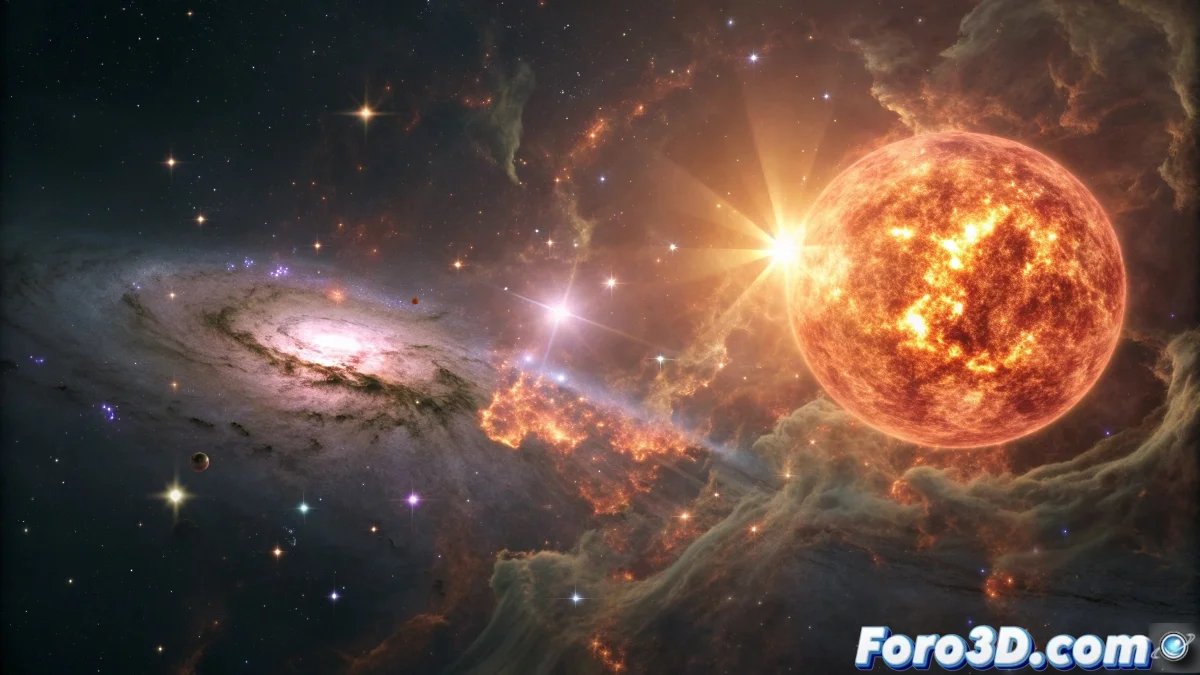
Discovery of Hyper-Massive Stars That Challenge Astrophysical Models
The astronomical community is revolutionized by data pointing to the existence of stellar bodies with masses that drastically exceed established parameters. Observations with state-of-the-art instrumentation reveal spectral features and brightness patterns incompatible with any star previously cataloged 🪐.
Revision of Stellar Formation Paradigms
The possible confirmation of these superstars demands a complete reformulation of models about stellar genesis and development. The accretion mechanisms and fusion processes at such colossal scales present conceptual challenges without precedent for theoretical physics.
Critical Aspects Under Investigation:- Models of matter accumulation under extreme conditions of the primordial cosmos
- Gravitational stabilization processes in bodies of extraordinary mass
- New computational simulations to understand their complete life cycle
"These objects could represent a completely new stellar class, formed under physical conditions that no longer exist in the current universe" - Cosmological Research Team
Impact on Our Understanding of the Cosmos
These findings provide an exceptional window to explore the chemical evolution of the universe in its initial phases. Hyper-stars, if their nature is confirmed, would have functioned as nuclear reactors of unparalleled efficiency.
Fundamental Cosmological Implications:- Production and distribution of heavy elements on galactic scales
- Explanation of anomalous chemical compositions in distant galaxies
- Revelation of formative processes during the first billion years
The Future of Stellar Research
The search continues to fully characterize these cosmic phenomena, where each discovery adds new layers of complexity to our understanding of the universe. The scientific community eagerly awaits what these stellar rarities may yet reveal to us about the limits of known physics 🌌.