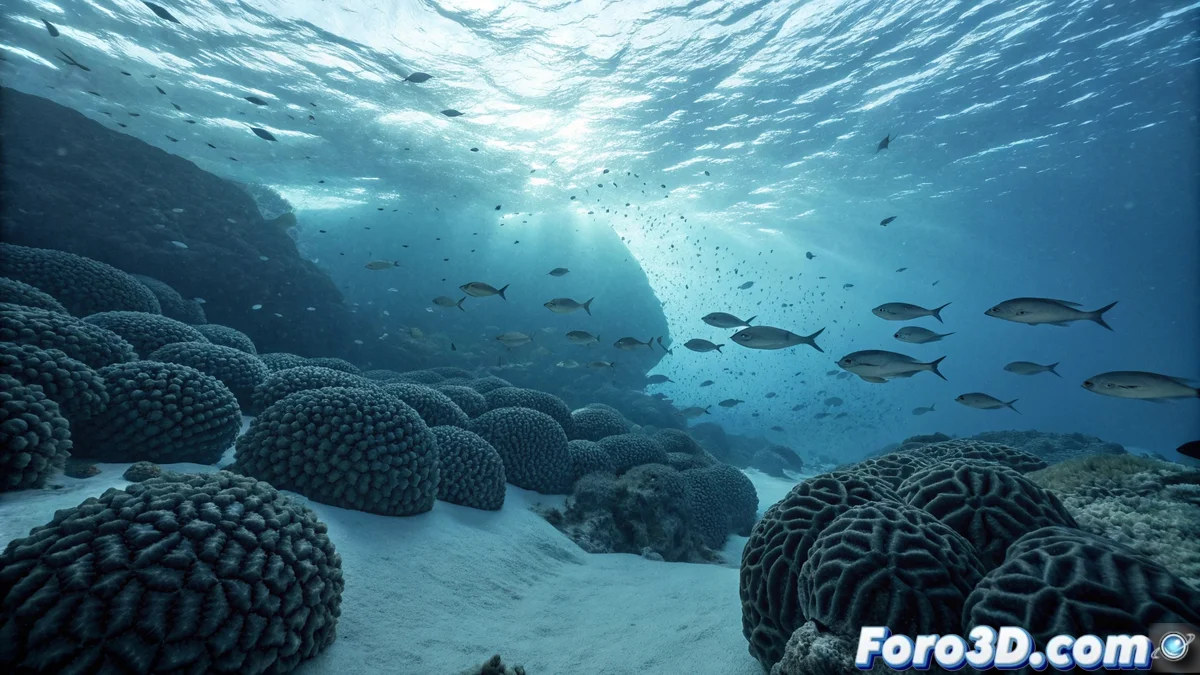
Discovery of Antarctic Fish Colonies with Organized Geometric Patterns
In the abyssal depths of the Weddell Sea, located in the icy Antarctica, a team of marine researchers has made a discovery that is revolutionizing our understanding of life in extreme ecosystems. It involves massive colonies of nests built by the fish Lindbergichthys nudifrons that exhibit an extraordinary spatial organization with geometric patterns of millimeter precision 🐠
Underwater Geometry as a Manifestation of Collective Intelligence
What makes this discovery particularly remarkable is that the nests are not randomly distributed, but instead form specific geometric configurations that include perfect oval shapes, symmetrical U-shaped structures, aligned straight lines, and defined groupings. This methodical arrangement creates what oceanographers call organized underwater neighborhoods, demonstrating a level of cooperation between individuals never before documented in deep polar water species.
Main Characteristics of the Colonies:- Densities of up to 60 nests per hectare with calculated spatial arrangement
- Patterns that repeat consistently across extensive areas of the seabed
- Structures that facilitate collective surveillance and community protection
"These colonies represent the underwater equivalent of planned cities, showing that life in the most adverse conditions can develop sophisticated social systems" - Dr. Elena Torres, leader of the Antarctic expedition
Evolutionary and Adaptive Implications of the Spatial Design
The researchers propose that these meticulous geometric patterns constitute an advanced evolutionary strategy to maximize offspring survival in a hostile environment. The specific arrangement not only hinders predators' access to the central nests but also creates natural surveillance corridors that allow adults to detect threats with remarkable efficiency. Furthermore, this organization optimizes the flow of marine currents around the nests, ensuring adequate oxygenation for the developing embryos.
Identified Adaptive Advantages:- Layered protection against natural predators of the Antarctic ecosystem
- Optimization of gas exchange for embryonic development
- Efficient communication between individuals through spatial arrangement
Revolution in the Understanding of Polar Marine Behavior
This extraordinary finding is challenging established paradigms about the limitation of complex social behaviors in deep-water, sub-zero temperature environments. The consistency observed in the patterns over kilometers of the seabed indicates that these fish not only build individual nests but coordinate their efforts at a community level. The discovery opens completely new perspectives on how marine species develop elaborate social systems as an adaptive response to specific environmental pressures, suggesting that life in the Antarctic depths possesses an organization that far exceeds previous scientific expectations 🌊