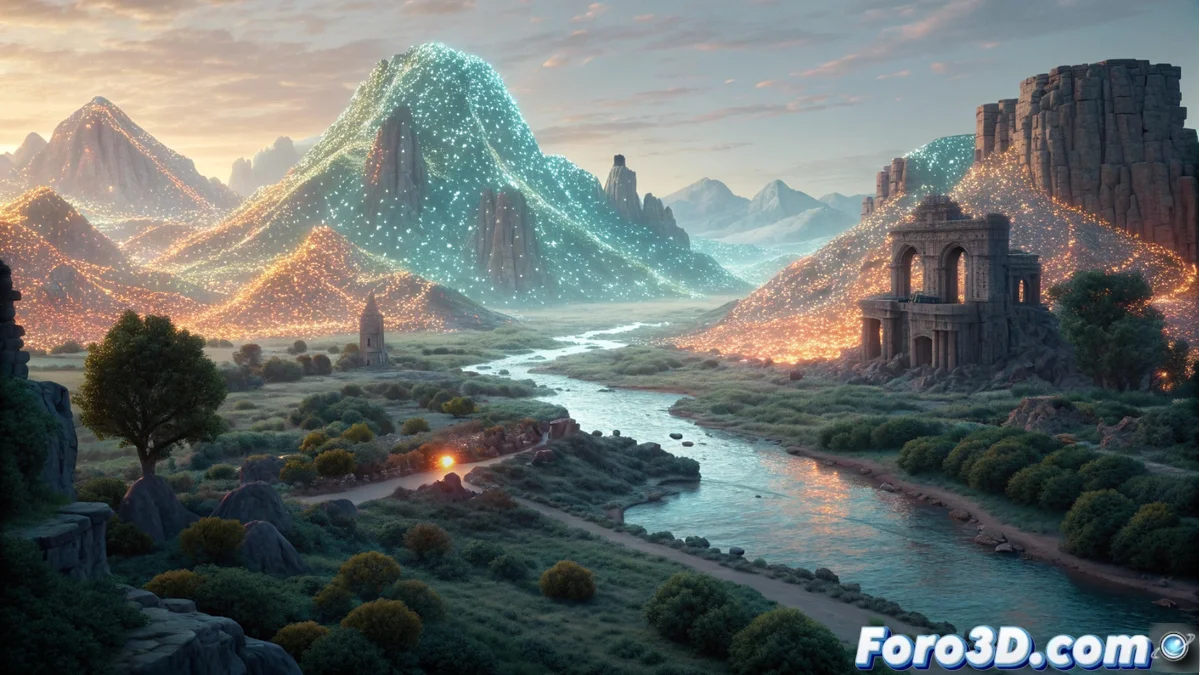
Direct Visualization of Massive Point Clouds
This methodology revolutionizes how massive scanning data is handled. It allows direct visualization of the information captured by laser or photogrammetry, completely skipping the step of generating a polygonal mesh. This is essential for handling large-scale environments, such as entire cities or extensive landscapes, because it preserves every detail of the original data without altering it. Graphics engines using this approach can handle billions of points in real-time, applying advanced shading techniques to control density and color. The result is a much more agile process from capture to viewing the final model. 🚀
Specialized Software to Handle Complexity
To manage these enormous data volumes, specific software is needed. Programs like CloudCompare, Autodesk ReCap, and Bentley Pointools, along with tools within Unity or Unreal Engine, are built for this purpose. Their graphics core focuses on organizing points into efficient spatial structures, such as octrees, which dramatically speeds up the rendering process. This allows the user to navigate interactively, measure distances, analyze the model, and present it without interruptions. The key technical aspect lies in how the software manages levels of detail (LOD), displaying only the necessary points based on the camera distance to maintain a constant and smooth frame rate.
Key Advantages of Skipping Mesh Generation:- Save Processing Time: The most resource-intensive stage, triangulating the surface from points, is eliminated.
- Avoid Triangulation Errors: On complex surfaces or with much noise, generating a mesh can introduce artifacts or distortions.
- Maintain Absolute Metric Precision: Points are raw data, so the representation is faithful to the measured reality.
What’s left over when working with a billion-point scan is free time waiting for it to convert into a mesh.
Applications Where Precision is Critical
This technique is not just about speed; it’s a necessity for projects demanding accuracy. In cultural heritage documentation, high-precision topography, or visual effects integration for film, a metrically correct representation of reality is required. The point cloud serves as a perfect geometric base upon which modeling, simulation, or integration of other digital elements can be done. Even if the scene consists solely of points in space, modern rendering techniques make it appear as a solid and coherent model.
Features of an Optimized Workflow:- Direct Integration: Scanned data can be used immediately as reference or geometry within other digital pipelines.
- Total Interactivity: The model can be explored, sectioned, and analyzed in real-time, even with huge datasets.
- Faithful Visualization: All original details are preserved, including colors and textures captured in the scan.
The Future of Real Data Visualization
The ability to process and render massive point clouds in real-time is changing entire industries. By prioritizing speed and data fidelity over slower traditional methods, it opens the door to new ways of documenting, analyzing, and presenting the real world in the digital environment. The continuous evolution of graphics hardware and software algorithms promises to handle even larger datasets, making this technique increasingly accessible and powerful. The message is clear: sometimes, the simplest and most direct representation of data is also the most powerful and efficient. 💡