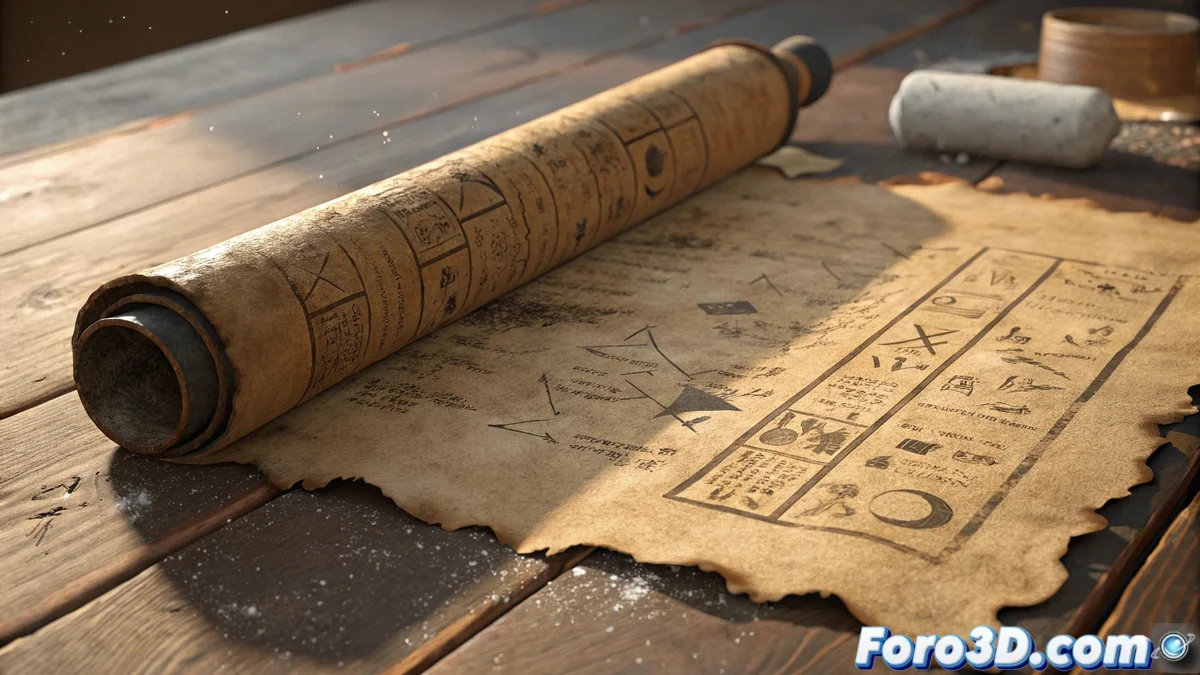
Digitally Deciphering the Mystery of Pompeii 📜
A 2,000-year-old carbonized scroll has been recovered from the ruins of Pompeii and partially deciphered using laser technology, revealing a text that matches no known language. This discovery baffles linguists and opens windows to lost ancient languages. Blender becomes the perfect tool to digitally recreate this artifact, capturing its fragility, carbonized texture, and the mystery of its indecipherable writing through modeling, sculpting, and advanced procedural materials.
Modeling the Scroll with Realistic Deformations
The process begins with a subdivided plane in Blender, to which the Simple Deform modifier with Bend adjustment is applied to create the characteristic rolled shape. Using Sculpt Mode with brushes like Clay Strips and Crease, wrinkles, folds, and irregular deformations typical of an ancient scroll are added. The Subdivision Surface modifier refines the geometry, while Displace with noise textures adds micro-surface details. For the carbonized edges, Masking combined with Extrude is used to create believable tears and burns. 🔥
Texturing with Procedural Materials
The carbonized appearance is achieved with procedural materials in Blender:
- Roughness Maps with Noise nodes to vary between shiny and matte areas
- Displacement connected to Voronoi textures that simulate carbonization cracks
- Color Ramps that blend ivory, sepia, and burn black tones
- Dirt Layers with Musgrave nodes for accumulated dust
For the indecipherable text, subtle emission maps or lightly engraved geometry with normals are used.
Texturing a carbonized scroll is like digitally preserving what time tried to destroy.
Archaeological Studio Lighting
The scene is lit with soft Area Lights from lateral angles that enhance the surface topography without creating annoying reflections. A dim frontal light fills the deep shadows, ensuring that the text details and burns remain visible. The use of Light Path nodes allows specific control of reflection intensity in the brighter carbonized areas. A neutral gray background keeps the focus on the scroll.
Composition and Contextual Elements
The scroll is placed on a low-poly modeled ancient wooden table, with worn wood textures. Animated dust particles with simple particle systems float around the object, adding subtle movement and a sense of antiquity. The camera focuses on areas where the text is most visible, with reduced depth of field that slightly blurs the edges, mimicking the focus of a research team examining the artifact.
Rendering and Post-Production
It is rendered with Cycles for maximum material quality, using adaptive sampling and denoising to keep render times manageable. In Blender's compositor, contrasts and saturation are slightly adjusted to accentuate the carbonized areas, and a subtle vignette is added that directs attention to the center of the scroll.
While linguists try to decipher a lost language, we try to decipher why the Subdivision Surface modifier sometimes decides our scroll should look more like a croissant than a historical artifact. In the end, both mysteries are deep... but at least ours is solved with Ctrl+Z. 😅