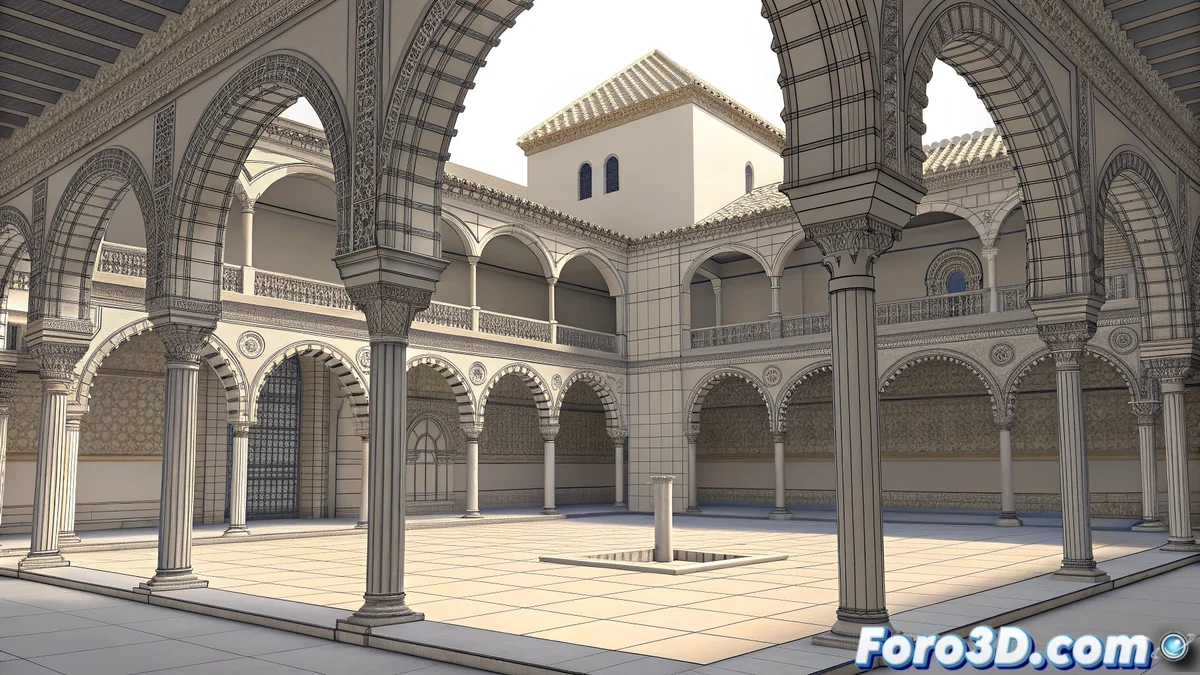
Digitally Reviving the Splendor of the Alcázar 🏰
The Alcázar of Seville, one of Spain's architectural jewels and a World Heritage Site, is immersed in an ambitious restoration process. Several rooms that had been in a state of abandonment for decades are being meticulously recovered to restore their original splendor. This project not only seeks to preserve historical heritage but also to enhance the city's cultural appeal. In parallel, tools like Cinema 4D allow for the digital recreation of this icon, exploring its architecture and atmosphere from a virtual perspective.
Modeling Mudéjar Architecture
Cinema 4D, with its powerful polygonal and parametric modeling system, is ideal for representing complex historical spaces like the Alcázar. The architecture, characterized by horseshoe arches, intricate plasterwork, and porticoed patios, can be modeled in reusable modules that accelerate virtual construction. Tools like spline modeling and cloning generators allow replicating repetitive elements such as columns and lattices while maintaining clean and optimized topology. 🏺
Texturing Tiles and Ornaments
One of the most significant challenges in this recreation is the Mudéjar tiles and decorations. Cinema 4D's material system allows generating repetitive mosaics using tile shaders and displacement maps to simulate reliefs without overloading the geometry. Applying controlled normal maps and specular maps helps capture the craftsmanship of Sevillian ceramics, where light interacts differently with glazed versus matte surfaces. Typical geometric patterns are replicated using procedurals that ensure historical consistency.
Each tile tells a story; replicating it digitally requires respecting its craftsmanship as much as its geometry.
Historical Lighting and Atmosphere
To convey the unique atmosphere of the Alcázar, lighting plays a central role. Setting up area lights in windows and patios, combined with global illumination, recreates the sensation of natural light filtering through lattices and reflecting on albero floors. Adjusting the color temperature to simulate the warmth of Mediterranean light and using soft shadows helps highlight contrasts between materials like stone, glazed ceramics, and carved wood. Cinema 4D's physical render engine ensures these light interactions are believable and emotive.
Workflow for Heritage Recreation
The process is structured in methodical phases:
- Modular modeling of key architectural elements
- Precise UV mapping for tiles and ornaments
- Material creation based on historical references
- Lighting setup with emphasis on naturalness
Using instances and cloners for repetitive elements like columns or arches optimizes the scene, allowing for greater detail where most needed.
Between Physical Restoration and Digital Exploration
While artisans restore the physical splendor to forgotten rooms, Cinema 4D offers the possibility to recreate them digitally, experiment with chromatic variations, or even imagine how they looked at their historical peak. This duality enriches the appreciation of heritage, allowing artists and conservators to dialogue through modern tools. 3D recreation does not compete with physical restoration; it complements it, offering a window to possibilities and alternative preservation.
While the Alcázar recovers its shine after centuries of history, we recover our patience after hours of adjusting displacement maps. In the end, the true heritage is achieving a render that doesn't crash when adding one more tile. 😅