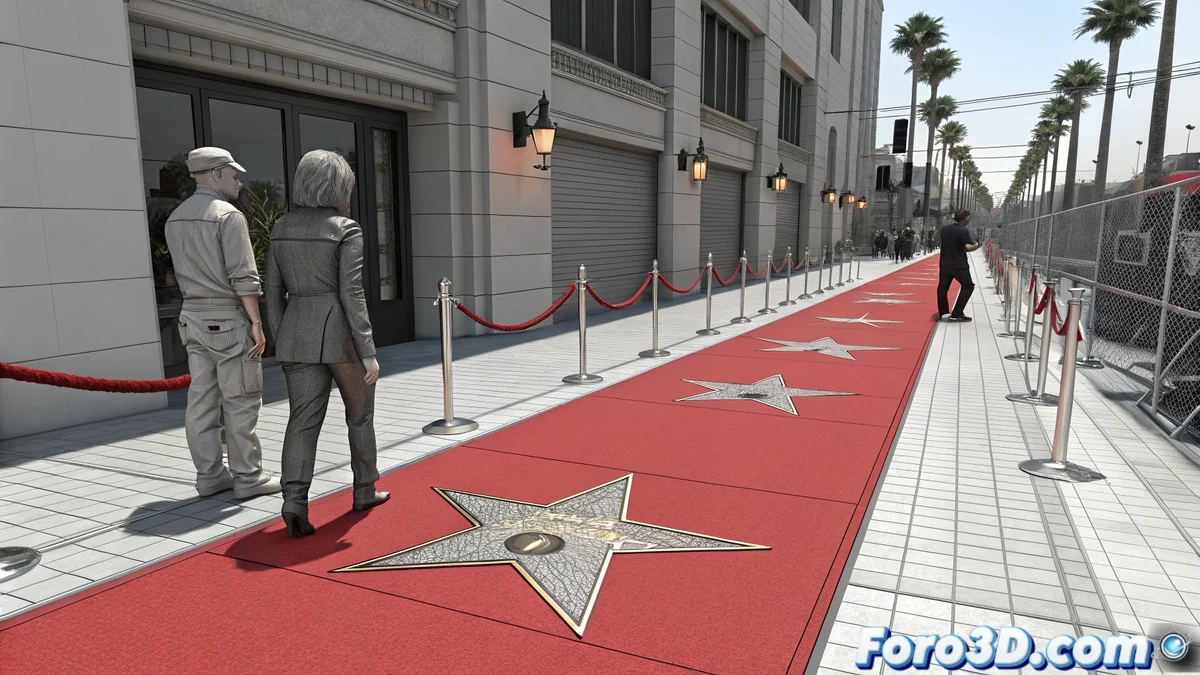
Digitally Illuminating the Recognition of a Real Star 🌟
The American actress Jessica Chastain has received her star on the Hollywood Walk of Fame in a ceremony attended by figures such as Al Pacino and Viola Davis. This event not only celebrates her career but also serves as a homage to cinema in general. In the digital realm, Autodesk Maya offers the perfect tools to recreate this symbolic moment, capturing the essence of Hollywood glamour through modeling, lighting, and strategic composition.
Modeling the Walk of Fame and the Star
The process begins by modeling the characteristic sidewalk of the Walk of Fame. Using a subdivided plane in Maya, the joints between tiles are extruded, and the geometry of Jessica Chastain's star is added with basic but recognizable details—her name and the movie camera icon. Modifiers like Bevel soften the edges, while Displacement Maps can add micro-surface details to emulate the real wear of the cement under the feet of millions of tourists. 🎥
Low-Poly Characters and Static Poses
The ceremony attendees—including figures like Pacino and Davis—are represented with low-poly models that prioritize silhouette over anatomical detail. These characters are rigged with basic skeletons that allow static but expressive poses: clapping, holding microphones, or taking photographs. The key lies in spatial arrangement; grouping figures around the star creates the illusion of a crowded event without the need for complex geometry.
In digital recreation, fewer polygons often mean more narrative.
Los Angeles-Style Lighting and Red Carpet
To emulate Hollywood's characteristic light, a Directional Light is set up to simulate the Californian sun, with high intensity and a slightly warm color temperature. Complementary Area Lights fill shadows on the characters' faces and highlight the star on the ground. The red carpet is modeled as a plane with a virtual velvet material—high roughness and controlled specular—that guides the viewer's gaze from the edge of the scene to the ceremony's focal point.
Composition and Environmental Details
The scene is enriched with elements that contextualize the event:
- Fences that delimit the press and public area
- Microphones from different broadcasters grouped in front of the star
- Photographic cameras and tripods in the foreground
- Palm trees modeled in low-poly to suggest the Hollywood Blvd environment
These details transform the technical recreation into a cohesive visual narrative.
Rendering and Controlled Reflections
Maya's Arnold renderer is used to achieve credible materials—especially on the metallic surfaces of the star and camera flashes. By carefully adjusting specular and roughness parameters, the cheap plastic look that sometimes plagues 3D recreations is avoided. Setting Ray Depth and appropriate sampling ensures that reflections on the polished ground and camera lenses appear sharp but not dominant.
While Jessica Chastain receives an eternal star in the real world, we console ourselves by rendering a digital version that, although it won't last decades in the cement, at least won't be erased by a save error. In the end, both types of stars have their value—hers illuminate Hollywood, ours illuminate our monitors (when the render doesn't crash). 😅