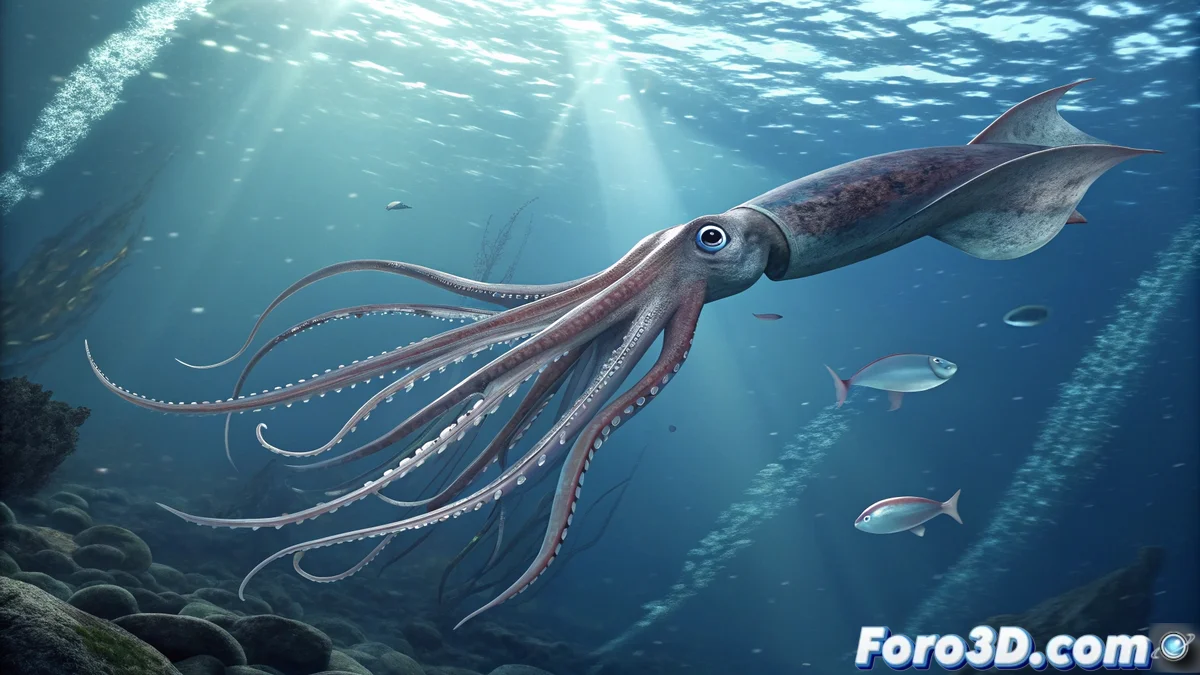
Bringing a Newly Discovered Abyssal Creature to Digital Life 🦑
Researchers from the University of Cambridge have identified a new species of giant squid in the depths of the Antarctic Ocean. This fascinating discovery not only expands our knowledge of marine biodiversity but also presents the perfect challenge for any 3D artist: digitally representing a creature that few have seen in detail. This is where Blender becomes the ideal companion for bringing this mysterious discovery to life in three dimensions, without the need to dive into icy waters.
Modeling the Creature from Scratch
The process begins by generating a simple geometric base within Blender. A cylinder serves as the starting point for the main body, while several Bezier curves are transformed into the characteristic tentacles. From this basic structure, Sculpt Mode is activated to define muscles, suckers, and all those organic details that make the creature unique. References from known cephalopods are useful, but the real challenge lies in letting the imagination run wild to complete the unknown.
Texturing and Materials for Submarine Skin
Creating textures that simulate the wet and shiny skin of a squid is crucial. Whether using Substance 3D Painter or working directly with Blender's nodes, roughness and displacement maps must be generated to add realism. Playing with subsurface scattering is essential to achieve that translucency feel in tentacles and fins, giving the impression that light filters through the tissues. 🎨
Organic texturing requires observing how light interacts with wet and translucent surfaces in low-light environments.
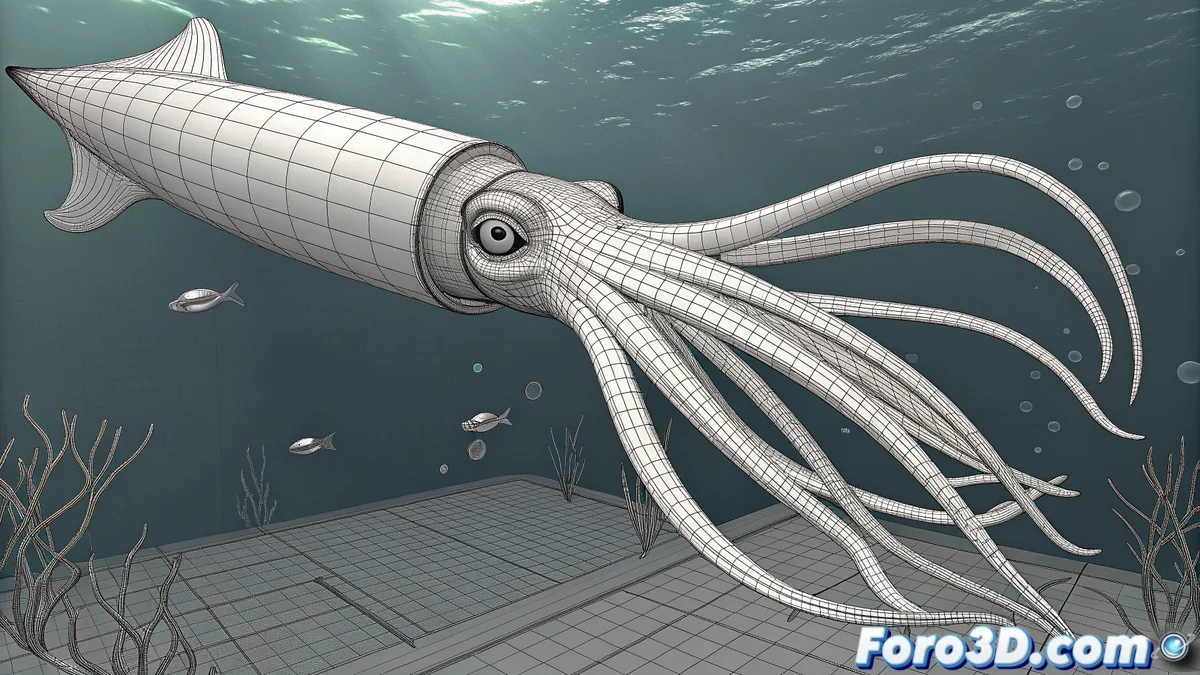
Animation in an Authentic Submarine Environment
The creature comes to life when integrated into its simulated natural habitat. Blender allows adding bluish fog volumes, caustic effects, and particles that mimic floating plankton. The giant squid is animated using deformers and simple rigs that control the undulating movement of the tentacles, always seeking the naturalness that characterizes marine creatures. 🌊
Technical Details for a Successful Recreation
For those who wish to embark on this project, these practical steps will be essential:
- Geometric Base: Start with a scaled cylinder for the body and Bezier curves for the tentacles
- Organic Sculpting: Use brushes like Draw, Inflate, and Crease to define folds and suckers
- Material System: Set up a Principled BSDF with subsurface scattering and procedural maps
The rigging is done using an internal armature with main bones for the body and independent bones for each tentacle, using Automatic Weights and manual adjustments with Weight Paint for perfect skinning. The lighting should be dim and bluish, simulating the twilight of the depths, with renders in Cycles to maximize realism or Eevee for faster results.
While Cambridge scientists battle sub-zero temperatures to study the real squid, you might be battling the geometry of a tentacle that insists on breaking the mesh. In the end, both are seeking to master the unknown, albeit from very different trenches. ❄️