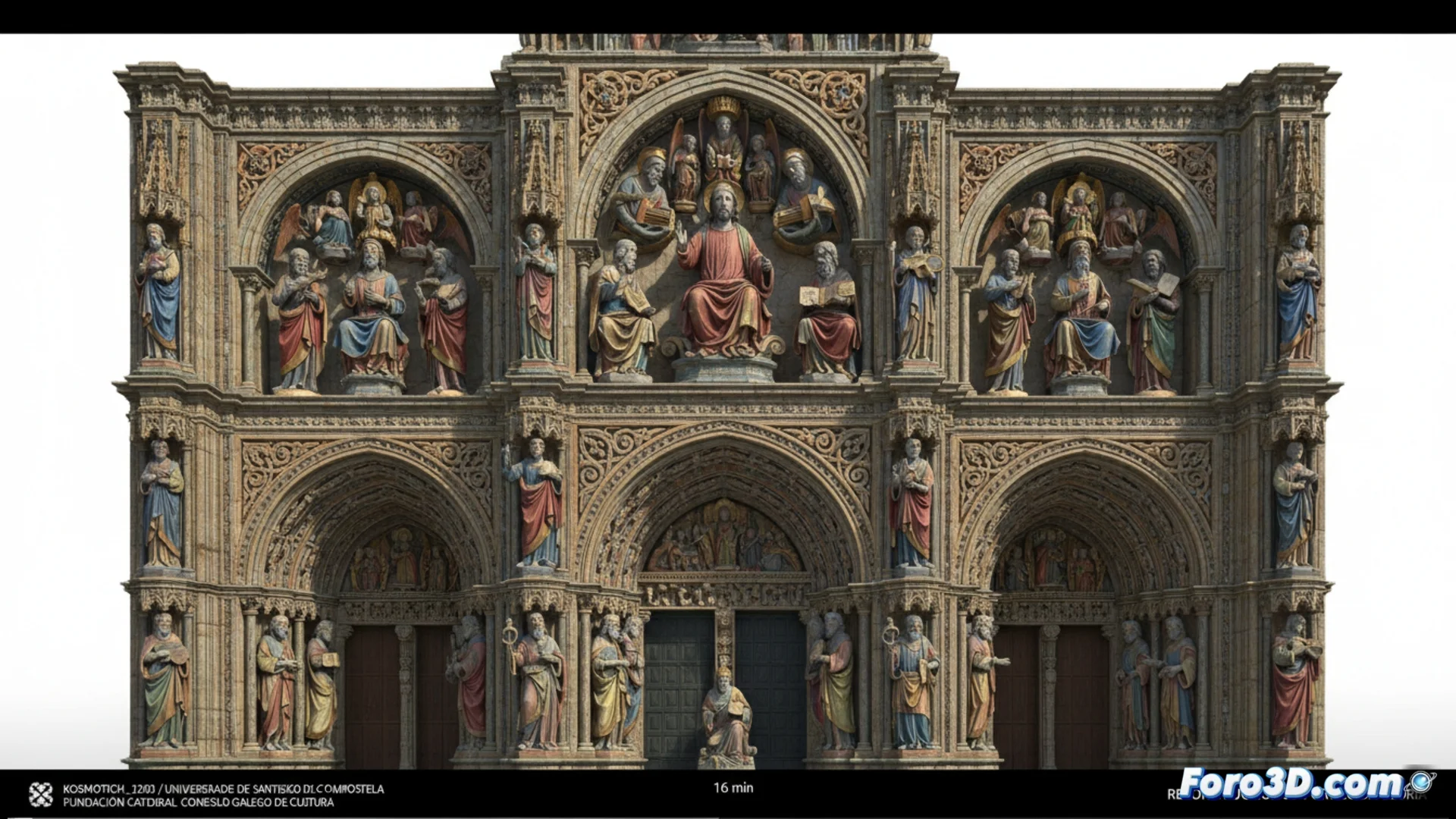
Digital Reconstruction of the Portal of Glory of Santiago de Compostela
An innovative project presents a complete digital reconstruction of the historic facade of the Portal of Glory. For the first time, a sixteen-minute audiovisual assembles all the original sculptures in their place, restoring the vision of Master Mateo 🏛ï¸?
Fusion of History and Advanced Technology
To achieve this virtual anastylosis, the KosmoTech_1200 project team integrates in-depth historical-artistic research with the latest virtualization tools. They employ high-resolution photogrammetry and 3D modeling to digitally recompose the lost fragments. This allows key pieces, such as the prophets and the figures of Ezekiel and Jeremiah, to be seen again united with the architectural ensemble for which they were designed.
Key Methodology of the Project:- Digitalize original sculptures that are now in different museums.
- Analyze pigments to restore the primitive polychromy of the figures.
- Use three-dimensional modeling to integrate each element into its historical context.
Now the prophets can reunite without asking permission from museum directors, a digital miracle that saves paperwork.
A Tool for Preservation and Dissemination
This method demonstrates how to process and visualize fragmented cultural heritage. By digitalizing and assembling physically separated elements, the research offers a powerful tool for studying, preserving, and promoting works of art. The result is a faithful representation that helps understand the original appearance and visual impact of the Romanesque portal.
Advantages of Virtual Reconstruction:- Allows studying the complete ensemble without moving the physical pieces, avoiding risks.
- Facilitates disseminating heritage to a global audience through digital media.
- Serves as a precise reference for future conservation and restoration work.
Institutional Collaboration for a Digital Legacy
The project is driven by the University of Santiago de Compostela together with the Santiago Cathedral Foundation and the Galician Council of Culture. This collaboration underscores the commitment to using technology not only to preserve, but to make cultural heritage more accessible and understandable for everyone 🌍.