Painting the Next Great Space Feat
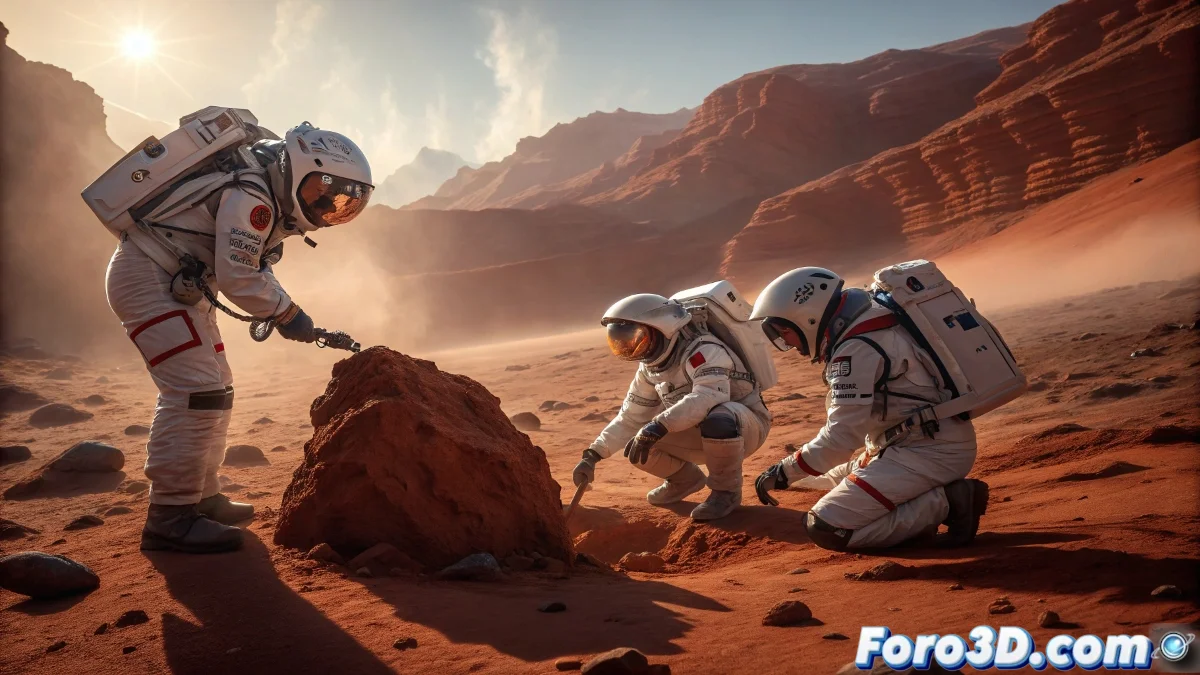
The search for past life on Mars depends on a bold mission: bringing a rock sample back to Earth, and three brave volunteers have stepped up to make it happen. 🚀 This scene, loaded with science and human drama, is perfect for a digital illustration in Corel Painter that combines scientific precision with artistic freedom. Capturing the moment when the astronauts interact with the Martian rock, under the dim sunlight, allows exploring textures, colors, and emotions on a single digital canvas.
Initial Canvas Setup
The first step is to open a new document in Corel Painter with a high resolution, recommended 3000x2000 pixels or more, to allow for detailed work. Organizing layers from the start is crucial: Background, Rock, Astronauts, and Effects should be separated to facilitate adjustments. Saving the project as mision_marte.cplr ensures no progress is lost… because in space and in art, mistakes can be costly.
Composition and Scene Blocking
Start by defining the basic shapes: the rock as the central element, the astronauts around it, and the Martian horizon in the background. 🪨 Using selection tools and shapes helps establish correct perspective and proportions, creating a solid foundation to work on. Separate layers allow experimenting with arrangements without compromising the rest of the illustration. After all, there are no composition rules on Mars… but in art, there are.
Scientific illustration doesn't just document facts; it communicates the excitement and risk of space exploration, inspiring new generations of artists and scientists alike.
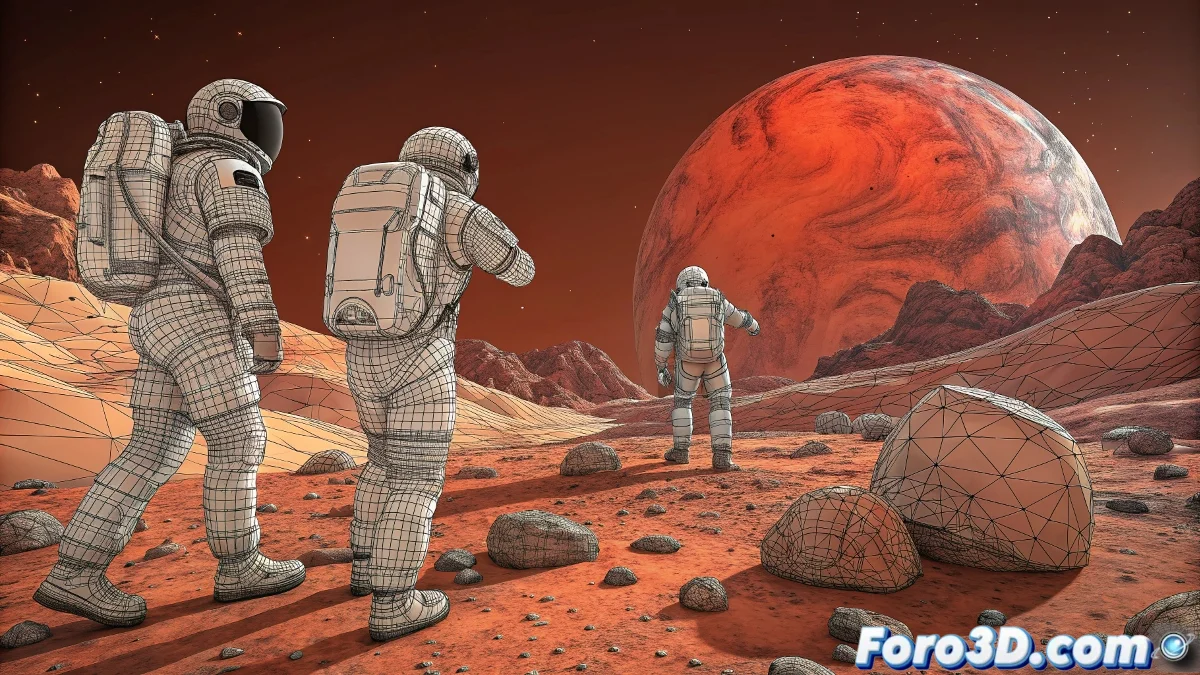
Detailing the Rock and Martian Environment
The rock is painted with textured brushes that simulate its eroded surface, applying typical reddish, orange, and brown tones of the planet. Cracks and crevices are added with fine brushes, suggesting the possible presence of fossils or minerals. The Martian background is created with warm gradients and airbrush brushes to simulate the dusty atmosphere, while distant mountains are blurred to give depth. 🌌 The key is to balance realism with a touch of artistic fantasy.
Bringing the Astronauts to Life
- Silhouettes and Volume: The spacesuits are drawn with base layers, adding shadows and highlights to create volume and realism.
- Reflective Details: The helmets are highlighted with subtle reflections of sunlight and the environment, using soft brushes and opacity adjustments.
- Interaction with the Scene: The astronauts are positioned examining the rock, with postures that convey curiosity and caution.
Lighting and Final Effects
Martian sunlight, dimmer than on Earth, is simulated with a clear direction, projecting elongated and contrasted shadows. Color levels are adjusted to slightly cool the shadows and warm the illuminated areas. 🎨 Particle effects are added around the rock and astronauts to simulate suspended dust, giving movement and atmosphere to the scene. Finally, the overall image cohesion is reviewed before exporting.
Thus, while scientists eagerly await that rock, digital artists have already recreated it… without needing a NASA budget or years of space travel. Because sometimes, the brush is faster than the rocket. 😉