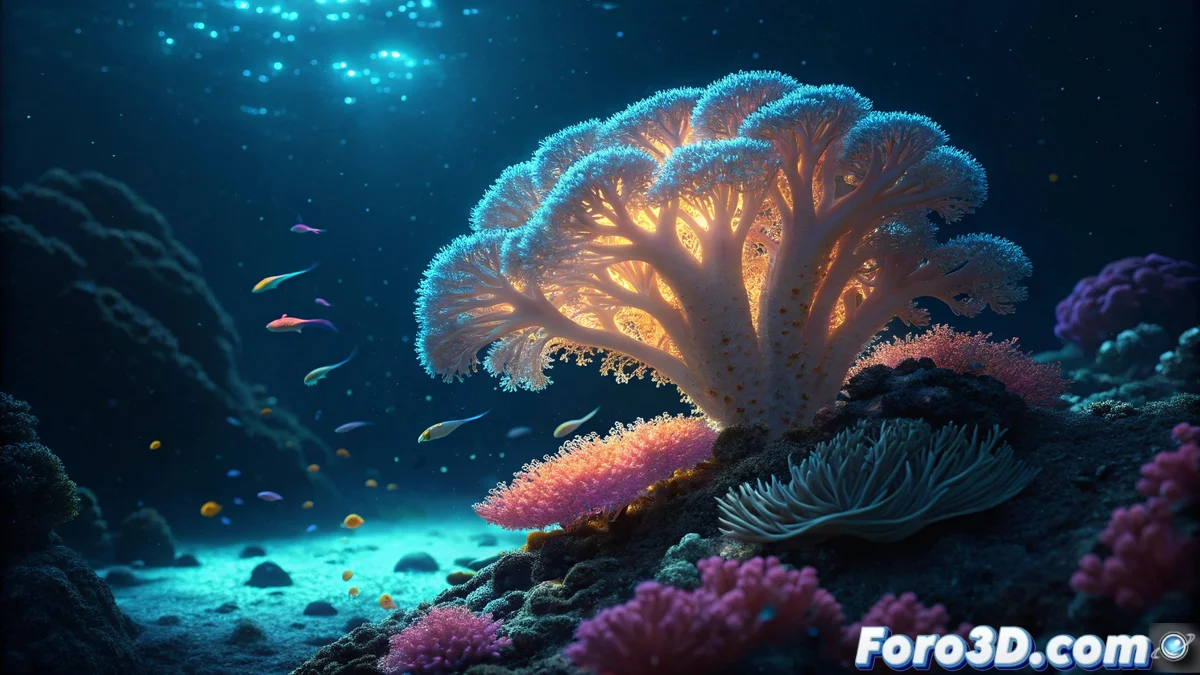
Illuminating the Depths with Digital Brushes 🌊
The recent discovery of a new species of bioluminescent coral in the depths of the Pacific Ocean has captured the imagination of scientists and artists alike. This finding not only offers valuable information about marine adaptation in total darkness environments, but also inspires colorful and luminous visual recreations. Photoshop emerges as the perfect tool to interpret this natural wonder, allowing the combination of illustration techniques with lighting effects that simulate the mysterious beauty of oceanic depths.
Creating the Submarine Base
The first step consists of establishing the deep oceanic environment. It begins with a dark background, using deep blues and blacks to represent the absence of natural light. Over this base, subtle texture layers are added to simulate suspended particles and variations in water density. This background not only serves as context, but will dramatically enhance the light effects that will be added later. 🐠
Painting the Bioluminescent Coral
Using textured and soft brushes, the coral structure is designed on an independent layer. The organic and irregular shape of these organisms allows playing with intricate silhouettes and natural patterns. Once the base shape is defined, the characteristic colors of bioluminescence—electric blues, vibrant greens, and deep purples—are applied using adjustment layers and blending modes like Color Dodge or Screen to achieve that light emission effect.
Digital bioluminescence is not just about glow, but about how light interacts with the surrounding submarine environment.
Lighting Effects and Realism
To simulate the natural light emission from the coral, layer effects like Outer Glow and Inner Glow are used, adjusting the intensity and size to achieve a subtle yet impactful effect. The key is to use multiple layers with different opacities and blending modes, creating a luminescence effect that seems to radiate from within the organism. Small floating particles and planktonic organisms illuminated by this light reinforce the sensation of a living and dynamic ecosystem. ✨
Composition and Visual Narrative
The scene is organized so that the coral is the focal point, surrounded by elements that complement the story of adaptation in darkness. Deep-sea fish, barely visible on the edges of the light, and rock formations indirectly illuminated add depth and context. The strategic use of:
- Fog layers to simulate water density
- Particle brushes to create suspended organic matter effect
- Contrast adjustments to direct the viewer's attention
transforms the illustration into a window to a hidden world, highlighting the beauty of natural bioluminescence.
Final Details and Atmosphere
The final adjustments involve unifying the scene with color filters and global settings. Balancing the cold tones of the environment with the warm colors of bioluminescent light creates a visually appealing contrast. Adding volumetric light effects, known as "God rays", using soft brushes and appropriate blending modes, brings that dramatic and ethereal touch characteristic of marine depths.
While marine biologists dive into abysses to study these corals, we dive into layers and brushes to prevent our creation from looking like an underwater party decoration. In the end, the real glow comes from mastering the right blending mode. 😉