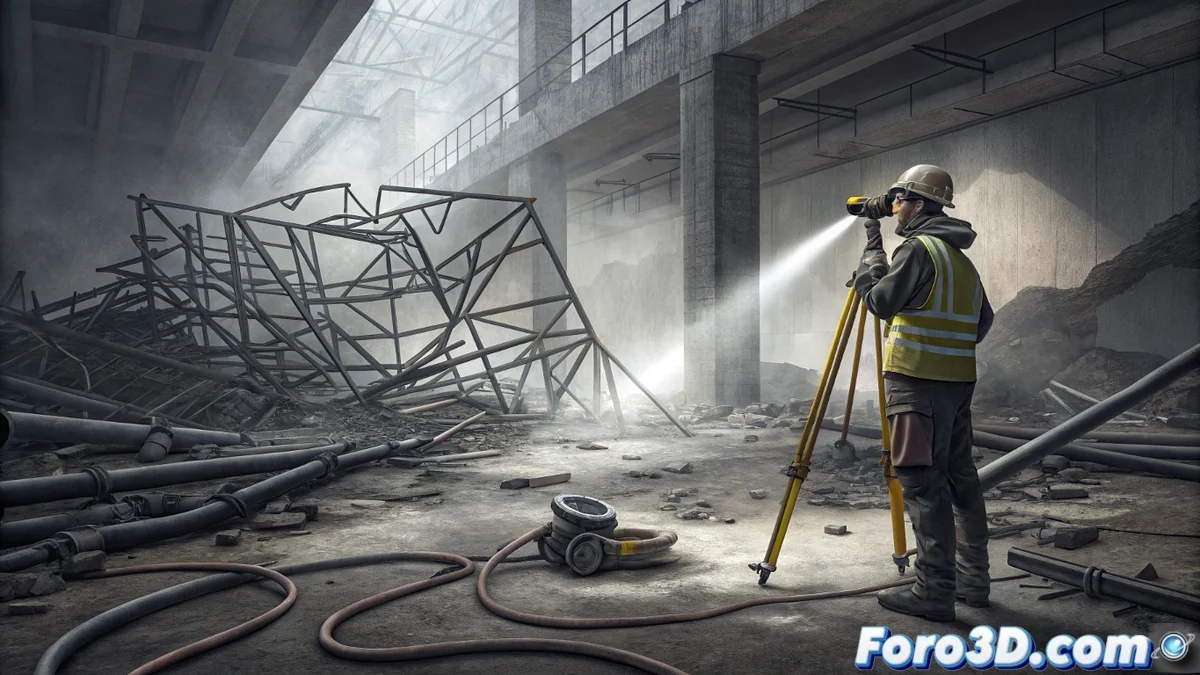
Digital Forensics: How to Analyze a Collapse with a 3D Pipeline
When a structural accident occurs, physical evidence is fragile and temporary. Digital forensic engineering intervenes to capture and preserve the scene with absolute precision, using cutting-edge 3D technology. This process turns debris into immutable data to uncover the truth behind the failure 🔍.
Capture the Scene with Millimeter Precision
The first step is to document the scene. Experts use a 3D laser scanner, such as the Leica RTC360, which records millions of points in three dimensions in just minutes. This device generates an extremely detailed point cloud, an exact digital duplicate of every tube, joint, and deformed component. This replica serves as objective digital evidence, allowing measurements of bending angles and displacements with submillimeter accuracy, something impossible with traditional methods.
Key Advantages of Forensic 3D Scanning:- Complete Documentation: Records the entire environment without omitting details, permanently preserving the post-accident state.
- Precise Measurement: Allows quantifying deformations, collapses, and distances between elements with minimal error.
- Remote Analysis: Experts can study the digital scene without needing to return to the site, which may be dangerous or inaccessible.
The point cloud is the digital footprint of the accident; it neither forgets nor distorts what it saw.
Reconstruct and Compare in the CAD Environment
The point cloud is imported into computer-aided design (CAD) software, such as SolidWorks or Autodesk Inventor. Here, technicians not only model each piece as it remained after the collapse but also recreate its theoretical original geometry. This direct comparison between the ideal "before" and the real "after" is fundamental. It allows isolating critical components, such as a loose clamp or a buckled bar, and preparing them for deeper engineering examination.
Forensic Modeling Process in CAD:- Import and Align: The point cloud is loaded and used as a precise reference to model each deformed component.
- Model the Original Geometry: Theoretical plans of the structure are recreated to establish the baseline for comparison.
- Isolate Failures: Elements showing the greatest damage or suspicious deformations are identified and separated digitally.
Simulate Causes with Finite Elements
Models of critical components are transferred to finite element analysis (FEA) software, such as Ansys or Abaqus. In this environment, all possible acting forces are simulated: the weight of workers and materials, wind pressure, vibrations, and even potential assembly errors. The software processes how the structure responds to these loads, calculating and visualizing points of excessive stress, plastic deformation, or failure.
The results of the structural analysis are conclusive. They can demonstrate whether the collapse originated from overloading a platform, improperly securing a joint, a hidden material defect, or, most commonly, a combination of environmental and human factors. This method reveals that the straightest-looking tube may hide internal fatigue, and the apparently sturdiest joint may be the weak point that triggers the disaster, proving that in structural forensics, appearances always deceive ⚠️.