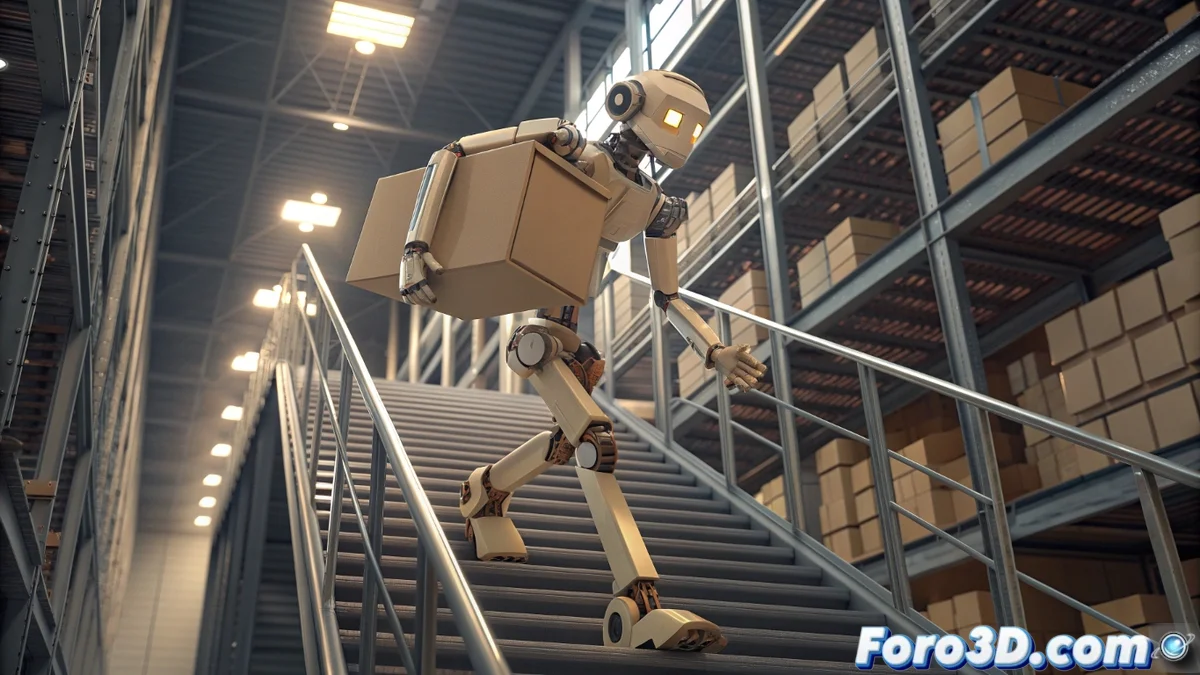
Digit from Agility Robotics: the humanoid redefining logistics automation
Advanced robotics is crossing a crucial threshold, moving from laboratories to integrate into our daily workspaces. A paradigmatic example is Digit, the industrial humanoid created by Agility Robotics. This machine is not a mere experiment, but an engineering solution designed to operate autonomously and safely in environments designed by and for humans. Its main mission is to revolutionize handling and transportation tasks at the core of the supply chain. 🤖
A design inspired by natural efficiency
The bipedal morphology of Digit is its greatest advantage, allowing it to move freely in a world built around two legs. Its lower limbs, with a joint that evokes the efficiency of birds, grant it exceptional mobility: it can walk, crouch, turn, and, fundamentally, navigate stairs. Its arms are functional tools capable of handling boxes up to 18 kg. When inactive, the robot folds onto itself to optimize space.
Its perception and navigation system:- Advanced sensor suite: Integrates cameras and LiDAR technology to create a real-time three-dimensional map of its environment.
- Autonomous navigation: Capable of detecting and avoiding obstacles, both static and moving, making route decisions independently.
- Interaction with human infrastructure: Designed to use corridors, shelves, and vehicles without the need for special adaptations.
Digit represents a paradigm shift: instead of adapting the environment to the robot, the robot is designed to adapt to the existing human environment.
Practical applications and future vision
The strategy of Agility Robotics is clear: establish Digit as a reliable robotic platform for logistics. It is already being deployed in real scenarios, such as loading/unloading delivery vans or internal goods transportation in warehouses. Its dexterity in interacting with containers and storage systems positions it as the ideal candidate to automate repetitive and physically demanding jobs.
Fields of action and projection:- Warehouse automation: Center of its current development, focused on improving efficiency in distribution and logistics centers.
- Last mile: Potential to assist in delivery tasks and order management in urban environments.
- Future expansions: Although its focus is industrial, the base platform could, in the long term, extend to retail assistance or even domestic environments.
Conclusion: More than a robot, a work companion
Digit embodies the next step in human-robot collaboration. It does not seek to replace, but to enhance, taking on the most arduous tasks and allowing workers to focus on higher-value activities. With its steady gait and ability to carry packages, it emerges not as a distant machine, but as an integrated element in the workflow of the future. Its motivation is certainly purely electric, but its impact will be profoundly human. ⚡