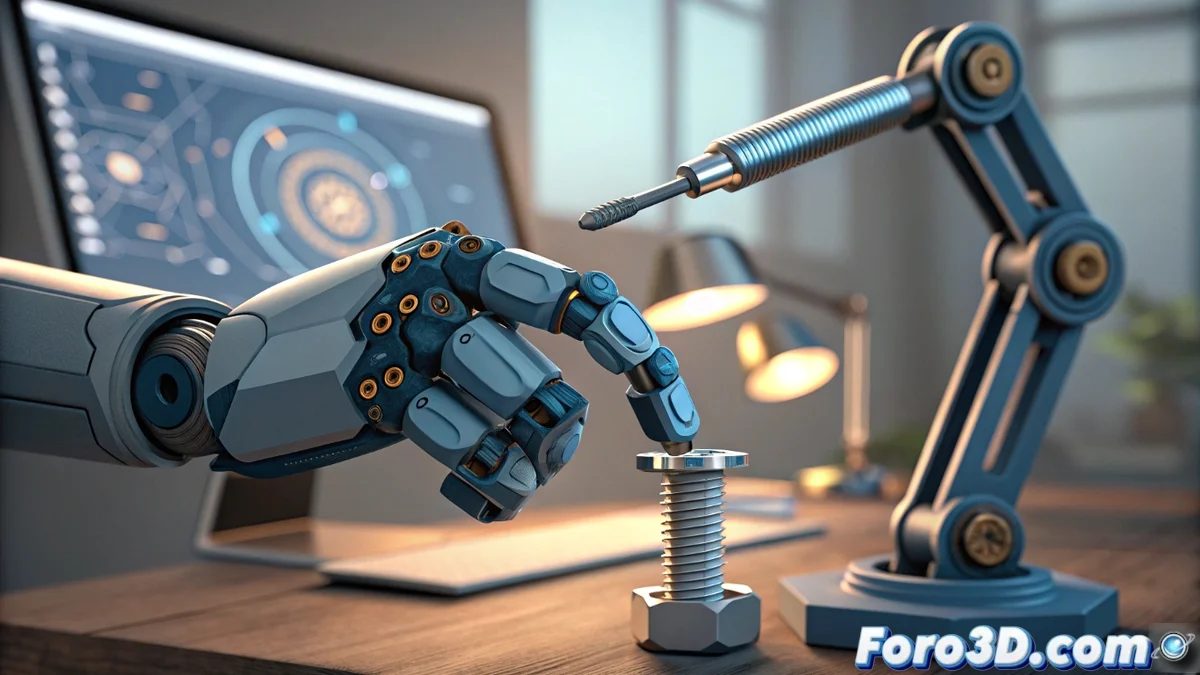
DexScrew: A Framework for Robots to Learn to Use Tools
A new advance in robotics, called DexScrew, employs reinforcement learning combined with transfer techniques from simulated environments to the real world. This framework enables multifinger robotic hands to perform complex manipulation operations, such as tightening nuts or using a screwdriver, with remarkable dexterity. 🤖
A Three-Stage Training Process
The system does not learn directly on the physical robot. Instead, it follows a structured workflow that increases its effectiveness and robustness. First, it is trained in a simulator using simplified models of the hand and objects. Here, through trial and error, it discovers the finger movements that achieve the task. Then, real demonstrations are collected via teleoperation, capturing rich sensory data such as tactile feedback and joint positions (proprioception). Finally, this real data is used to train a final policy through behavior cloning, which crucially integrates real tactile perception.
Key Advantages of the DexScrew Approach:- Generalizes to different tools: The learned policy works with nuts and screwdrivers of various shapes and sizes, not just those used in training.
- Outperforms direct transfer: It is more robust and reliable than trying to use a policy trained only in simulation directly on a real robot, where physics differs.
- Captures the complexity of real contact: By incorporating real tactile data, the system better handles friction and precise contact forces.
The pattern of training on simple models and then refining by imitating real data is key to closing the gap between simulation and reality.
Implications for Graphics Engines and Content Creation
This research transcends robotics and offers valuable lessons for the 3D graphics and animation sector. The method encourages improving how contacts, friction, and collisions are simulated in physics engines, which can lead to more stable and realistic simulations in virtual environments. Additionally, the knowledge of how a hand manipulates objects serves to procedurally animate hands and create automatic control systems (rigs) with more natural and believable movements.
Potential Applications in Creative Workflows:- AI-Refined Low-Poly Physics: Engines like Blender, Unreal Engine, or Unity could use approximate simulations that an AI then refines to generate precise physical animations.
- Reduce Manual Work: Artists could spend less time manually animating each keyframe for repetitive object manipulation tasks.
- Pattern Applicable to Other Problems: The strategy of learning from simulation and fine-tuning with real data can be used for other challenges in character animation and simulation.
A Future with More Skilled Robots and Smarter Animations
DexScrew represents a step toward robots capable of interacting with the physical world with near-human skill, solving specific mechanical tasks. Parallely, its hybrid training methodology points to a path for digital content creators to automate and improve the way complex interactions are simulated and animated, making creative processes more efficient and the results more convincing. The bridge between simulation and reality strengthens for the benefit of both fields. 🔧