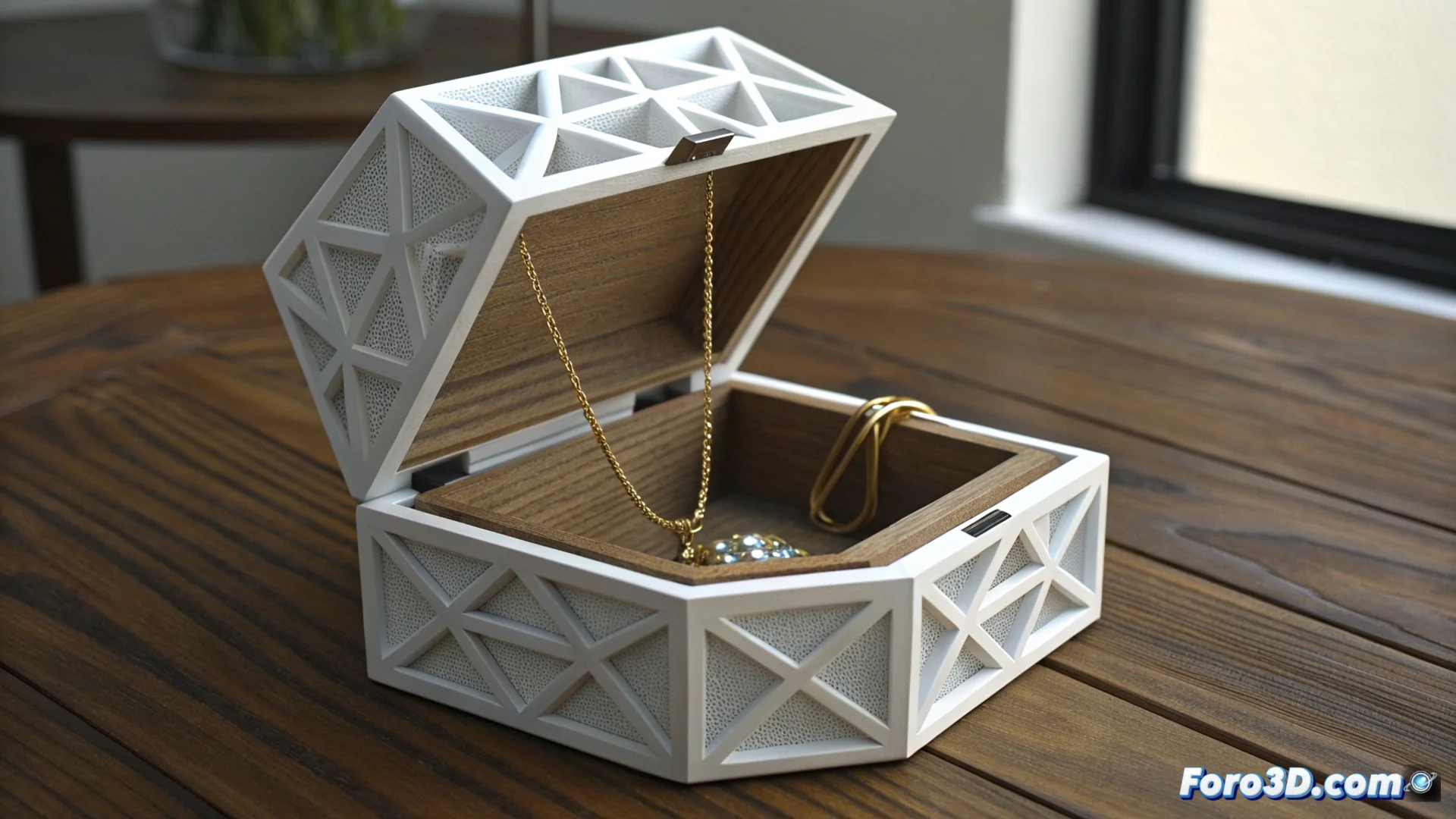
Design and Print a Jewelry Box with a Secret Mechanism
Manufacturing an object that combines functional design and 3D printing allows for creating unique pieces. This project focuses on producing a decorative jewelry box that hides a secure compartment, appearing to be a simple figure or box. To access its interior, a specific action must be performed, adding an element of intrigue and utility 🧩.
Select and Plan the Hidden Mechanism
The first step is to define how the secret compartment will open. The most commonly used systems employ neodymium magnets hidden inside or pieces that rotate and slide like a puzzle. A frequent design is a box that only releases its lid when aligning specific marks or pressing a specific camouflaged point in its texture. When modeling in design software, it is crucial to integrate supports for the magnets and design channels that allow moving parts to fit without jamming.
Common Mechanism Options:- Hidden Magnets: They are housed in printed cavities, ensuring the polarities are correct so they attract or repel as needed.
- Rotating or Sliding Mechanisms: Pieces that must move in a precise sequence, similar to a puzzle, to unlock the opening.
- Camouflaged Pressure Points: Buttons or zones integrated into the model's relief that, when activated, release the internal lock.
The magic of the object lies in its secret function not being evident at first glance, challenging the observer to discover how to open it.
Configure Printing for a Perfect Fit
The precision of the secret mechanism depends directly on how the pieces are printed. Properly calibrating the 3D printer and adjusting the filament expansion compensation are indispensable steps. Materials like PLA or PETG are recommended for their good dimensional stability, with a 0.4 mm nozzle and a layer height between 0.15 and 0.2 mm to capture fine details.
Key Printing Steps:- Fit Tests: Print prototypes at scale or only the critical parts (like joints) to measure clearances and friction.
- Iterate the Design: It is common to modify the digital model two or three times after testing prototypes, until the pieces fit with the right resistance.
- Verify Tolerances: Ensure that the spaces between moving parts are as designed, which often requires fine-tuning the flow settings or horizontal compensation.
The Final Challenge: Remembering How to Open It
After dedicating time to precise modeling and printing calibration, an ironic detail arises. The hiding place can be so effective that even its creator forgets the sequence or exact point to open it. Therefore, it is good practice to document the process or save the mechanism instructions. This project demonstrates how 3D printing allows materializing ideas of ingenious design, creating objects that are both functional and conversational 🔐.