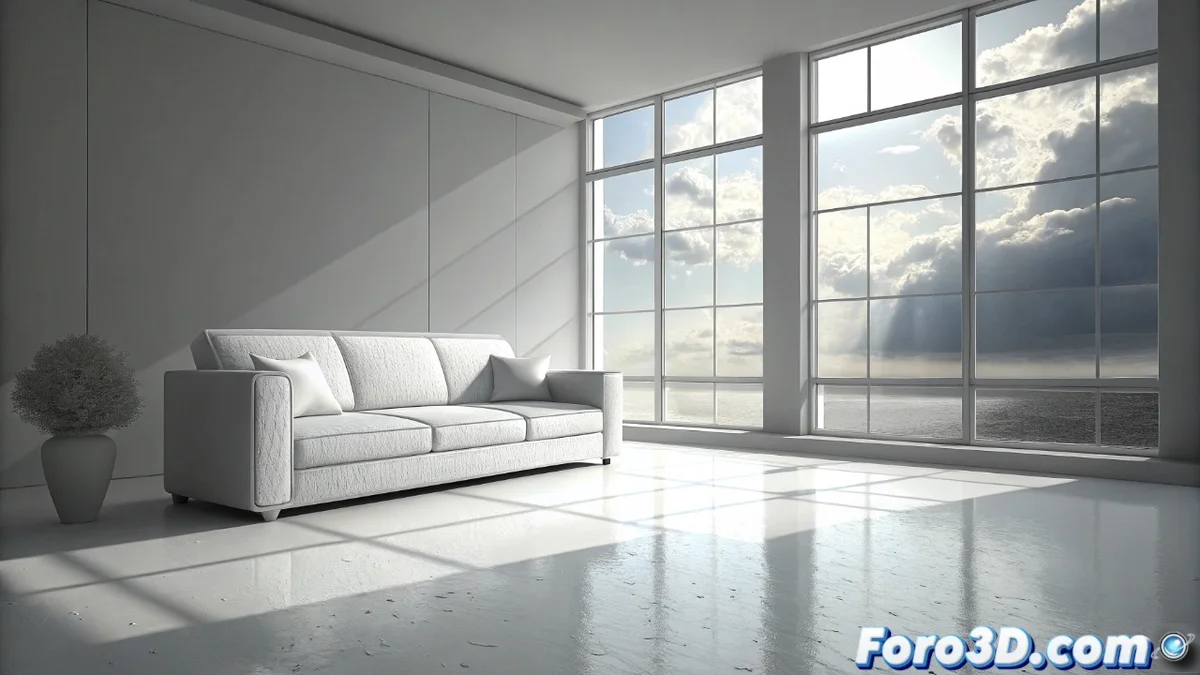
Deliberate Overexposure in 3D Renders: When to Avoid It and How to Fix It
Intentional overexposure occurs when forcing the lights to the point of losing information in the brightest areas, creating completely white areas without detail that break the visual harmony of the image. When there is no clear artistic justification, this effect conveys a sense of professional negligence that can ruin visualization projects. 🎨
Diagnosis of the Technical Problem in Renders
Burned areas appear when luminance values exceed the dynamic range of the rendering engine, generating completely white pixels with no recoverable information. In 3D environments, this frequently occurs with overly intense point lights, incorrect HDR configurations, or uncontrolled specular reflections, producing white spots that draw attention to areas without visual interest. 📸
Factors that Generate Overexposure:- Excessive intensity in directional and point lights
- Specular reflections with multipliers set too high
- Poorly adjusted HDR configurations in global illumination environments
"Some artists defend burned areas as personal style, until the client asks why their product looks like it suffered a nuclear fire"
Practical Strategies to Control Highlights
To effectively manage highlights, we use tools like the real-time histogram, adjusting light intensity before the final render. In post-production, we recover detail through exposure bracketing techniques or separate render passes for lights and reflections. The key is to keep the dynamic range within manageable limits using physically based lighting systems with real-world values. 💡
Effective Correction Techniques:- Constant monitoring of the histogram during the lighting process
- Use of separate render passes for individual control of lights and reflections
- Verification of RGB values in the brightest points of the scene
Balance Between Artistic Expression and Technical Quality
While some professionals defend the strategic use of burned areas for dramatic effects, it is crucial to differentiate between a conscious artistic choice and a technical error. Deliberate overexposure only works when there is a clear creative intention that justifies the loss of detail, always maintaining total control over the final result. 🎭