Deciphering the Secrets of the Lost Library of Herculaneum
The Herculaneum library, preserved but carbonized by the eruption of Vesuvius in 79 AD, is finally revealing its millennial secrets through advanced imaging technologies. Using Nuke with cutting-edge hardware, we will recreate the virtual reading process that allows deciphering texts that remained illegible for centuries. 🏛️
Nuke Project Setup for Digital Archaeology
We begin by preparing a complex multi-pass composition that combines real papyrus scans with CGI recreations, optimizing the workflow for the power of RTX 4080/RX 7900 XTX and Intel Core i9-14900K.
Advanced Technical Setup in Nuke:- Create an 8K project with deep compositing to handle multiple layers of volumetric data
- Set up ScanlineRender nodes to integrate 3D elements with real footage
- Establish premultiplied alpha channel for precise blends between CGI and scientific scans
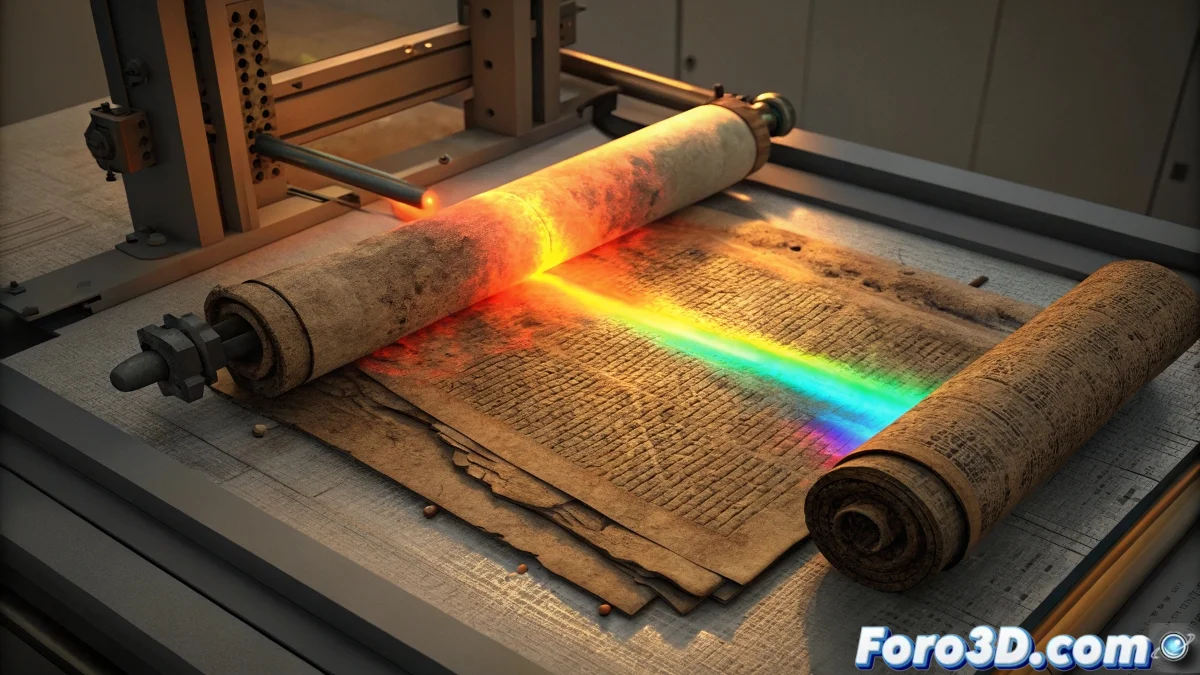
Phase-contrast X-ray tomography allows reading carbonized papyri without unrolling them, preserving these fragile ancient documents
Integration of X-ray Tomography Data
We import and process real scientific data from tomography scans, applying advanced enhancement techniques to reveal ink invisible to the naked eye.
Scan Data Processing:- Import DICOM tomography sequences using Read nodes
- Apply contrast enhancement filters with Grade and ColorLookup
- Create masks to isolate Greek and Latin characters from the surrounding carbon
Recreation of the Digital Revealing Process
The central sequence shows how text layers gradually emerge from the carbon, using compositing techniques that simulate the real scientific process.
Textual Revealing Animation:- Create progressive dissolve transitions between the carbonized papyrus and the revealed text
- Animate rotoscoped masks that follow the structure of ancient characters
- Apply displacement effects to simulate the three-dimensional curvature of the rolled papyrus
3D Reconstruction of the Villa of the Papyri
We use 3D integration in Nuke to recreate the original library where these texts were stored, contextualizing the archaeological discovery.
Architectural Reconstruction Elements:- Import 3D model of the Villa of the Papyri with textures based on archaeological evidence
- Create particle systems to simulate volcanic ash and eruption effects
- Integrate historically accurate lighting using HDRI of Mediterranean environments
Visualization of Multispectral Imaging Techniques
We represent the different imaging technologies used in real research, showing how each method reveals complementary information.
Visualized Imaging Techniques:- Infrared image layers showing carbon-based ink residues
- UV fluorescence visualization to reveal invisible pigments
- Integration of optical coherence tomography data for internal structure
Composition of Translated and Annotated Texts
The deciphered texts are presented with overlaid translations and academic annotations that explain their historical and philosophical meaning.
Academic Presentation Elements:- Overlay of ancient Greek text with modern English translation
- Callouts explaining philosophical references and historical contexts
- Diagrams showing the structure of the recovered philosophical treatises
Degradation and Temporal Preservation Effects
The visual narrative includes representations of the state of preservation over time, from the moment of the eruption to modern discovery.
Timeline Elements:- Transitions showing the carbonization process during the eruption
- Representation of centuries of burial and compression under volcanic ash
- Recreation of the archaeological discovery moment in the 18th century
Post-production and Final Mastering
The finishing process utilizes all the power of the recommended hardware to create a cinematic composition that communicates the historical importance of this discovery.
Final Compositing Stage:- Apply color correction with OCIO for academic consistency
- Integrate film grain effects and textures for a historical feel
- Render in EXR to preserve full dynamic range
Historical and Archaeological Impact
This Nuke visualization not only shows an advanced technical process, but communicates the profound cultural significance of recovering voices from the past that were thought lost forever. The ability to read these texts transforms our understanding of ancient philosophy and demonstrates how modern technology can dialogue with classical heritage. 📜