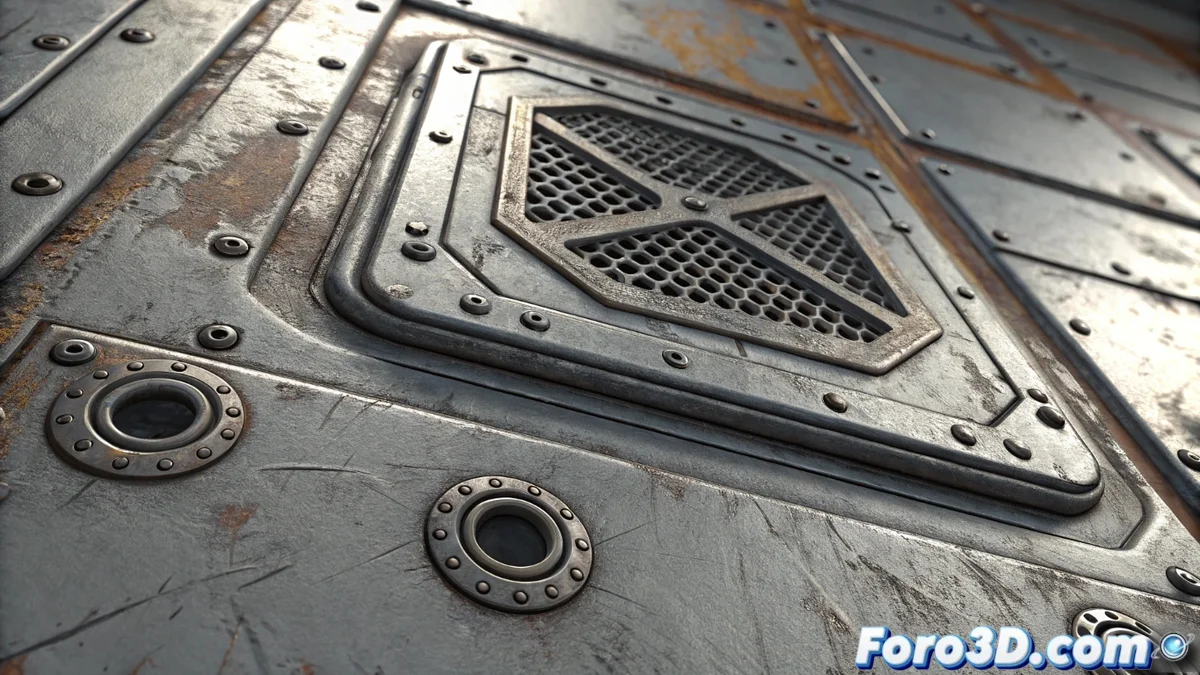
Normal Decal Blending: The Non-Destructive Detailing Technique for Texturing
In the field of visual development for video games and real-time rendering, there is a methodology that has revolutionized the way to add surface complexity: Normal Decal Blending. This sophisticated decal technique specializes in projecting only the normal map data onto an already textured mesh. 🎨 The result is the incorporation of high-fidelity reliefs and geometric details in a completely non-destructive manner, preserving intact the albedo, roughness, and metallic maps of the original material. This gives artists unprecedented freedom to enrich any digital asset narratively and visually.
The Operating Principle and Its Fundamental Advantage
The power of this methodology lies in its selective precision. Unlike a conventional decal, which can overwrite multiple shader channels simultaneously (such as color and relief), Normal Decal Blending focuses solely on the normals channel. In practice, this translates to the ability to overlay detailed geometry from a grid, an engraving, a weld seam, or a scratch onto a base surface, while keeping its color and light reflection properties unaltered. The surface gains visual richness and a tactile feel without forcing the artist to redo or manually blend the fundamental textures, a process that is usually rigid and inflexible during iteration and prototyping phases. 💡
Practical Use Cases Where It Shines:- Environmental Storytelling: Add accumulated dirt in corners, peeling labels, or graffiti with real volume on walls, without repainting the albedo.
- Localized Damage and Wear: Incorporate dents, scratches, or specific wear marks on vehicles or armor, while maintaining the base paint pattern.
- Manufacturing Details: Project screws, rivets, joints, or panels onto smooth surfaces to break uniformity and add industrial realism.
It's the elegant solution when your war tank, after hard work, still looks like a polished soda can due to lack of rivets. A simple normal decal later, and it acquires the character of a veteran machine, all without touching the precious albedo map that was so hard to create.
Integration in Modern Engines and Production Pipeline
Its implementation is standard in contemporary development environments like Unreal Engine and Unity, where decal systems usually offer granular controls to select which material channels are affected by the projection. The workflow is intuitive: the artist generates or uses a decal resource containing a detailed normal map, and in the actor or component properties, configures the blend so that it only interacts with the underlying geometry's normals channel. This approach makes it the perfect tool for the "last mile" of detail, applied once the base materials are fully defined and approved, allowing quick variations and contextual adjustments without compromising the base work. ⚙️
Key Benefits in the Artistic Pipeline:- Fast Iteration: Detail changes and adjustments are made in seconds, testing different decals over the same base.
- Asset Preservation: Base texture maps (albedo, roughness, etc.) remain pristine and can be reused in other contexts or projects.
- Memory Optimization: In many cases, high visual detail is achieved without excessively increasing the resolution of base textures or the 3D model density.
Conclusion: An Indispensable Tool for the Technical Artist
Normal Decal Blending has established itself as a fundamental pillar in real-time texturing. Beyond being a mere technical trick, it represents a non-destructive and efficient work philosophy that empowers artists to add layers of complexity and narrative to their creations. By allowing the separation of color information from high-detail geometric information, it facilitates a flexible, iterative, and powerful workflow, essential for achieving the levels of realism and visual richness demanded by the current industry. Mastering this technique is, without a doubt, a crucial step for any professional in the field. 🚀