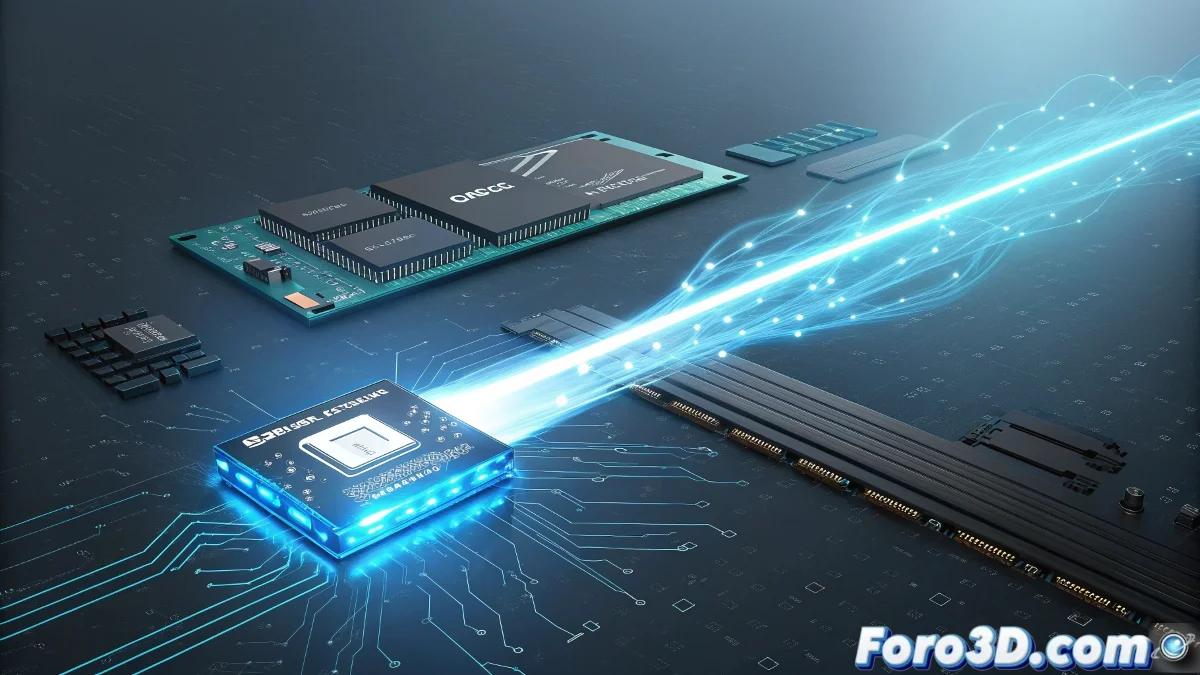
The Race for the Fastest Data
In the world of hardware, memory is the true bottleneck that determines a system's agility. 🏎️ The imminent arrival of DDR6 memory and the already present GDDR7 marks a turning point as significant as the jump to DDR4 or DDR5 was in its day. These are not simple updates; they represent a fundamental change in how data will move in the computers of the future, especially critical for bandwidth-hungry tasks like 3D rendering, machine learning, and next-generation gaming.
DDR6: Cruising Speed for the System
DDR6 memory promises to double the speed of its predecessor, DDR5, taking base frequencies to new levels. 💻 But perhaps its most significant improvement is energy efficiency. By consuming less energy to do more work, it not only delivers superior raw performance but also more stable systems with less residual heat. This is crucial for workstations that run for hours rendering or calculating AI models, where stability is as important as speed.
DDR6 is not a luxury, but the foundation for the next generation of processors.
GDDR7: The Fuel for Graphics
While DDR6 feeds the main processor, GDDR7 is the soul of new graphics cards. Its major breakthrough is the adoption of PAM3 signal modulation techniques, which allow packing more data into each clock cycle. 🚀 The result is astronomical bandwidth that GPUs can leverage for ultra-high-resolution textures, complex scenes, and resolutions like 8K. For 3D artists and gamers, this translates to fewer frame drops and almost non-existent loading times.
- Professional Performance: Smoother workflows in design and VFX software.
- Future-Proof: Technology ready for the demands of the coming years.
- Initial Investment: The high initial cost will be amortized as prices drop.
Who Really Needs This Power?
The answer is clear: any professional whose time equals money. 🕒 For an animation studio, reducing the render time of a complex scene from 10 to 6 hours thanks to a combination of DDR6 and a GPU with GDDR7 is a monumental productivity improvement. However, it's true that for the average user who browses the internet and watches movies, the difference will be less noticeable... although they will always appreciate the computer not slowing down with a hundred tabs open.
In the end, these technologies demonstrate that Moore's Law now also applies to memory. And who would have thought that the quietest part of the PC would end up being the one shouting the loudest. 🔊 Although, our wallets will be the first to hear the bang.