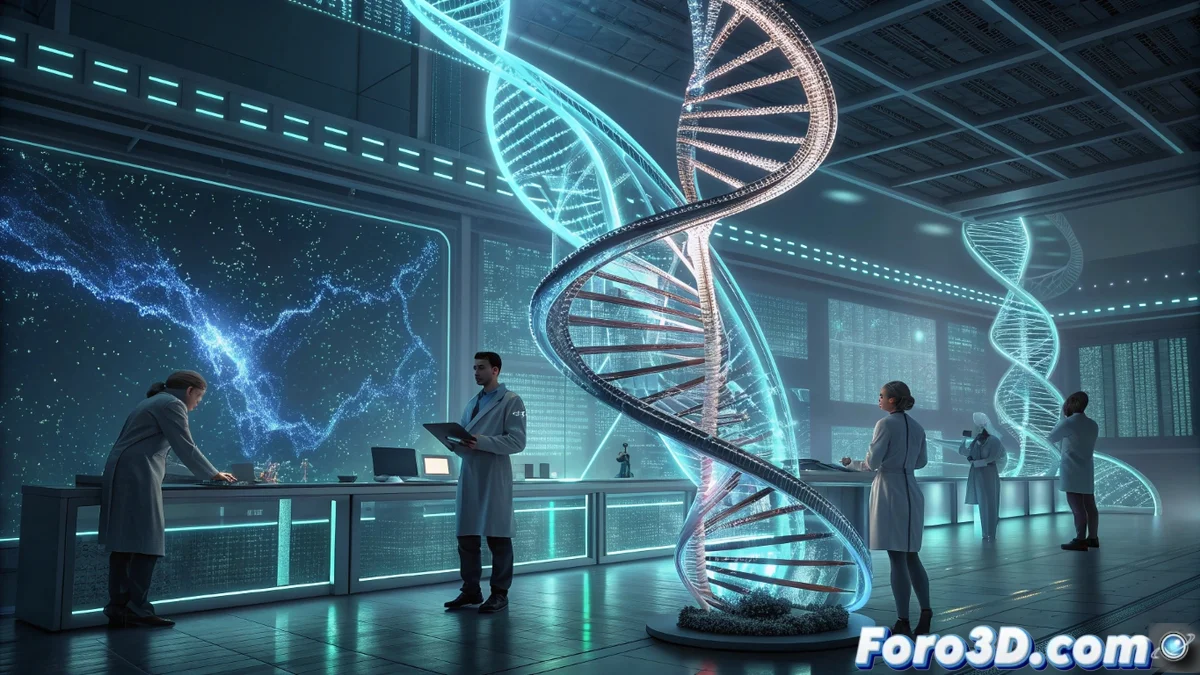
Data Storage in Synthetic DNA
Imagine a future where data doesn't get lost in hardware failures, but is stored in the very essence of life: synthetic DNA. In this hyperconnected world, experts are revolutionizing data storage by turning biological molecules into massive repositories, offering an ultra-efficient alternative to traditional hard drives. This idea is not science fiction, but a reality in development that promises to transform how we preserve information for future generations 📂.
Main Advantages of This Innovation
This technology stands out for its ability to compact information impressively, allowing a gram of synthetic DNA to hold up to 215 petabytes, equivalent to thousands of digital libraries in a minimal space. Its natural resistance makes it withstand the passage of time, keeping data intact for centuries in controlled environments, positioning it as a revolutionary solution for long-term archiving. Researchers in cutting-edge laboratories are driving these advances, making it seem almost magical to store so much in something so small 😲.
Descriptive List of Key Benefits:- Exceptional Density: A single gram of DNA can hold 215 petabytes, far surpassing any current device and allowing massive savings in physical space in servers and data centers.
- Lasting Stability: Thanks to its natural molecular structure, synthetic DNA avoids the common degradation in traditional media, promising conservation for thousands of years without constant maintenance.
- Disaster Resistance: Unlike hard drives vulnerable to mechanical failures or natural disasters, this method is ideal for extreme environments, such as securely archiving historical or scientific data 🌍.
In a world where we lose files on hard drives like socks in the washing machine, storing data in DNA seems like cosmic irony: now, if we forget the "biological password," we could wipe out human history in one fell swoop.
Current Challenges and Progress on the Horizon
Despite its potential, the process of encoding and decoding data in synthetic DNA remains an obstacle, as it requires high investments and prolonged times, complicating its widespread adoption. However, teams at institutions like Microsoft and Harvard are working intensively to optimize these steps, with tests that accelerate access and reduce costs, opening doors to a more accessible and efficient era in digital storage 🚀.
Another Descriptive List of Challenges and Advances:- High Costs: The DNA synthesis and reading process is still expensive, limiting its use to specialized applications, but recent research seeks more affordable materials to scale production.
- Processing Times: Currently, encoding and decoding data takes hours or days, although advances in algorithms and automated tools promise to reduce it to minutes in the near future.
- Collaborative Development: Laboratories like those at Microsoft and Harvard are leading the way, with collaborations that integrate artificial intelligence to make the method faster and more precise, accelerating its mass implementation 🤝.
Final Reflections on This Emerging Technology
As we close this glimpse into data storage in synthetic DNA, it is clear that we are facing a tool that could redefine the digital future, combining biology with computing to overcome the weaknesses of current systems. However, we must balance enthusiasm with precautions, such as robust security protocols, to prevent this promise from becoming an existential risk. In short, it is a bold step toward the immortality of information, but let's remember that, in the era of the ephemeral, even the most advanced science needs a touch of humility 🔮.