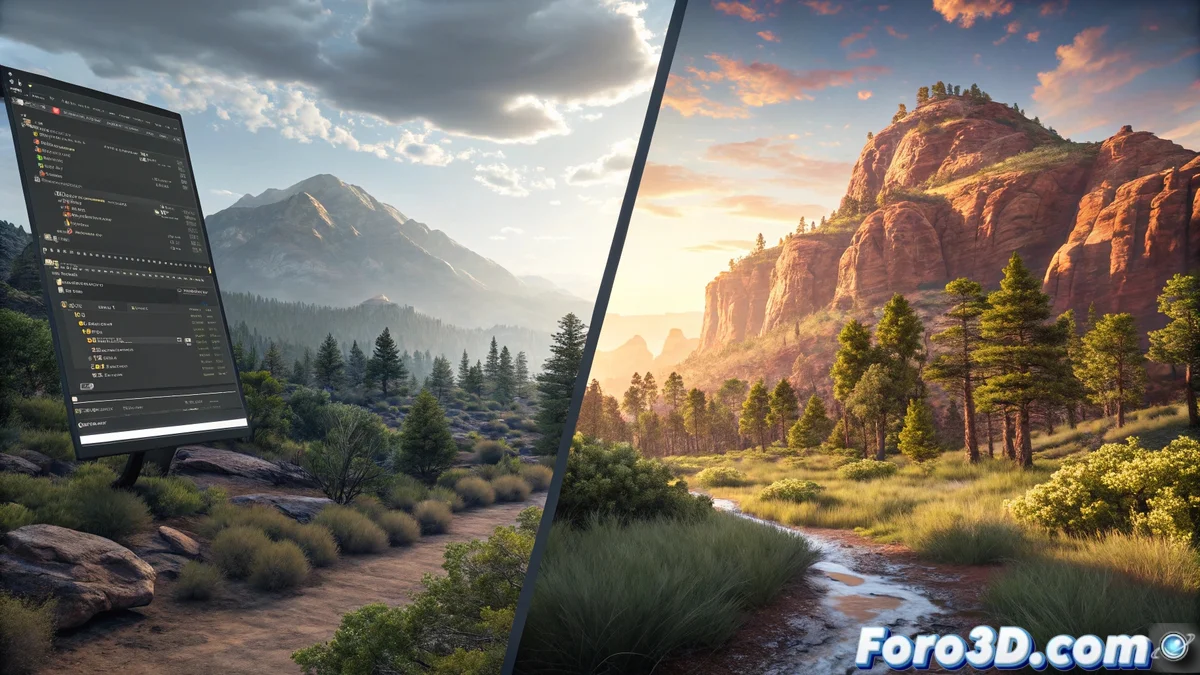
Cyllista Engine vs Unreal Engine: Contrasting Development Philosophies
In the universe of contemporary video game development, two graphics engines represent diametrically opposed approaches. Cyllista Engine positions itself as a solution specialized in extremely efficient rendering, while Unreal Engine maintains its status as a universal platform for projects of any scale. Both share the purpose of simplifying the creation of interactive experiences, although their design principles exhibit structural divergences that every creator must evaluate before selecting a technology. 🎮
Technical Architecture and Performance Optimization
Cyllista Engine is based on a modular renderer that prioritizes hardware-level control over operational simplicity, providing direct interfaces for the graphics pipeline and memory management. Its Shader/Compute system enables architecture-specific optimizations, demonstrating particular effectiveness in projects demanding maximum performance in complex scenarios. Unreal Engine implements a more generalist strategy through its component-based architecture and the Blueprints system, offering visual tools that accelerate development but incorporating some abstract overhead. Its rendering engine, although highly optimized, operates with higher abstraction layers that can restrict fine-tuning in performance-critical contexts. ⚡
Differentiating Performance Characteristics:- Cyllista Engine: Direct APIs for granular control of the graphics pipeline and precise memory management
- Unreal Engine: Component architecture with Blueprints that accelerates development but adds abstract layers
- Hardware Optimization: Cyllista allows device-specific adjustments, Unreal operates with generalized abstractions
The choice between absolute control and accelerated development defines the battle between these engines - Graphics Engine Architecture Expert
Development Ecosystems and Integration Philosophies
The main advantage of Unreal Engine lies in its comprehensive ecosystem, unifying global illumination systems, terrain generation tools, and audio and physics solutions within a single unified environment. Its marketplace offers thousands of assets and plugins that notably accelerate development, while Blueprints allow designers and artists to implement complex logic without traditional programming. Cyllista Engine counters with a minimalist approach where developers select and integrate only the required libraries, favoring projects where total control over each element is decisive. This philosophy particularly attracts studios that prefer to build custom systems rather than adapt to predefined solutions. 🛠️
Key Ecosystem Elements:- Unreal Engine: Extensive marketplace, integrated visual tools, and Blueprints system for non-programmers
- Cyllista Engine: Modular approach where only necessary components are implemented for each project
- Flexibility vs Completeness: Unreal offers a complete solution, Cyllista allows for custom construction
Final Considerations for Developers
While some creators passionately debate which engine symbolizes the future of the industry, others simply choose the one that allows them to complete their projects within established deadlines. The decision between Cyllista Engine and Unreal Engine transcends mere technical comparison to become a philosophical choice about work methodology, creative control, and operational efficiency. Both tools represent valid paradigms that will continue to evolve to meet the changing demands of interactive experience development. 🚀